
Dell Technologies: Navigating the AI Revolution—Strategic Repositioning and Execution Risks
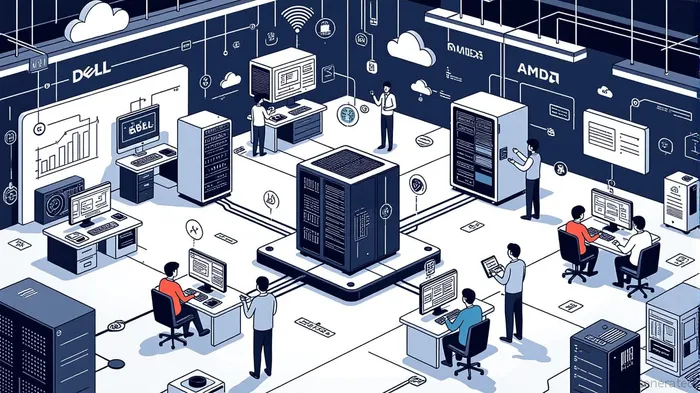
In the rapidly evolving landscape of enterprise IT, Dell TechnologiesDELL-- (DELL) has positioned itself as a pivotal player in the AI-driven transformation. The company’s strategic repositioning under the Dell AI Factory initiative aims to democratize access to artificial intelligence by offering an integrated portfolio of infrastructure, software, and services. However, as with any ambitious technological pivot, execution risks loom large, from margin pressures to geopolitical headwinds. This analysis evaluates Dell’s long-term value proposition through the lens of its AI strategy and the challenges it must overcome.
Strategic Repositioning: Building the AI Factory
Dell’s AI Factory is a bold attempt to simplify and accelerate AI adoption across enterprises. The initiative centers on end-to-end infrastructure, spanning edge inferencing on AI PCs to large-scale data center workloads. Notable innovations include the Dell Pro Max Plus laptop, equipped with Qualcomm’s AI 100 PC Inference Card—the first mobile workstation with an enterprise-grade NPU—enabling secure on-device inferencing for massive models like a 109-billion-parameter system [1]. At the data center level, the PowerEdge XE9785 servers with AMDAMD-- Instinct MI350 GPUs promise up to 35 times greater inferencing performance, addressing the growing demand for high-capacity AI processing [1].
Complementing hardware advancements, DellDELL-- has introduced the AI Data Platform and Project Lightning, which streamline data access and double the throughput of competing file systems, accelerating AI workflows [1]. Cooling innovations, such as the PowerCool eRDHx, reduce energy costs by 60%, addressing a critical pain point for AI server deployments [1]. These technical strides are bolstered by strategic partnerships with NVIDIANVDA--, AMD, Cohere, and Mistral AI, enabling tailored solutions for generative AI and enterprise search [1]. For instance, the joint engineering effort with Mistral AI focuses on secure, customizable AI applications, underscoring Dell’s ecosystem-driven approach [1].
Dell’s emphasis on hybrid and on-premises solutions also aligns with data sovereignty concerns, a growing priority for global enterprises. By embedding AI capabilities into endpoints, edge devices, and data centers, Dell aims to become a one-stop shop for AI infrastructure, software, and implementation [6]. With over 3,000 customers already leveraging the AI Factory, the company aspires to replicate the transformative impact of the Model T in the automotive industry [6].
Execution Risks: Margins, Demand, and Competition
Despite these strategic strengths, Dell faces significant execution risks. Financially, the company grapples with compressed profit margins driven by high manufacturing costs and competitive pricing pressures in the AI hardware market [1]. A recent decline in AI server backlog—from $14.4 billion in Q1 to $11.7 billion in Q2 of fiscal 2025—has raised investor concerns about the sustainability of demand [1]. This trend, coupled with underperformance in the Client Solutions Group (PCs), signals potential volatility in Dell’s revenue streams [1].
Technically, Dell’s reliance on expensive AI processors from NVIDIA and AMD introduces operational and financial vulnerabilities. Supply chain disruptions or price fluctuations in these components could erode gross margins, particularly if demand for AI servers softens [1]. Furthermore, the complexity of integrating AI infrastructure with existing enterprise systems poses challenges in technical adoption, requiring robust support services to ensure customer retention [2].
Competitive pressures are equally formidable. While Dell’s ecosystem partnerships provide a buffer, emerging AI startups and cloud providers are rapidly innovating, threatening to displace traditional infrastructure vendors. Geopolitical tensions, such as U.S.-China trade dynamics, also complicate Dell’s global supply chain and market access [1]. These factors necessitate continuous investment in R&D and ecosystem expansion to maintain relevance.
Balancing Opportunities and Risks
Dell’s long-term value proposition hinges on its ability to balance innovation with operational efficiency. The AI Factory’s focus on hybrid solutions and data readiness positions Dell to capitalize on enterprises’ need for localized AI deployment. However, the company must address margin pressures through cost optimization and pricing strategies that reflect the value of its integrated offerings.
A critical test will be Dell’s capacity to scale its AI security and resilience services, which address governance concerns around infrastructure, data, and models [1]. As AI adoption matures, enterprises will prioritize solutions that ensure compliance and resilience, areas where Dell’s full-stack approach could differentiate it from competitors.
Conclusion
Dell Technologies’ strategic repositioning in the AI-driven enterprise IT sector is ambitious and well-aligned with market trends. The AI Factory’s comprehensive infrastructure, coupled with ecosystem partnerships, offers a compelling value proposition. Yet, execution risks—ranging from margin compression to competitive and geopolitical challenges—demand vigilant management. For investors, Dell’s success will depend on its ability to innovate while maintaining financial discipline, ensuring that its AI vision translates into sustainable long-term value.
**Source:[1] Dell Technologies Fuels Enterprise AI Innovation with Infrastructure Solutions and Services [https://www.dell.com/en-us/dt/corporate/newsroom/announcements.detailpage.press-releases~usa~2025~05~dell-technologies-fuels-enterprise-ai-innovation-with-infrastructure-solutions-and-services.htm][2] DELL'S AI STRATEGY: ANALYSIS OF DOMINANCE IN COMPUTER TECHNOLOGY [https://www.klover.ai/dell-ai-strategy-analysis-of-dominance-in-computer-technology/]





Comentarios
Aún no hay comentarios