
Dell's Price Hike Amid Memory Shortages: A Strategic Play in a Supply-Constrained AI Era
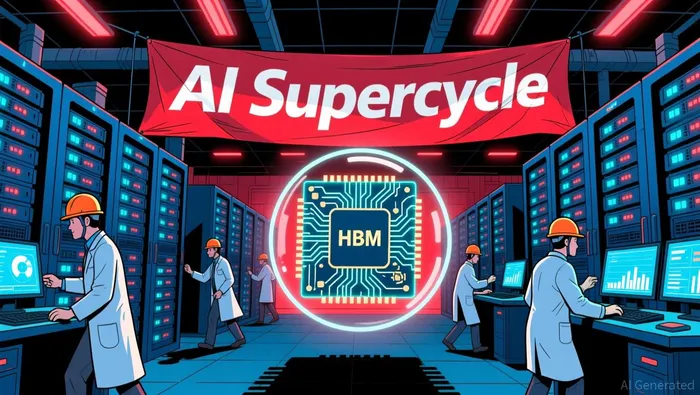
The global AI boom has triggered a seismic shift in the technology sector, with memory chip shortages emerging as a critical bottleneck. DellDELL-- Technologies' recent decision to raise prices on its commercial hardware by up to $765 for systems with 128GB of memory reflects the broader industry's struggle to balance surging demand for AI infrastructure with constrained supply chains according to reports. As memory manufacturers prioritize high-margin AI-specific components like High-Bandwidth Memory (HBM), traditional DRAM and NAND production has lagged, creating a pricing "supercycle" that threatens to reshape the competitive landscape for hardware stocks research indicates. For investors, the question is whether Dell's strategic adjustments signal a resilient long-term opportunity or a cautionary tale of margin compression in a volatile market.
Industry-Wide Supply Chain Pressures
The memory shortage is not an isolated issue for Dell but a systemic challenge across the tech sector. DRAM prices have surged by up to 170% year-over-year, driven by AI data centers' insatiable appetite for high-performance storage according to Reuters. Major producers like Samsung and SK Hynix have reallocated production capacity toward HBM, which commands premium margins, while neglecting commodity memory markets according to analysis. This shift has left companies like Microsoft, Google, and ByteDance scrambling to secure allocations, with some retailers imposing purchase limits to manage dwindling supplies according to Reuters. Analysts warn that the shortage could persist until 2027 or 2028, given the 18–24-month lead times required to build new fabrication plants according to reports.
 Dell's pricing strategy-raising commercial PC prices by 15–20%-is a direct response to these pressures according to Gurufocus. The company's COO, Jeff Clarke, described the situation as "unprecedented," emphasizing the need to "rework product configurations" and adjust pricing to maintain supply continuity according to CRN. This mirrors actions by competitors like Lenovo and HP, which are also preparing for similar hikes according to PC Gamer. The ripple effects extend beyond hardware: Intel faces declining gross margins as it struggles to pass costs to consumers, while Adobe's traditional subscription model is challenged by AI-driven tools offering lower-cost alternatives according to Morningstar.
Dell's AI-Driven Resilience
Despite these headwinds, Dell's strategic focus on AI infrastructure positions it as a potential winner in the long term. The company reported a $18.4 billion AI server backlog in Q3 2026, up from $11.7 billion in the prior quarter, and revised its FY2026 revenue forecast to $111.7 billion. This growth is fueled by early adoption of cutting-edge AI systems like the NVIDIA GB200 and GB300, which give Dell a technical edge in the market according to Investing.com. Its AI Data Platform, including PowerScale and ObjectScale, further solidifies its role as an end-to-end infrastructure provider for data-intensive workloads according to Dell.
However, margin sustainability remains a concern. Memory costs now account for 10–70% of Dell's bill of materials, and Morgan Stanley has downgraded the stock due to fears of margin compression according to TechBuzz. The company's gross margin of 21.26%-lower than its historical average-reflects the squeeze from rising input costs according to Yahoo Finance. Yet, analysts like Goldman Sachs remain cautiously optimistic, raising Dell's price target to $185 from $175 on the back of improved earnings guidance and strong AI server demand according to Investing.com.
Investment Implications in a Memory-Scarce Era
For value investors, Dell's positioning in the AI era presents a nuanced opportunity. On one hand, the memory shortage and associated pricing pressures could erode short-term margins. On the other, Dell's leadership in AI infrastructure and its ability to innovate-such as integrating agentic AI platforms and parallel NFS support-suggest long-term resilience according to Dell. A discounted cash flow analysis indicates Dell is undervalued by about 21.6% based on projected free cash flows according to Yahoo Finance, while its actual price-to-earnings ratio remains significantly below its fair value benchmark according to Investing.com.
The broader tech sector, however, faces a more uncertain outlook. As Wedbush Securities notes, companies reliant on traditional hardware models-like Intel and Adobe-are at greater risk of being "left behind" in the next phase of the AI boom according to Morningstar. For investors, the key differentiator will be a company's ability to navigate supply chain volatility while maintaining margin discipline. Dell's experience in managing prior DRAM cycles and its agile supply chain strategies provide a competitive edge according to CRN.
Conclusion
Dell's price hike is both a symptom and a strategic response to the AI-driven memory crisis. While the immediate impact on margins is undeniable, the company's focus on high-growth AI infrastructure and its ability to adapt to supply constraints position it as a resilient player in a memory-scarce environment. For value investors, the challenge lies in balancing short-term margin pressures with long-term growth potential. In a sector where AI is redefining the rules of competition, Dell's ability to innovate and execute may prove to be the defining factor in its success-or failure.







Comentarios
Aún no hay comentarios