
The Delisting Dilemma: Evaluating the Viability of Bitcoin Treasury Firms as Public Investments
In 2025, BitcoinBTC-- treasury firms-often dubbed Digital Asset Treasury Companies (DATCOs)-have become a defining feature of the corporate finance landscape. These firms, which allocate significant portions of their balance sheets to Bitcoin, have attracted over $100 billion in investor capital and now hold 6.2% of the total Bitcoin supply. Yet, as the market matures, a critical question emerges: Are these firms viable long-term public investments, or are they primed for a delisting dilemma driven by structural risks and market misalignment?
Strategic Risk Assessment: Frameworks and Fault Lines
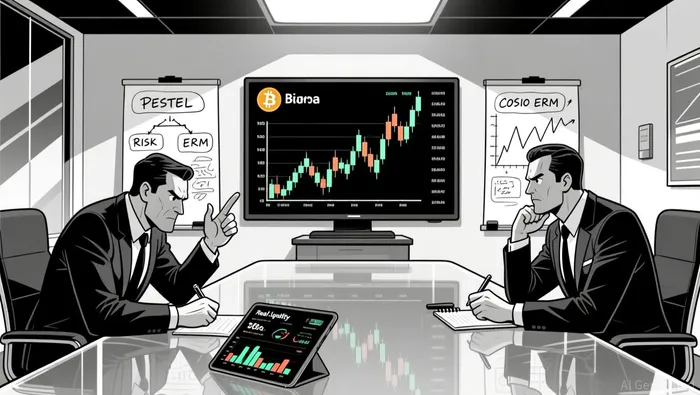
To evaluate DATCOs, we must first dissect their strategic risks through established frameworks. A PESTEL analysis reveals stark contrasts. Politically, regulatory clarity-such as the U.S. SEC's 2024 approval of spot Bitcoin ETFs-has legitimized Bitcoin as an asset class. However, economic risks loom large: Bitcoin's volatility (annualized price swings exceeding 100%) creates existential challenges for firms reliant on leveraged capital structures as revealed in SEC filings. Socially, while 75% of business users with fewer than 50 employees allocate 10% of net income to Bitcoin, institutional adoption remains concentrated in tech and mining firms according to industry reports. Technologically, hybrid custody models (combining third-party and self-custody) mitigate operational risks but introduce counterparty dependencies as noted in business strategy analysis. Legally, FASB's fair-value accounting standards for crypto holdings add transparency but also amplify earnings volatility during price swings.
The COSO ERM framework further highlights vulnerabilities. DATCOs often rely on convertible debt and equity issuances to fund Bitcoin purchases, creating leverage cycles that amplify downside risk. For example, MicroStrategy's aggressive accumulation of 582,000 BTC by June 2025 was financed through convertible notes, a strategyMSTR-- that works in bull markets but falters when Bitcoin prices dip below cost bases. A 2025 study found that DATCOs with high leverage face a 34.7% greater risk of margin calls or forced selling during downturns.
Market Alignment Metrics: Beta, Liquidity, and Regulatory Gaps
Market alignment metrics paint a mixed picture. DATCOs exhibit beta coefficients ranging from 0.354 to 1.34, indicating they are both less and more volatile than Bitcoin itself, depending on capital structure as demonstrated in academic research. For instance, "Classic DATs" like Strategy (formerly MicroStrategy) show betas exceeding 1.0, meaning their stock prices swing 1.34x more than Bitcoin's movements according to empirical evidence. This dual sensitivity-both to Bitcoin's price and broader equity markets-creates a compounding risk.
Liquidity metrics also raise red flags. While DATCOs often maintain 6–12 months of operating expenses in fiat reserves to buffer volatility, their reliance on centralized custody and ETFs has shifted Bitcoin liquidity into a "shadow system" dominated by corporate debt cycles. In Q3 2025, Bitcoin's trading volume dropped 8% to $25.3 billion amid broader market jitters, signaling fragility in liquidity provision. Regulatory benchmarks, meanwhile, remain uneven. While stablecoin legislation in July 2025 bolstered confidence, DATCOs still face scrutiny over custody practices and earnings volatility.
The Delisting Dilemma: Risks vs. Rewards
The delisting dilemma hinges on whether DATCOs can align their strategies with market realities. On one hand, Bitcoin's fixed supply and institutional adoption-e.g., 190 public companies holding Bitcoin as of September 2025-suggest a long-term tailwind. Innovations like Lightning Network liquidity provision-where firms earn routing fees by supplying Bitcoin to the network-have already generated annualized yields of 24% for early adopters according to industry analysis.
On the other hand, structural risks persist. A 2025 analysis found that "The Imitators"-micro-cap firms pivoting to Bitcoin without clear value propositions-underperformed by 86.9%, with Sharpe ratios of -0.423. These firms, often overleveraged and lacking operational diversification, face existential threats during market stress. Furthermore, as Bitcoin prices dipped below average cost bases in late 2025, forced selling pressures intensified, exacerbating price declines.
Conclusion: A Calculated Bet for the Long-Term
For investors, the viability of DATCOs depends on their ability to navigate these dual challenges. Firms with conservative capital structures (e.g., 5–10% Bitcoin allocation of reserves), robust liquidity buffers, and diversified revenue streams (e.g., Lightning Network yields) are better positioned to weather volatility as recommended in business strategy reports. Conversely, those relying on speculative debt or opaque custody models face a higher delisting risk.
As the market evolves, DATCOs must prove they are not just HODLers but innovators-leveraging Bitcoin's unique properties to build resilient, revenue-generating treasuries. Until then, the delisting dilemma remains unresolved, demanding a cautious yet opportunistic approach from investors.





Comentarios
Aún no hay comentarios