
The Delicate Balance: Assessing the Resilience of Consumer Sentiment Amid Inflationary Pressures and Policy Uncertainty
The U.S. economy is walking a tightrope. A modest rebound in consumer sentiment, as measured by the University of Michigan's index, has offered a sliver of optimism in a landscape still shadowed by inflationary fears and policy turbulence. Yet, the question lingers: Is this improvement a harbinger of a sustainable recovery, or a fragile rebound built on shifting sands?
The July 2025 data, which saw the index rise to 61.8 from 60.7, is a five-month high but remains 16% below its December 2024 peak. This suggests a cautious optimism among consumers, particularly in their assessment of current economic conditions. However, the Index of Consumer Expectations—critical for gauging future spending—remains tepid, up just 0.9% to 58.6. Year-ahead inflation expectations, at 4.4%, and long-run expectations, at 3.6%, remain elevated, underscoring the lingering specter of price pressures. As Joanne Hsu, the director of the Surveys of Consumers, notes, “Unless there is greater certainty that inflation will not worsen, consumer confidence is unlikely to rebound significantly.”
The equity markets have mirrored this duality. While the S&P 500 and Nasdaq hit record highs in early July, the gains were narrow, driven by a handful of mega-cap tech stocks. Tesla's 3% surge and TSMC's record quarterly profits highlighted the sector's resilience, but Netflix's 5% drop despite strong earnings underscored the fragility of market leadership. The Nasdaq's five-day streak of record highs, meanwhile, was underpinned by AI-driven optimism, yet the broader market's reliance on a small cluster of stocks raises red flags.
The Federal Reserve's stance further complicates the outlook. With inflation expectations still above the 2.8% and 3.0% levels seen in December 2024, policymakers remain wary of cutting rates. The prospect of a September rate cut is now priced at 70%, but officials like Christopher Waller have emphasized the need for “sustained disinflation,” particularly in services sectors like housing and healthcare. This uncertainty has kept the 10-year Treasury yield hovering near 4.2%, a level that constrains growth in risk assets.
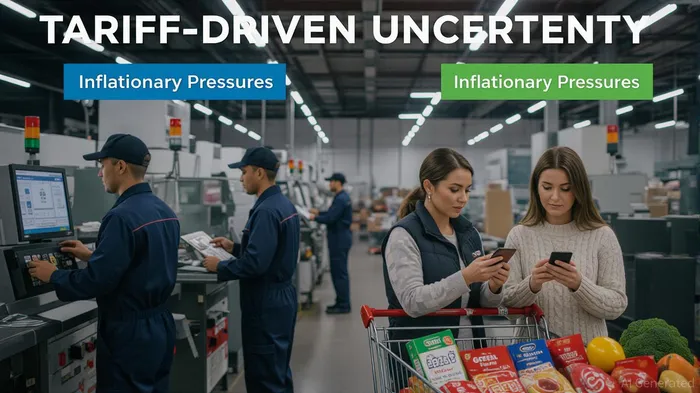
Trade policy has emerged as a wildcard. Proposed U.S. and European tariffs on Chinese electric vehicles and semiconductors have rattled global supply chains, prompting manufacturers to pass costs to consumers. While the immediate impact on the consumer sentiment index was muted, the long-term implications for inflation are clear. As one manufacturing executive put it, “Every new tariff is a tax on the future.”
Investor behavior reflects this cautious calculus. Money market fund balances have swelled to $7 trillion, a record high, as capital remains sidelined. Fund flows have favored sectors with durable cash flows—Technology, Energy, and Financials—while defensive sectors like Utilities and Consumer Staples have seen outflows. This bifurcation suggests investors are hedging against both inflation and potential economic softness.
The cryptocurrency market, too, has taken note. Bitcoin's surge to $117,700 following the congressional approval of a stablecoin bill signals a growing appetite for alternative assets amid macroeconomic uncertainty. Yet, this move also highlights the broader market's search for yield in a low-interest-rate environment.
For investors, the path forward demands a balance between optimism and caution. The recent uptick in consumer sentiment, while welcome, is not a green light for aggressive risk-taking. A diversified portfolio, with exposure to AI enablers, small-cap equities, and international markets, may offer better protection against the volatility of a narrow leadership. Defensive sectors, often overlooked in a growth-driven market, could also provide ballast.
The key lies in monitoring the divergence between services and goods inflation. While the former remains stubbornly high, the latter has shown signs of moderation. A shift in policy—from tariffs to targeted fiscal support—could tip the scales. Until then, the market's resilience will depend on its ability to navigate the interplay of policy, inflation, and consumer behavior.
In the end, the July 2025 data offers a glimpse of hope but not a roadmap. For investors, the lesson is clear: In a world of persistent uncertainty, sustainability trumps speed.





Comentarios
Aún no hay comentarios