
DeFi Token Sales and Market Volatility: Assessing Unconfirmed Claims and Evaluating Credibility in Speculative Crypto Projects
The decentralized finance (DeFi) sector has emerged as a cornerstone of the crypto ecosystem, yet its rapid growth has been accompanied by unprecedented volatility. Between 2023 and 2025, DeFi token sales have become increasingly entangled with speculative behavior, unconfirmed claims, and sophisticated attack vectors that distort market dynamics. For investors, navigating this landscape requires a nuanced understanding of how unverified practices and malicious activities amplify volatility while undermining trust. This analysis explores the interplay between DeFi token sales, market instability, and the tools available to assess the credibility of speculative projects.
The Volatility Conundrum: Sandwich Attacks and Liquidity Mismanagement
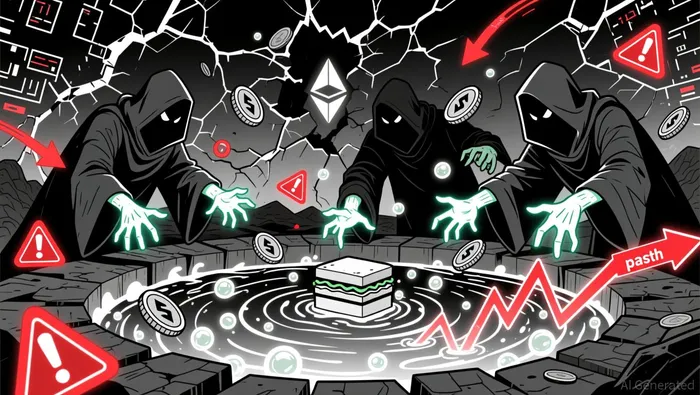
DeFi's transparency, a double-edged sword, has enabled a surge in transaction manipulation. A critical driver of volatility is the rise of sandwich attacks, where malicious actors exploit unconfirmed transactions in Ethereum's memory pools. By dynamically adjusting gas bids, attackers execute "buy-victim-sell" sequences that distort Automated Market MakerMKR-- (AMM) pricing curves and destabilize liquidity pools. According to EigenPhi, over 63,000 such attacks are detected monthly, resulting in hidden asset losses and compounding market uncertainty. These attacks not only erode investor confidence but also create artificial price swings, particularly in low-liquidity tokens.
Compounding this issue is the inefficiency of DeFi liquidity. A Yahoo Finance report reveals that 95% of DeFi liquidity remains idle, with $12 billion in assets locked in smart contracts without generating returns. This stagnation increases exposure to impermanent loss and amplifies volatility, as liquidity providers face asymmetric risks without commensurate rewards. The combination of idle capital and predatory trading strategies creates a self-reinforcing cycle of instability, where speculative projects become increasingly vulnerable to flash loan attacks and rug pulls.
Regulatory Frameworks as Credibility Filters
As DeFi matures, regulatory frameworks are emerging as critical tools for evaluating project credibility. In 2025, the European Union's Markets in Crypto-Assets Regulation (MiCA) and Digital Operational Resilience Act (DORA) are reshaping compliance standards. MiCA mandates operational transparency for stablecoin issuers and tokenized assets, while DORA requires stress testing and incident reporting for DeFi platforms. Similarly, the U.S. Senate's proposed DeFi framework seeks to extend SEC and CFTC oversight to front-end applications, emphasizing independent code audits and risk management programs.
These regulations, though contentious, serve as de facto credibility benchmarks. Projects adhering to MiCA or DORA requirements demonstrate a commitment to transparency and cybersecurity, which are essential for institutional adoption. For example, compliance with NIS2's endpoint encryption and multi-signature authentication standards reduces the risk of validator network breaches. Investors should prioritize projects that align with these frameworks, as compliance often correlates with reduced volatility and long-term sustainability.
Tools for Verifying Unconfirmed Claims
Beyond regulatory alignment, investors must leverage technological tools to assess speculative projects. Real-time detection systems, such as those developed to counter sandwich attacks, offer insights into transaction integrity. These systems employ optimized algorithms to identify multi-token manipulation scenarios, enabling proactive risk mitigation. Additionally, platforms like Chainalysis, Elliptic, and Nansen provide granular analytics on transaction accuracy and liquidity flows, helping investors verify claims about TVL and yield generation.
A promising innovation is the integration of multimodal large language models (MLLMs) with verification tools. By combining grammar checkers, compilers, and symbolic model verifiers, these systems reduce the risk of hallucinations in AI-generated content, ensuring that project claims are logically consistent and factually grounded. For speculative projects, this technology can validate whitepaper assertions, audit code repositories, and cross-reference liquidity pool data with on-chain metrics.
Conclusion: Balancing Opportunity and Risk
DeFi's potential for high returns remains undeniable, but its volatility is inextricably linked to unconfirmed claims and liquidity inefficiencies. Investors must adopt a dual strategy: leveraging regulatory frameworks to filter credible projects and deploying technological tools to verify speculative claims. As the sector evolves, the ability to distinguish between innovation and manipulation will define long-term success in DeFi.






Comentarios
Aún no hay comentarios