
DeFi Sustainability and Governance Risks: The Fragile Allure of High-Yield APY Models in Bear Markets
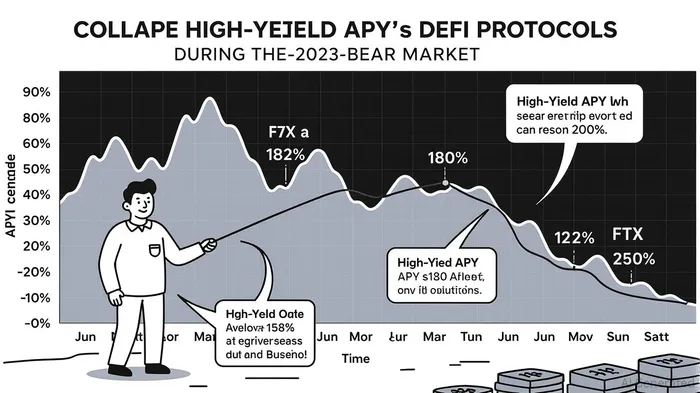
The decentralized finance (DeFi) sector, once hailed as a revolutionary force in financial innovation, has faced a sobering reality check during the 2022–2023 bear market. Protocols that once promised astronomical returns—often exceeding 20% annual percentage yields (APY)—have crumbled under the weight of liquidity crunches, tokenomics misdesign, and governance failures. These collapses, from the Terra ecosystem’s $40 billion loss to VaultTech’s $250 million investor fund disappearance, underscore a critical truth: high-yield APY models are inherently fragile in downturns, particularly when underpinned by unsustainable token incentives or algorithmic mechanisms [1].
The Systemic Fragility of High-Yield APY Models
High-yield APYs in DeFi are often engineered through token emissions, algorithmic stablecoins, or leveraged lending strategies. While these models attract liquidity during bull markets, they expose systemic vulnerabilities when investor sentiment shifts. For instance, Anchor Protocol’s 20% APY on TerraUSD (UST) deposits became a liability when UST depegged in May 2022, triggering a cascade of redemptions and insolvencies across interconnected platforms like CelsiusCELH-- and FTX [2]. Similarly, VaultTech’s 35% APY model collapsed in early 2025 as token prices plummeted and liquidity dried up, revealing a reliance on speculative tokenomics rather than economic fundamentals [3].
These cases highlight a recurring pattern: protocols prioritize short-term capital inflows over long-term sustainability. As noted in a 2023 IMF report, delayed crisis responses and rigid parameter adjustments exacerbate instability, as protocols struggle to recalibrate incentives or liquidity mechanisms during downturns [4]. The result is a self-reinforcing cycle of panic withdrawals, asset devaluations, and cascading failures.
Governance Failures: Concentration, Misalignment, and Inaction
DeFi governance structures, designed to decentralize decision-making, often falter under stress. Pendle Finance’s vePENDLE model, for example, concentrated voting power among large token holders, enabling decisions that prioritized short-term yield maximization over protocol health [5]. Emission allocations skewed toward high-risk pools further incentivized speculative behavior, while slow responses to liquidity crises—such as delayed parameter adjustments—allowed vulnerabilities to compound [6].
The Terra and FTX collapses exemplify how governance misalignment can amplify systemic risks. Terra’s algorithmic stablecoin relied on a fragile arbitrage mechanism, while FTX’s unsecured lending practices exposed the sector to liquidity spirals akin to traditional banking crises [7]. In both cases, governance frameworks lacked tools to mitigate cascading failures, underscoring the need for more adaptive, community-driven risk management.
Lessons for Investors and Protocol Designers
The 2022–2023 bear market has served as a stress test for DeFi, revealing critical weaknesses in both economic models and governance structures. For investors, the takeaway is clear: high-yield APYs should be scrutinized for their underlying mechanics. Protocols relying on token emissions or uncollateralized lending, for instance, are more susceptible to collapse during downturns [8].
For protocol designers, the path forward demands a shift toward sustainability. Innovations like Yearn Finance’s automated yield aggregation and Enzyme Finance’s multi-strategy approaches demonstrate how diversification and risk mitigation can enhance resilience [9]. However, these solutions must be paired with governance reforms—such as decentralized autonomous organizations (DAOs) with transparent voting mechanisms and anti-Whale safeguards—to prevent centralization and misaligned incentives [10].
Conclusion
The DeFi sector’s promise of financial democratization remains compelling, but its sustainability hinges on addressing the fragility of high-yield APY models and governance shortcomings. As the 2022–2023 bear market has shown, protocols must prioritize long-term economic viability over short-term gains, while investors must remain vigilant against the allure of unsustainable returns. Without structural reforms, the next downturn could repeat—and amplify—the failures of the past.
Source:
[1] Mapping Systemic Tail Risk in Crypto Markets: DeFi, https://www.mdpi.com/1911-8074/18/6/329
[2] Global Crypto Industry Overview and Trends [2022–2023], https://www.bitcoininsider.org/article/196694/global-crypto-industry-overview-and-trends2022-2023-annual-reportlast-part
[3] What Is Sustainable Yield Farming? A Fundamental Analysis, https://news.superex.com/articles/547.html
[4] 2023 External Sector Report - IMF eLibrary, https://www.elibrary.imf.org/downloadpdf/display/book/9798400245688/9798400245688.pdf
[5] PENDLE — A Comprehensive Crypto Yield Market Analysis, https://medium.datadriveninvestor.com/pendle-a-comprehensive-crypto-yield-market-analysis-83311b5be8e6
[6] Comparing Two Bear Market Grinders: Kujira And Frax - ICI, https://interchaininfo.zone/resources/comparing-two-bear-market-grinders-kujira-and-frax
[7] Crypto bear market: Strategies & tips (2025 update), https://medium.com/coinmonks/crypto-bear-market-strategies-and-tips-11407d3c3485
[8] Tail connectedness of DeFi and CeFi with accessible ..., https://www.sciencedirect.com/science/article/abs/pii/S1057521924003569
[9] Understanding DeFi Asset Management Protocols, https://www.coingecko.com/learn/defi-asset-management-protocols
[10] [Abstract], https://papers.ssrn.com/sol3/Delivery.cfm/5337259.pdf?abstractid=5337259&mirid=1&type=2







Comentarios
Aún no hay comentarios