
DeFi's Structural Dependency on TradFi and Its Implications for Long-Term Growth
The decentralized finance (DeFi) ecosystem has long been heralded as a revolutionary force, promising to disintermediate traditional financial systems and democratize access to global capital. Yet, as the sector matures, a stark reality emerges: DeFi's infrastructure remains deeply entangled with traditional finance (TradFi). From governance and risk management to custody solutions and technical limitations, the interdependence between DeFi and TradFi reveals a paradox. While DeFi aims to eliminate centralized intermediaries, its operational reality often necessitates reliance on the very systems it seeks to disrupt. This structural dependency raises critical questions about its scalability, regulatory viability, and long-term growth potential.
Governance and Risk Management: A Fragile Foundation
DeFi's decentralized governance model, while innovative, lacks the institutional safeguards that TradFi has honed over decades. Case studies from 2023 highlight this vulnerability: over $10 billion in direct losses and $1.3 billion in indirect market capitalization declines stemmed from hacks, exploits, and governance failures. These events exposed the inadequacy of decentralized risk management frameworks, particularly in crisis scenarios where rapid decision-making is required. Unlike TradFi institutions, which leverage centralized oversight and insurance mechanisms, DeFi protocols often rely on fragmented, community-driven responses.
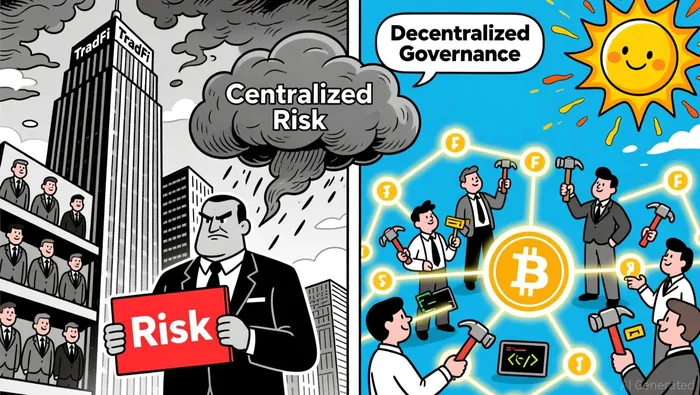
The insurance landscape further underscores this gap. DeFi insurance remains an "incomplete market", with limited coverage and regulatory ambiguity. Protocols frequently turn to TradFi-like insurance models or institutional partnerships to mitigate risks-a dependency that undermines the ethos of self-sovereign finance. For investors, this signals a critical trade-off: DeFi's promise of autonomy comes at the cost of resilience, requiring hybrid solutions to bridge the gap between decentralization and stability.
Custody and Settlement Layers: Bridging the Trust Gap
Custody solutions represent another critical juncture where DeFi leans on TradFi. By 2025, 25% of global custodians were expected to offer institutional-grade digital asset custody services, addressing the need for secure, compliant asset management in DeFi. This shift is driven by institutional demand for trust and regulatory compliance, particularly in markets like the U.S., EU, and Asia, where innovation-friendly policies are fostering adoption.
JPMorgan's Onyx platform exemplifies this trend. By leveraging JPM Coin, the bank reduced cross-border settlement times by 80% and slashed transaction fees. Such integrations highlight how TradFi infrastructure can enhance DeFi's scalability and efficiency. However, they also expose a fundamental tension: DeFi's reliance on centralized custodians for security and compliance contradicts its core principles. For instance, the SEC's Rule 206(4)-2 complicates DeFi operations by mandating that assets be held by approved custodians, a requirement incompatible with decentralized wallets or smart contracts. Institutions navigating this landscape often adopt hybrid strategies, combining institutional-grade custody with transparent disclosures and insurance to mitigate risks.
Technical Infrastructure: Oracle Centralization and Scalability Bottlenecks
Beyond governance and custody, DeFi's technical infrastructure reveals systemic dependencies on TradFi. Oracle centralization remains a critical vulnerability: while DeFi protocols tout decentralization, they often depend on centralized data feeds for price feeds and external inputs. This creates single points of failure, exposing the ecosystem to manipulation and outages. For example, a compromised oracle could trigger cascading liquidations or flash loan attacks, undermining the trustless nature of DeFi.
Scalability challenges further hinder DeFi's independence. Despite advancements in layer-2 solutions and sharding, EthereumETH-- and other blockchains still face congestion and high gasGAS-- fees during peak usage. Interoperability issues compound this problem, as isolated blockchain ecosystems limit seamless asset and data transfers. While frameworks like PolkadotDOT-- and CosmosATOM-- aim to address these gaps, real-world implementations remain fragmented, with bottlenecks in throughput and consensus mechanisms. These technical limitations force DeFi protocols to rely on TradFi systems for liquidity and cross-border payments, perpetuating a hybrid model that blurs the line between decentralization and centralization.
Regulatory Evolution: A Double-Edged Sword
Regulatory frameworks are evolving to accommodate DeFi, but they also reinforce its dependency on TradFi. The EU's Markets in Crypto-Assets (MiCA) regulation and the U.S. GENIUS Act aim to establish consistent standards for stablecoins and digital assets. While these frameworks promote responsible innovation, they also impose compliance burdens that DeFi protocols must navigate. For instance, stablecoin issuers now face requirements to maintain TradFi-like reserves and transparency, aligning them with conventional banking practices.
This regulatory convergence has a silver lining: 88% of major global banks are exploring blockchain-based services, signaling a shift toward coexistence rather than competition. However, for DeFi to achieve true autonomy, it must innovate beyond compliance-driven adaptations. The path forward lies in developing self-sustaining infrastructure-such as decentralized oracles, interoperable protocols, and community-driven insurance models-that reduces reliance on TradFi without sacrificing security or scalability.
Implications for Investors
For investors, DeFi's structural dependency on TradFi presents both opportunities and risks. On one hand, the integration of TradFi infrastructure enhances DeFi's credibility and scalability, attracting institutional capital. On the other, it exposes the ecosystem to regulatory and operational risks inherent in centralized systems. The key is to identify protocols that balance innovation with resilience-those that leverage TradFi's strengths while advancing DeFi's core principles.
The long-term growth of DeFi hinges on overcoming its infrastructure limitations. Until decentralized solutions mature, the sector will remain a hybrid ecosystem, where the promise of decentralization coexists with the pragmatism of TradFi. For now, investors must navigate this duality, recognizing that DeFi's evolution is not a binary shift but a complex interplay between two financial paradigms.






Comentarios
Aún no hay comentarios