
DeFi and Speculative Crypto: The Synergy of Token Allocation and Viral Marketing in 2025
In 2025, decentralized finance (DeFi) and speculative crypto assets have evolved into a $1.2 trillion market, driven by innovative token allocation strategies and viral marketing campaigns. These dual forces—structured incentives and community-driven hype—are reshaping how projects achieve adoption, liquidity, and long-term sustainability. This analysis examines the interplay between tokenomics and marketing, drawing on case studies from Compound, ArbitrumARB--, and memecoins like PepePEPE-- Dollar to illustrate what works—and what doesn't—in today's hyper-competitive crypto landscape.
Token Allocation: The Foundation of DeFi Success
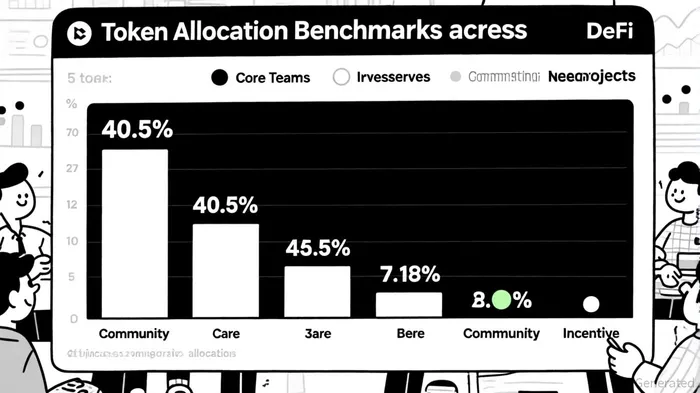
A well-designed token allocation strategy is no longer optional; it is a prerequisite for survival in DeFi. According to a report by Liquifi.finance, successful projects typically allocate 18.8% of tokens to the core team, 16% to investors, 22% to reserves, and 40.5% to community incentives[1]. This structure balances decentralization with long-term value creation. For example, Compound (COMP) distributes 4,229 tokens daily to users, incentivizing participation in its lending platform[2]. Similarly, Uniswap's (UNI) airdrop to early users not only rewarded adopters but also aligned community interests with the protocol's success[2].
Vesting periods further stabilize ecosystems. Core teams often face 3–4-year vesting schedules, while investors receive 2-year lockups[1]. Filecoin's phased vesting for investors (20–30% allocated with long-term unlocks) prevented market flooding and ensured sustained commitment[4]. In contrast, projects like Ethereum and EOS demonstrated how transparent, fair distribution models—such as Ethereum's 2014 presale or EOS's 70% public allocation—fostered trust and broad participation[1].
However, tokenomics alone are insufficient. Without complementary marketing, even the most equitable allocation can fail to attract users.
Viral Marketing: The Engine of Speculative Growth
Viral marketing in 2025 has transcended traditional airdrops and influencer campaigns. Projects now leverage gamification, AI-driven content, and cross-platform engagement to scale rapidly. Arbitrum's $ARB airdrop, for instance, distributed 1.162 billion tokens to 625,143 addresses using anti-Sybil measures, resulting in 200,000 wallets delegating voting rights and a 300% surge in daily active users[1]. This community-first approach transformed Arbitrum from a technical Layer 2 into a governance-driven DAO.
Speculative assets like Pudgy Penguins and Pepe Dollar have also mastered viral tactics. Pudgy PenguinsPENGU-- partnered with WalmartWMT-- to sell 2 million physical toys, bridging NFTs with mainstream retail and boosting its floor price by 11.2%[1]. Meanwhile, Pepe Dollar combined memeMEME-- culture with deflationary tokenomics, allocating 45% to presales and 29% to federal burns to create scarcity[5]. These projects prove that speculative assets thrive when they blend humor with utility.
Influencers remain pivotal. BitBoy Crypto's collaboration with Binance drove 200,000 new staking users, while micro-influencers on platforms like Telegram and TikTok offer higher engagement rates at lower costs[2]. For example, Lido Finance achieved a 340% higher conversion rate by partnering with 25 micro-influencers compared to macro-influencers[1].
The Speculative Edge: Memecoins and Multichain Strategies
The 2025 memecoinMEME-- boom—valued at $74.5 billion—has redefined speculative investing. Projects like Dogeverse and Dawgz AI leverage multichain launches (Ethereum, BNB Chain, Solana) to maximize liquidity and accessibility[1]. Dogeverse raised $6 million by listing on multiple chains, while Dawgz AI uses AI bots to automate trading and community interactions[1].
Tokenomics in this space prioritize scarcity and utility. MoonBull ($MOBU) offers exclusive staking rewards and private roadmap updates to early adopters, creating a sense of FOMO[3]. Conversely, Shiba Inu ($SHIB)'s unrestricted supply has led to diluted returns, underscoring the importance of structured burns and capped supply models[1].
Viral campaigns are equally critical. The Milady Meme Coin's TikTok challenge generated 15 million views and a 200% trading volume spike in a week[1]. Gamification, such as meme contests with NFT rewards, has driven 300% engagement increases for projects like Telegram's Hamster Kombat[1].
The Risks and Rewards of Speculation
While speculative projects can deliver explosive returns, they are inherently volatile. Pump-and-dump schemes and liquidity crises remain risks, necessitating diversified portfolios and on-chain analytics tools[3]. For instance, Arctic Pablo Coin (APC) mitigates risk with deflationary burns and high APY staking, while Arbitrum's governance model ensures community oversight[3].
Investors must also balance logic and hype. As AllianceAENT-- Bernstein notes, digital tokens are increasingly viewed as strategic assets for portfolio diversification[1]. However, success hinges on projects that combine tokenomics with viral marketing—like EigenLayer, which used a points-based gamification system to attract $15 billion in TVL before its token launch[1].
Conclusion: The Future of DeFi and Speculation
The 2025 crypto landscape is defined by projects that harmonize token allocation with viral marketing. DeFi protocols like AaveAAVE-- and PendlePENDLE-- demonstrate that fair distribution and governance incentives drive long-term TVL growth[5]. Meanwhile, memecoins like Pepe Dollar and Dogeverse show that speculative assets can thrive when they blend humor, utility, and strategic tokenomics.
For investors, the key takeaway is clear: success in crypto requires more than a catchy meme or airdrop. It demands a holistic approach—where tokenomics align with community incentives, and marketing campaigns are as data-driven as they are creative. As the market matures, only those projects that master this balance will endure.






Comentarios
Aún no hay comentarios