
DeFi Security Risks and Token Resilience in the Wake of the PancakeSwap Scam
The PancakeSwap Scam: A Case Study in Social Engineering
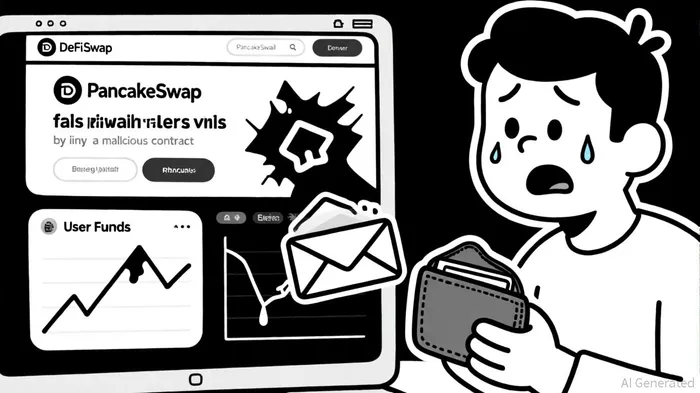
The 2025 PancakeSwap incident exemplifies the growing sophistication of DeFi scams. Scammers created near-identical replicas of the platform's interface, using domains like pancakeswap.cam to mimic the official pancakeswap.finance site, as CoinPedia reported. These fake platforms exploited user trust in the brand, prompting victims to connect their wallets via MetaMask or Trust Wallet. Once connected, malicious smart contracts automatically drained assets, with individual losses ranging from $8,000 to $13,000, according to CoinPedia. The scam also involved a phishing attack on PancakeSwap's official Chinese X account, promoting a fraudulent token called "Sir Pancake" that generated $20 million in trading volume before being exposed, CoinPedia added.
This incident highlights the dual threat of domain spoofing and social engineering, where attackers exploit human psychology rather than technical flaws. A Malware Guide post reports that over 46,000 individuals have reported cryptocurrency scams since 2021, with losses exceeding $1 billion. The FTC further notes that phishing scams now account for 68% of DeFi-related fraud.
Broader DeFi Security Vulnerabilities
Beyond the PancakeSwap case, DeFi platforms face systemic risks rooted in smart contract vulnerabilities and oracle manipulation. For instance, the 2025 GMXGMX-- V1 exploit exploited a re-entrancy vulnerability, draining $40–42 million from liquidity pools, CCN reported. Similarly, the Resupply platform lost $9.5 million due to an unprotected exchange-rate function. These incidents reveal that even well-established protocols are not immune to technical flaws, particularly as cross-chain bridges and vault systems grow in complexity.
A critical challenge lies in the immutability of smart contracts. Once deployed, vulnerabilities cannot be easily patched without community consensus, creating a lag in response times. As noted in a 2025 Oxford study, DeFi platforms have collectively lost $12 billion to fraud and cyberattacks since 2021, with the Poly Network and RoninRON-- hacks alone accounting for $1.2 billion in losses.
Token Resilience and Investor Adaptation
Despite these risks, DeFi's long-term viability hinges on token resilience and security innovation. Post-2025, platforms like 1inch1INCH-- and AaveAAVE-- have integrated real-time threat detection tools, such as Web3 Antivirus and formal verification systems, as Cointelegraph reported. Additionally, frameworks like DeFiTrust use transformer-based machine learning to analyze transaction logs and social media sentiment, enabling early detection of scam tokens, Cointelegraph noted.
Investor behavior, however, remains a wildcard. A 2025 Georgia Tech study found that 72% of DeFi users still fail to revoke token approvals or use multi-factor authentication (2FA) effectively. This behavioral inertia leaves assets vulnerable to phishing attacks, even as platforms enhance technical safeguards.
Investment Trends and Trust Metrics
The DeFi market has shown surprising resilience post-2025 scams. Total Value Locked (TVL) in DEXs grew to $123.6 billion by Q2 2025, with EthereumETH-- alone accounting for $78.1 billion, according to Coinlaw's data. This growth reflects institutional confidence in DeFi's potential, despite high-profile frauds. However, the sector's volatility remains a concern: daily TVL fluctuations averaged 1.4% in 2025, compared to 3.2% in 2024.
User trust metrics also reveal a nuanced picture. While North America leads in DeFi adoption (37% market share), regulatory uncertainty and AI-driven deepfake scams have eroded confidence among retail investors, the Cryptonomist reported. For example, deepfakes impersonating influencers have blurred the line between genuine and fraudulent promotions, complicating due diligence.
Evaluating Long-Term Viability
The long-term investment case for DeFi depends on three factors:
1. Technological Innovation: Platforms must prioritize fail-safe design principles, such as quantum-resistant algorithms and multi-layered security protocols, as noted in the Oxford study.
2. User Education: Investors need to adopt best practices, including wallet revocation tools and real-time monitoring platforms like DappRadar, a step many platforms and analysts have urged following increased scam activity.
3. Regulatory Clarity: Governments must balance innovation with consumer protection, as seen in the EU's MiCA framework, which mandates smart contract audits, according to Cybersecurity Insiders.
While the PancakeSwap scam and similar incidents have exposed DeFi's fragility, the ecosystem's adaptability offers hope. For instance, PancakeSwap's swift response-deleting fake posts and enhancing account verification-led to a 15% surge in CAKECAKE-- token prices, CoinPedia reported. This suggests that transparency and proactive governance can restore trust.
Conclusion
DeFi's future is neither a utopia nor a dystopia. The 2025 PancakeSwap scam and other exploits have exposed critical vulnerabilities, but they have also catalyzed advancements in security and governance. For investors, the key lies in balancing optimism with caution: leveraging tools like DeFiTrust and DappRadar while advocating for regulatory frameworks that protect users without stifling innovation. As the sector matures, token resilience and user education will be the linchpins of DeFi's long-term viability.






Comentarios
Aún no hay comentarios