
DeFi Security Risks and Arbitrage Opportunities: A Post-Hack Analysis of the UXLINK Incident
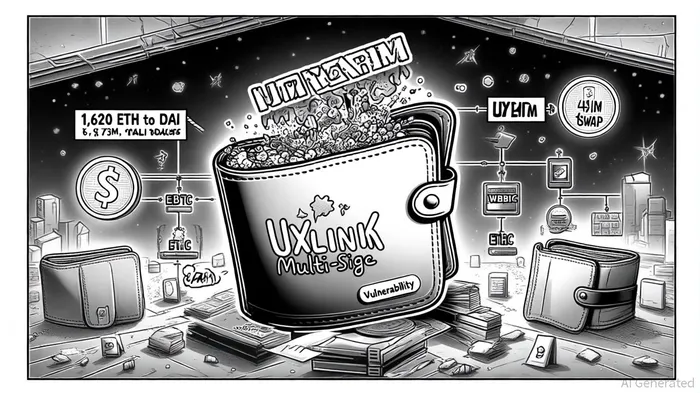
The September 2025 UXLINK hack serves as a stark reminder of the fragility of decentralized finance (DeFi) infrastructure and the lucrative opportunities that emerge from post-hack market imbalances. By analyzing the attacker's 1,620 ETH to 6.73M DAIDAI-- swap and subsequent asset shuffling, we uncover critical insights into DeFi security vulnerabilities and the mechanics of liquidity arbitrage in crisis scenarios.
DeFi Security Risks: A Case of Exploited Trust
The UXLINK breach began with a delegate call vulnerability in its multi-sig wallet, granting the attacker administrative access to mint 1 billion UXLINK tokens[1]. This exploit, which led to a 70% price collapse, highlights the risks of poorly audited smart contracts and misconfigured permissions. Multi-sig wallets, often considered a cornerstone of DeFi security, proved insufficient here due to a lack of rigorous code reviews[2].
Compounding the issue, the attacker fell victim to a phishing scam, losing $43 million in UXLINK tokens to the Inferno Drainer group[3]. This underscores the human element in DeFi security—a flaw that automated systems alone cannot address. As stated by blockchain analytics firm ArkhamARKM-- Intelligence, “The UXLINK incident demonstrates that even technical safeguards are vulnerable to social engineering and operational errors”[4].
Liquidity Arbitrage: Profiting from Post-Hack Chaos
The attacker's 1,620 ETH to 6.73M DAI swap, executed 48 hours after the initial exploit, created significant liquidity pool imbalances. Automated Market Makers (AMMs) rely on balanced liquidity to maintain stable pricing, but large trades—especially in volatile markets—disrupt this equilibrium. Data from on-chain trackers indicates that the swap caused price slippage in the DAI/ETH pool, as the attacker's sell pressure temporarily devalued ETH relative to DAI[5].
Arbitrageurs capitalized on these imbalances using cross-exchange and spatial strategies. For instance, traders bought UXLINK at depressed prices on exchanges with weaker demand and sold on platforms where the token retained higher value, profiting from the 70% price drop[6]. Additionally, the attacker's fund shuffling across multiple wallets and chains created localized liquidity gaps, enabling arbitrageurs to exploit regional price discrepancies[7].
Market Impact and Investor Sentiment
The UXLINK hack triggered a broader loss of trust in DeFi protocols, with exchanges freezing deposits and users fleeing volatile assets[8]. While UXLINK's emergency migration to a capped-supply smart contract aimed to restore confidence, the incident exposed systemic risks in decentralized governance. As noted by crypto security firm OneSafe, “The UXLINK case reinforces the need for real-time on-chain monitoring and multi-layered security audits”[9].
For investors, the event highlights two key lessons:
1. Risk Mitigation: Prioritize projects with transparent audits, multi-sig wallet backups, and active community governance.
2. Arbitrage Opportunities: Post-hack volatility creates short-term profit potential, but requires rapid execution and risk management to avoid losses from further market shocks[10].
Conclusion
The UXLINK hack exemplifies the dual-edged nature of DeFi: while security flaws can lead to catastrophic losses, they also generate arbitrage opportunities for savvy participants. As the industry evolves, protocols must adopt stricter security standards, and investors must balance opportunism with caution. The 1,620 ETH to DAI swap, though a criminal act, inadvertently demonstrated the resilience—and fragility—of decentralized markets in the face of systemic shocks.







Comentarios
Aún no hay comentarios