
DeFi's Regulatory Uncertainty and Market Impact: Strategic Positioning for Institutional Investors in a Fragmented Policy Environment
The decentralized finance (DeFi) ecosystem has evolved from a niche experiment into a $150+ billion market, but its path to mainstream adoption remains fraught with regulatory uncertainty. For institutional investors, navigating this fragmented policy landscape requires a nuanced understanding of jurisdictional arbitrage, compliance innovation, and product diversification. As 2025 unfolds, the interplay between regulatory clarity and technological adaptation is reshaping DeFi's risk-reward profile-and the winners will be those who align with both innovation and institutional-grade safeguards.
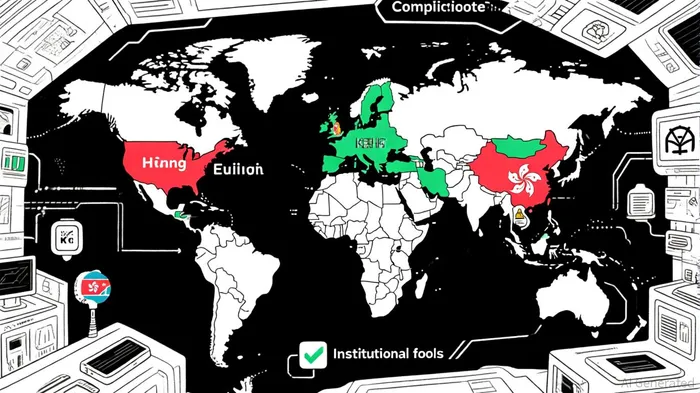
Regulatory Developments: A Patchwork of Progress and Paralysis
The U.S. and EU have taken significant steps to anchor DeFi within traditional financial frameworks. The GENIUS Act mandates 1:1 reserve backing for stablecoins and independent audits, while the EU's MiCA introduces licensing, investor protections, and AML compliance requirements, according to a FintechScoop analysis. These frameworks have created a "regulatory runway" for institutional capital, with platforms like DeFi Technologies reporting revenue growth driven by secure custody infrastructure and legal clarity, according to SmartLiquidity.
However, Asia's fragmented approach complicates the picture. Hong Kong emphasizes AML and corporate governance, whereas Singapore adopts a more innovation-friendly stance, according to CryptoLiveUpdate. This divergence forces DeFi platforms to operate in a "compliance mosaic," where protocols must tailor strategies to regional requirements. For example, Aave's Arc-a permissioned liquidity pool-has struggled to attract institutional capital due to unresolved legal ambiguities around smart contract enforceability, as highlighted in a LinkedIn piece.
Institutional Strategies: Compliance, Arbitrage, and Diversification
Institutional investors are adopting three core strategies to mitigate regulatory risks:
Compliance-First Infrastructure
Platforms are integrating zero-knowledge proofs (ZKPs) and decentralized identifiers (DIDs) to satisfy AML and KYC requirements without sacrificing privacy, as noted in a Crypto.com guide. The XRP Ledger, with its automated market makers and real-time oracles, has become a hub for institutional-grade DeFi, enabling secure trading and custody, a Ripple insight explains.Jurisdictional Arbitrage
Regulatory divergence creates opportunities for strategic market entry. For instance, Ontario's approval of staking-enabled ETFs contrasts with the U.S.'s regulatory lag, according to a Nasdaq article. This arbitrage is evident in BitcoinBTC-- yield products, which now dominate institutional DeFi due to their simpler legal profiles, a Forbes survey shows.Product Diversification
Beyond Bitcoin, institutional DeFi is expanding into tokenized real-world assets (RWAs) and fixed-income layers. Aave (TVL: $63B), Pendle ($9.7B), and Ethena ($11.59B) are redefining yield generation with capital-efficient models that cater to traditional finance's risk appetite, a PinkBrains roundup highlights. Fluid and Spark further illustrate this trend, offering modular liquidity layers and cross-chain capital allocation, a Bulldog Law article details.
Case Studies: Lessons from the Frontlines
- DeFi Technologies: By securing custody licenses and aligning with MiCA, the firm has transformed into a legally recognized investment vehicle, attracting $2.1B in institutional assets, SmartLiquidity reported.
- XRP Ledger: Ripple's focus on compliance tools and institutional-grade AMMs has positioned it as a bridge between DeFi's permissionless ethos and traditional finance's risk management, a Ripple insight notes.
- Aave Arc: Despite its KYC-compliant design, the platform's limited TVL ($1.2B) underscores the need for secondary market liquidity and clearer legal frameworks, a LinkedIn piece argued.
The Road Ahead: Balancing Innovation and Institutional Trust
While regulatory fragmentation remains a hurdle, it also creates a "first-mover advantage" for platforms that master jurisdictional arbitrage. For example, Singapore's proactive stance has attracted JPMorgan and other traditional players to explore tokenized repo settlements, a market projected to reach $1 trillion, according to a PwC report.
Institutional investors must prioritize three actions:
1. Adopt modular compliance layers that adapt to evolving regulations.
2. Leverage favorable jurisdictions to pilot products before scaling globally.
3. Diversify into RWAs and fixed-income DeFi to align with traditional finance's risk-return expectations.
Conclusion
DeFi's regulatory uncertainty is not a dead end but a catalyst for strategic innovation. As the ecosystem matures, the institutions that thrive will be those that embrace compliance as a competitive advantage-not a compliance burden. The next phase of DeFi's evolution will be defined by platforms that harmonize decentralization with institutional-grade safeguards, turning regulatory complexity into a blueprint for global adoption.





Comentarios
Aún no hay comentarios