
DeFi Regulatory Uncertainty and Its Impact on U.S. Crypto Market Structure Legislation: Strategic Positioning for DeFi-Native Assets Amid Divergence
The U.S. crypto regulatory landscape in late 2025 is a battleground of competing visions for the future of digital assets. With the passage of the Digital Asset Market Clarity (CLARITY) Act and the ongoing development of the Responsible Financial Innovation Act, the lines between the Securities and Exchange Commission (SEC) and Commodity Futures Trading Commission (CFTC) jurisdictions are being redrawn. For DeFi-native asset projects, this regulatory divergence presents both existential risks and unprecedented opportunities. The key to survival-and thriving-in this environment lies in strategic positioning, compliance innovation, and leveraging global regulatory arbitrage.
The CLARITY Act: A New Framework for Digital Commodities
The CLARITY Act, passed by the House in July 2025, grants the CFTC "exclusive jurisdiction" over digital commodity spot markets, while the SEC retains oversight of investment contracts. This legislative move aims to eliminate regulatory overlap and provide clarity for market participants. However, it also introduces a critical distinction: tokens classified as "digital commodities" (e.g., BitcoinBTC-- and Ethereum) fall under CFTC purview, whereas those deemed "investment contracts" remain under SEC scrutiny.
For DeFi projects, this creates a binary choice: align with the CFTC's commodity framework or navigate the SEC's securities regime. The CLARITY Act also includes exemptions for decentralized operations, such as open-source software development and self-custody, which . Yet, the Act's ambiguity around definitions like "blockchain" and "decentralized finance" leaves room for regulatory interpretation, forcing projects to adopt a cautious approach.
Strategic Responses: Compliance Innovation and Jurisdictional Arbitrage
DeFi-native assets are responding to this regulatory uncertainty with a mix of compliance-driven innovation and geographic diversification.
Automated Compliance Protocols
Projects are embedding automated compliance tools into their smart contracts to meet evolving AML/KYC requirements. For example, multi-tiered compliance mechanisms now include real-time transaction monitoring, governance token registration pathways, and flexible reporting dashboards according to industry analysis. These innovations not only align with the CLARITY Act's emphasis on investor protection but also position DeFi platforms as institutional-grade infrastructure.Jurisdictional Shifts
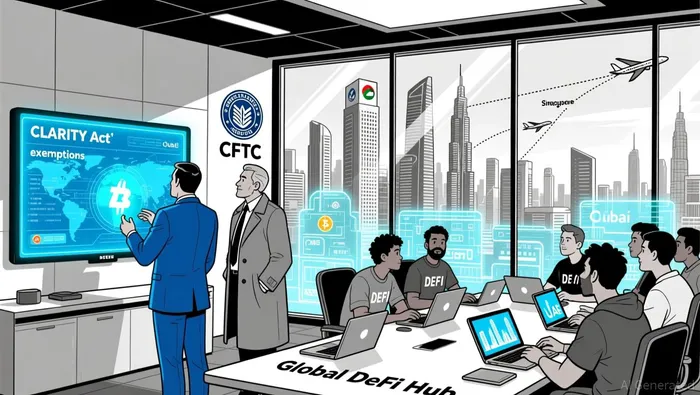
Regulatory divergence has driven DeFi projects to seek friendlier jurisdictions. The European Union's MiCA regulation, for instance, has led to a 18.9% decline in Q1 2025 DeFi DEX trading volumes within the EU, with over 40% of users migrating to offshore platforms in Singapore and the UAE. These regions offer clearer licensing frameworks and tax incentives, enabling DeFi projects to pilot tokenized debt, synthetic assets, and algorithmic stablecoins without U.S.-style regulatory friction.
- Product Design Adaptations
DeFi protocols are reengineering their tokenomics to align with regulatory expectations. For example, stablecoin projects are adopting transparent reserve audits and programmable smart contracts to comply with the GENIUS Act's 1:1 backing requirements. Similarly, decentralized exchanges (DEXs) are integrating hybrid models that blend on-chain liquidity with off-chain compliance layers, ensuring adherence to the CFTC's tokenized collateral guidance.
The Risks of Regulatory Divergence
While these strategies mitigate compliance risks, they also expose DeFi to cross-border operational challenges. For instance, the SEC's Howey Test remains a wildcard, with enforcement actions still targeting tokens that fail to meet its criteria for "investment contracts" as reported by legal experts. Additionally, state-level initiatives like the NASAA's SAFE Act threaten to fragment enforcement authority, creating a patchwork of rules that complicate global expansion.
The Senate Agriculture Committee's proposed expansion of CFTC jurisdiction further complicates the landscape. By defining "digital commodities" more broadly than the CLARITY Act, this draft legislation could force DeFi projects to register as CFTC-regulated entities, increasing compliance costs.
The Path Forward: Balancing Innovation and Compliance
For DeFi-native assets to thrive in this environment, three strategic imperatives emerge:
1. Proactive Jurisdictional Planning: Prioritize markets with clear regulatory frameworks (e.g., Singapore, UAE) while maintaining U.S. access through CFTC-compliant operations.
2. Compliance-By-Design: Embed regulatory requirements into protocol architecture, leveraging zero-knowledge proofs (ZKPs) and decentralized identity (DID) systems to balance privacy and transparency according to industry experts.
3. Lobbying for Clarity: Advocate for federal legislation that harmonizes SEC and CFTC oversight, as seen in the Senate's planned January 2026 markup sessions.
Conclusion
The CLARITY Act and its counterparts represent a pivotal moment for DeFi. While regulatory uncertainty persists, the industry's ability to innovate-through compliance tools, jurisdictional agility, and product design-demonstrates its resilience. For investors, the key takeaway is clear: DeFi projects that strategically navigate this regulatory maze will not only survive but redefine the future of finance.






Comentarios
Aún no hay comentarios