
DeFi Platforms Outperforming During Market Downturns: Network Usage and Revenue Resilience Signal Long-Term Value
The Downturn: A Harsh Reality for DeFi
The 2023 crypto market downturn and its ripple effects into 2025 exposed vulnerabilities in DeFi. By March 2025, Solana-based platforms like Pump.fun and Jito saw a 55% revenue drop compared to February, while Ethereum-based protocols such as Lido and AaveAAVE-- fell by 52%, and BNBBNB-- Chain's PancakeSwapCAKE-- reported a 54% decline in monthly revenue, according to the 2025 Q3 Crypto Industry Report. These numbers reflect a broader trend: reduced user engagement, fewer transactions, and a flight to safety as investors retreated from speculative assets.
Yet, even in this bleak landscape, outliers emerged. MakerDAO (now Sky) bucked the trend, reporting an 11% revenue increase in March 2025 in the same report. This anomaly hints at a critical insight: not all DeFi platforms react the same way to market stress. Those with robust use cases-like stablecoin issuance or yield generation-tend to retain value, even when the broader market is in freefall.
Network Usage: A Barometer of Resilience
Network usage metrics tell a more nuanced story. During the October 2025 market crash, Ethereum's daily fees spiked to $13.8M due to liquidations and congestion but stabilized at $2M within days, according to DeFi Analytics 17th October 2025. That report also noted decentralized exchanges (DEXs) saw a surge in volume, hitting $177B during the crash-a 42% increase from pre-crash levels. Such data suggests that DeFi platforms are increasingly serving as critical infrastructure during market stress, not just speculative tools.
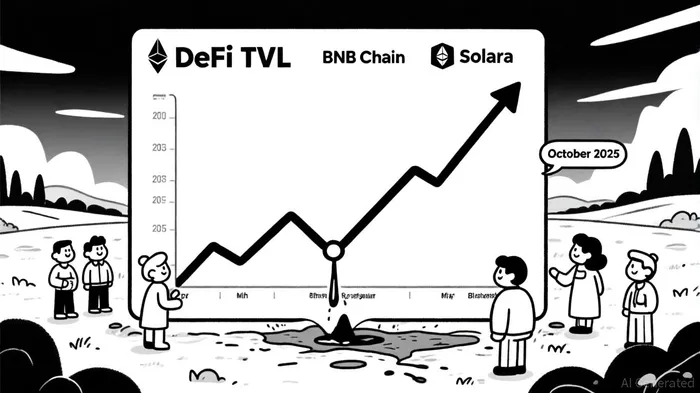
Total Value Locked (TVL) also tells a tale of resilience. By Q3 2025, DeFi TVL rebounded to $237B, driven by Ethereum's 49% share and the rise of stablecoins, as reported by Cointelegraph. Even as daily active wallets dropped 22%, cross-chain activity grew by 52%, fueled by LayerLAYER-- 2 solutions and blockchain bridging - the Cointelegraph piece highlighted this shift. This indicates that while retail participation may wane, institutional capital and protocol-level innovation are keeping DeFi afloat.
Revenue Resilience: Aave and Stablecoins Lead the Way
Revenue resilience is perhaps the most compelling argument for DeFi's long-term value. During the Q1 2025 downturn, Aave generated $6M in revenue through decentralized liquidations, as Cryptopotato reported. Similarly, stablecoins now drive over 30.8% of DeFi revenue, acting as a backbone for leverage loops, yield strategies, and transactional flows, according to the Keyrock report. These protocols are less correlated to speculative cycles and more tied to utility, making them attractive during downturns.
The Q3 2025 rebound further validates this trend. DeFi's market share climbed from 3.3% to 4.0%, with TVL rising 40.2% to $161B, per the Coingecko industry data. This growth was fueled by Ethereum's resurgence and the launch of perpetual DEXes like AsterASTER--, which saw a 42% volume increase, according to the Lookonchain Weekly Report. Even as BNB Chain's TVL grew by 15%, Solana's TVL dropped 33%-highlighting the importance of platform-specific fundamentals noted in the Keyrock analysis.
The Road Ahead: Opportunities and Risks
While DeFi's resilience is encouraging, challenges persist. Cash burn and counterparty risks remain significant, particularly for protocols reliant on volatile assets, as Cryptopotato highlighted. Regulatory scrutiny also looms large, with stablecoins and lending platforms under the microscope. However, the sector's ability to adapt-through innovations like Mutuum Finance's decentralized lending solutions and Nasdaq listings-suggests a path to sustainability, a point echoed in the Lookonchain overview.
For investors, the key takeaway is clear: DeFi platforms with strong network usage, utility-driven revenue models, and cross-chain interoperability are better positioned to outperform during downturns. These metrics are not just survival tools; they're indicators of long-term value creation in a market that thrives on chaos.
Conclusion
DeFi's journey through 2023–2025 has been anything but smooth. Yet, the sector's ability to maintain network activity, generate revenue during crises, and innovate in the face of adversity paints a bullish picture for the future. As the market matures, investors who focus on resilience-rather than short-term volatility-will likely find themselves ahead of the curve. The next bull run may not be far off, and DeFi's foundations are stronger than ever.






Comentarios
Aún no hay comentarios