
DeFi Partnership Hype and Market Trust Erosion: A Cautionary Investment Analysis
DeFi Partnership Hype and Market Trust Erosion: A Cautionary Investment Analysis
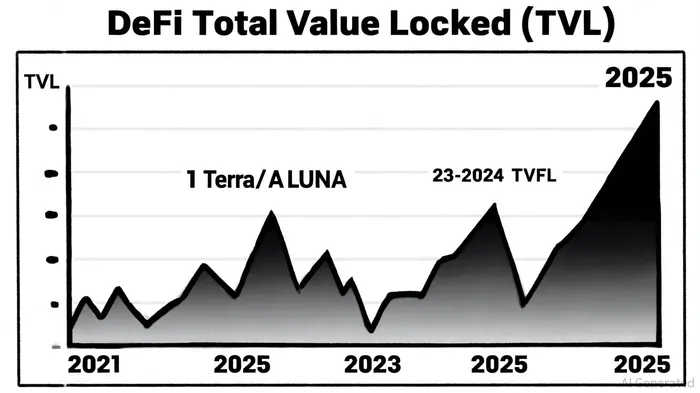
The DeFi sector has long been a double-edged sword for investors: a beacon of innovation and a graveyard of overhyped partnerships. Between 2023 and 2025, the industry witnessed a wave of speculative alliances and tokenomics-driven hype that ultimately eroded market trust, triggering significant financial losses and regulatory scrutiny. This analysis evaluates the long-term investment risks of such overhyped DeFi partnerships, drawing on case studies, TVL trends, and regulatory responses to underscore the fragility of the ecosystem.
The Hype Cycle: From Promises to Panic
DeFi partnerships in this period were often marketed as revolutionary, promising yield farming, algorithmic stablecoins, and cross-chain interoperability. However, many projects lacked sustainable economic models or robust security frameworks. Iron Finance, for instance, collapsed in 2021 due to a death spiral triggered by a partially collateralized stablecoin (IRON/TITAN). As users panicked and redeemed tokens, TITAN's value plummeted, wiping out $2.5 billion in TVL and exposing the instability of algorithmic designs, according to a SmartLiquidity report. Similarly, Yam Finance's 2020 failure-caused by a coding flaw in its rebasing mechanism-highlighted the risks of untested smart contracts, leading to a 99% loss in its token's value, as discussed in a DeFi Planet analysis.
These failures were not isolated. Harvest Finance's 2020 flash loan exploit, which siphoned $24 million, revealed vulnerabilities in oracleADA-- design and price manipulation, the same report noted. Collectively, these cases underscored a pattern: overhyped partnerships prioritized short-term gains over long-term sustainability, often relying on unrealistic APYs and inflationary tokenomics. By 2025, over 80% of DeFi projects launched in the previous three years had either shut down or lost >90% of their TVL, according to a ProtechBro analysis.
TVL Trends and Investor Behavior Shifts
The Total Value Locked (TVL) metric, once a proxy for DeFi's growth, became a barometer of trust erosion. In Q1 2025, DeFi TVL fell 27% to $156 billion, driven by security breaches like the $1.4 billion Bybit hack and macroeconomic uncertainty, per a Bitget report. Ethereum's TVL alone dropped 37% to $96 billion, while blockchains like SuiSUI-- and SolanaSOL-- saw declines exceeding 40%, as Cointelegraph noted. These drops mirrored investor behavior shifts: daily active users (DAUs) on DeFi platforms surged from 60,000 in 2021 to 1 million by 2022, but by 2025, retail participation had waned as trust eroded, according to a DappFort post.
Institutional investors, however, showed resilience. An EY-Parthenon and Coinbase survey found that 83% of institutional investors planned to increase digital asset allocations, citing regulatory clarity as a key driver. Yet, even this optimism was tempered by caution. For example, the SEC's enforcement of the Howey Test-classifying tokens like LUNALUNA-- as unregistered securities-sparked legal battles and compliance costs, deterring institutional entry, as noted in a Trendswide article.
Regulatory Responses and the Path Forward
Regulators have increasingly targeted overhyped DeFi projects. The EU's Markets in Crypto-Assets (MiCA) regulation, enacted in 2025, mandated licensing for crypto-asset service providers (CASPs), while the U.S. Treasury's sanctioning of Tornado Cash in 2022 signaled a shift toward holding smart contracts themselves accountable for AML/CFT violations, according to a GRVT analysis. These measures, while fostering transparency, also raised concerns about stifling innovation.
Despite these challenges, the DeFi landscape is maturing. Projects like DeXRP prioritized audits, real-world utility, and regulatory alignment, attracting institutional capital. Meanwhile, tokenization of real-world assets (RWAs) and embedded compliance tools (e.g., zero-knowledge proofs) are redefining DeFi's value proposition, as explored in a Bulldog Law article. By 2025, TVL had rebounded to $170 billion, driven by institutional-grade infrastructure and hybrid models balancing decentralization with compliance, per a CoinDesk report.
Conclusion: Lessons for Investors
The DeFi partnership hype of 2023-2025 serves as a cautionary tale for investors. Overhyped alliances, flawed tokenomics, and inadequate security have eroded trust, as evidenced by TVL drops and regulatory crackdowns. While the sector's long-term potential remains, investors must prioritize projects with audited smart contracts, sustainable economic models, and regulatory alignment. As one analyst noted, "DeFi's future lies not in chasing hype but in building bridges between innovation and trust," observed in a SmartLiquidity piece.






Comentarios
Aún no hay comentarios