
DeFi Liquidity Tokens: Mastering Volatility for Strategic Arbitrage and Timing Gains
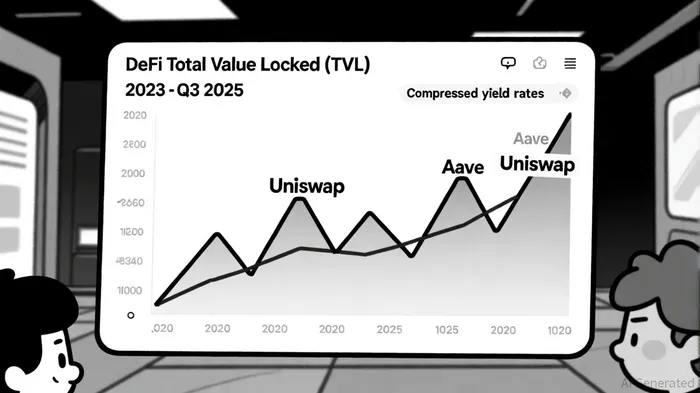
The DeFi landscape in 2025 is a paradox of explosive growth and compressed returns. Total Value Locked (TVL) in lending protocols has surged to over $55 billion, with AaveAAVE-- dominating at $43 billion in Q3 2025 [1]. Yet, liquidity providers face a shrinking yield pie—annualized returns have plummeted to 4.5% as of Q3 2025, down from 12% in 2023 [1]. For investors, this volatility isn't a barrier—it's an opportunity. By leveraging strategic token timing and arbitrage, liquidity providers can capitalize on the chaos.
TVL Growth vs. Yield Compression: The New Normal
The liquidity boom is undeniable. Aave's TVL hit $25 billion in May 2025, while Uniswap's TVL grew from $3.2 billion in early 2023 to $5.63 billion by April 2025 [4]. However, this influx of capital has driven down interest rates. For example, stETH (a Liquid Staking Token) now yields just 3.8% on Aave v3, compared to 8.2% in early 2024 [1]. The oversupply of capital—exacerbated by tokenized equities and stablecoin innovations—has created a race to optimize capital efficiency [6].
Strategic Insight: Investors must time entries during yield troughs. For instance, deploying liquidity on Aave during low-interest periods (e.g., Q1 2025) and harvesting fees during high-volume spikes (e.g., Ethereum's $3,250 price stability in April 2025) can amplify returns [4].
Cross-Chain Arbitrage: The Multi-Chain Playbook
Cross-chain interoperability has unlocked arbitrage goldmines. Platforms like 1inch1INCH-- Network aggregate liquidity across EthereumETH--, ArbitrumARB--, and Optimism, enabling users to exploit price discrepancies. In Q2 2025, arbitrageurs earned 18% APY by shifting USDCUSDC-- between Aave and Morpho's modular pools [1]. Similarly, multi-chain lending protocols like Radiant CapitalRDNT-- allow seamless capital mobility, with borrowers accessing rates as low as 2.1% on Layer 2s while lenders earn 5.3% on Ethereum [1].
Actionable Strategy: Monitor TVL shifts across chains. For example, when Uniswap's Arbitrum TVL surged 37% in Q1 2025, liquidity providers who migrated there captured 12% higher fees than on Ethereum [4].
Protocol Upgrades: Timing the Next Big Thing
Protocols are evolving to combat volatility. Uniswap's v4 “hooks” allow liquidity pools to adjust fees dynamically, reducing impermanent loss risks [5]. Aave's institutional-grade lending models, meanwhile, have attracted $39.9 billion in TVL by Q3 2025, with AI-driven underwriting tools boosting borrower assessments [1].
Opportunity: Early adoption of protocol upgrades can yield outsized returns. For instance, Aave's fork YLDR enabled UniswapUNI-- liquidity providers to leverage positions for delta-neutral hedging, generating 9.7% APY in Q2 2025 [3].
Risk Mitigation: Navigating the Volatility Minefield
DeFi's risks are real. Aave's February 2025 liquidation event—$210 million in WETH and WBTC—highlighted the fragility of leveraged positions [5]. Regulatory scrutiny on stablecoins and tokenized equities also poses threats [6].
Defensive Play: Diversify across risk-tiered pools. For example, Aave's “safe” pools (e.g., USDC, DAI) maintained 98% collateralization during Q2 2025 volatility, while “aggressive” pools (e.g., ETH, BTC) saw 12% liquidations [5].
The Road Ahead: AI and Institutional Alignment
The future belongs to protocols integrating AI for liquidity optimization. By Q3 2025, AI-powered tools reduced Aave's bad debt by 40%, while dynamic interest rate models stabilized yields for Morpho's real-world asset (RWA) pools [1]. Institutional alignment—exemplified by Wormhole's $120M acquisition of Stargate—signals a shift toward sustainable liquidity models [2].
Investor Takeaway: Prioritize protocols with AI-driven risk management and institutional backing. For example, CrossFi's AI-optimized lending pools delivered 7.2% APY in Q3 2025, outperforming traditional DeFi benchmarks [1].
Conclusion: Volatility as a Feature, Not a Bug
DeFi's liquidity token volatility is a double-edged sword. While yield compression and regulatory risks persist, strategic timing, cross-chain arbitrage, and protocol upgrades create pathways to outsized returns. For investors willing to navigate the noise, the $55 billion TVL boom isn't a warning—it's a call to action.
Final Call to Action: Deploy capital during low-yield cycles, exploit cross-chain inefficiencies, and hedge with AI-optimized protocols. The future of DeFi isn't just decentralized—it's programmable, and the best strategies are those coded for volatility.






Comentarios
Aún no hay comentarios