
DeFi Liquidity Dynamics and Aave's Strategic Positioning: Analyzing Stani Kulechov's 4M ENA OTC Deposit as a Liquidity Signal
The decentralized finance (DeFi) ecosystem has entered a new phase of institutional-grade liquidity and systemic complexity, with AaveAAVE-- emerging as a cornerstone protocol. Stani Kulechov, founder of Aave, has positioned the platform as a bridge between traditional finance (TradFi) and decentralized systems, leveraging innovations like cross-chain lending and real-world asset (RWA) tokenization. A recent 4M ENAENA-- over-the-counter (OTC) deposit into Aave liquidity pools—part of Ethena's broader integration with the protocol—has sparked debate about its implications for liquidity dynamics, market sentiment, and systemic risk. This analysis examines the deposit as a liquidity signal and evaluates Aave's strategic positioning in the evolving DeFi landscape.
Aave's Liquidity Expansion and the Aavethena Synergy
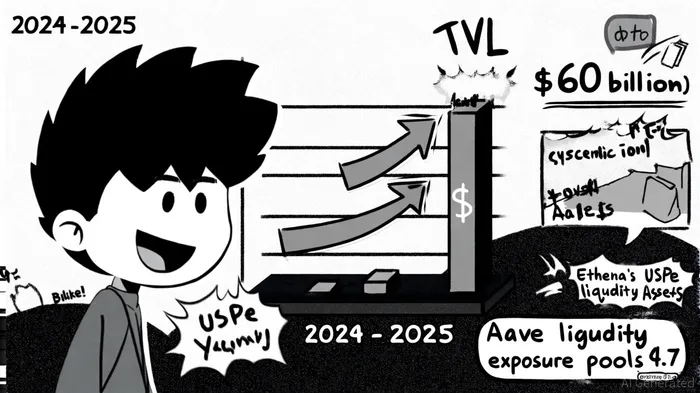
Aave's Total Value Locked (TVL) surpassed $60 billion in August 2025, tripling from $18 billion in August 2024[1]. This growth is driven by high-yield stablecoins like GHO (11% APY) and strategic partnerships, including Ethena's USDeUSDe-- synthetic dollar. Ethena's integration with Aave has been particularly significant: as of Q3 2025, $4.7 billion in USDe backing assets are deposited on Aave, representing 55% of the stablecoin's total collateral[2]. The 4M ENA OTC deposit—likely a governance or liquidity provision move by Kulechov—signals confidence in Aave's infrastructure and reinforces the Aavethena synergy.
Ethena's USDe supply has surged 75% in a month to $9.3 billion, with $6.4 billion of its assets on Aave[3]. This interdependence creates a flywheel effect: EthenaENA-- users leverage Aave's liquidity to amplify yields on sUSDe, while Aave benefits from increased TVL and fee revenue. However, the concentration of USDe collateral on a single protocol raises concerns about systemic fragility. Risk analysts at Chaos Labs warn that rehypothecation strategies—where the same assets back both USDe and Aave yield generation—could amplify risks during deleveraging events[4].
Market Sentiment and Strategic Alignment
Kulechov's 4M ENA deposit has been interpreted as a bullish signal for Aave's liquidity pools. The ENA token, Ethena's governance asset, surged 43% in a week amid speculation about a fee switch mechanism that would share protocol revenue with sENA holders[5]. While the deposit's exact terms remain undisclosed, its timing aligns with Aave's Q4 2025 v4 upgrade, which introduces a Hub-and-Spoke architecture to optimize cross-chain liquidity and a Reinvestment Module to deploy idle capital[6]. These upgrades aim to reduce reliance on single-chain liquidity and enhance capital efficiency, addressing concerns about over-concentration.
The deposit also underscores Aave's strategic alignment with Ethena. By enabling Ethena to tokenize real-world assets (RWAs) and integrate them into Aave's lending pools, the partnership bridges TradFi and DeFi. Kulechov has emphasized that tokenized RWAs—such as government bonds and real estate—will outgrow native crypto assets within five years[7]. This vision is reflected in Aave's Horizon product, which allows institutions to use tokenized money market funds as collateral[8].
Risks and Systemic Considerations
Despite the optimism, the 4M ENA deposit highlights potential vulnerabilities. Ethena's $106 million ENA token unlock in August 2025 added selling pressure, causing a 5.6% price drop[9]. While ENA remains above key moving averages, the interplay between token unlocks and Aave's liquidity exposure could destabilize the market. If trust in USDe wanes or mass redemptions occur, Aave's stablecoin borrow rates could spike, triggering a liquidity crunch[10].
Moreover, Aave's reliance on Ethena's assets—55% of USDe collateral is concentrated on the protocol—poses systemic risks. Traditional finance's shift to blockchain, as Kulechov notes, hinges on DeFi being “10 times better” than legacy systems[11]. However, the current model's fragility suggests that Aave must diversify its liquidity sources and strengthen risk management frameworks.
Conclusion: Aave's Path Forward
Stani Kulechov's 4M ENA OTC deposit is more than a liquidity event—it is a strategic signal of confidence in Aave's infrastructure and its role in the DeFi-TradFi convergence. While the Aavethena synergy has driven TVL growth and innovation, the protocol must address systemic risks through diversification and robust governance. Aave's Q4 v4 upgrade and RWA integrations position it to lead the next phase of DeFi, but the path to $100 billion in net deposits by 2025 will require navigating volatility and ensuring resilience in a rapidly evolving market.
For investors, the key takeaway is that Aave's strategic positioning offers high-growth potential but demands vigilance. The interplay between liquidity concentration, token economics, and systemic risk will define the protocol's trajectory—and the broader DeFi ecosystem—in the months ahead.






Comentarios
Aún no hay comentarios