
DeFi's Liquidity Bridge Risks: A Looming Threat to Investor Trust and Capital Returns?
Liquidity Bridge Misexecution: A Case Study in Systemic Fragility
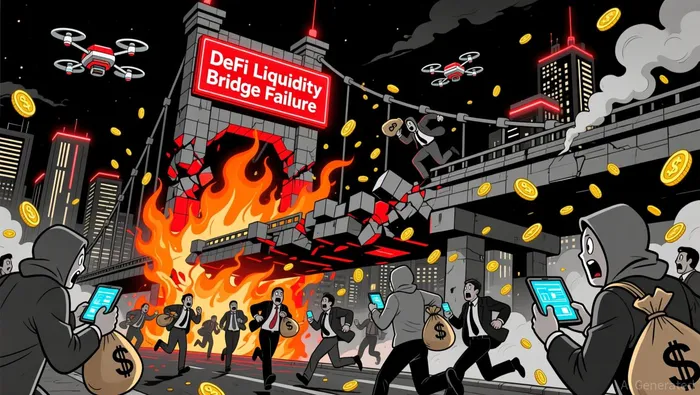
The collapse of Stream Finance in 2025 serves as a cautionary tale. A combination of opaque off-chain transactions by an external "Curator" and recursive lending with deUSD in the Elixir protocol led to a $93 million loss. This triggered a chain reaction: $160 million in user funds were frozen, and Euler protocol incurred $137 million in bad debt. The Curator model, adopted by platforms like MorphoMORPHO-- and EulerEUL-- with over $8 billion in total value locked (TVL), has proven particularly vulnerable to misaligned incentives and operational opacity.
Such failures highlight a critical flaw in DeFi's design philosophy: the assumption that decentralization alone ensures resilience. When liquidity bridges-meant to connect disparate blockchain ecosystems-lack robust governance and transparency, they become single points of failure. The Stream Finance incident underscores that even protocols with high TVL are not immune to cascading losses when foundational trust is compromised.
Cross-Chain Vulnerabilities: Exploits in the Fast Lane
Beyond governance flaws, technical vulnerabilities in cross-chain bridges have exacerbated risks. In 2025, reentrancy bugs, oracle manipulation, and liquidity pool drains siphoned over $1.5 billion from DeFi platforms according to CyberDaily Australia. The February Bybit hack, which drained $1.5 billion, and the Cetus exploit, which extracted $223 million in 15 minutes, exemplify the speed and scale of modern attacks.
These breaches are not isolated events but symptoms of a broader problem: the prioritization of speed and scalability over security. As stated by a report from CyberDaily Australia, "High-speed blockchain vulnerabilities have become a priority concern for investors, with 2025 marking a record year for DeFi security breaches exceeding $3.1 billion" according to CyberDaily Australia. The lack of standardized audit practices across protocols leaves gaping holes that malicious actors exploit with surgical precision.
Investor Trust Erosion: The Human Cost of Technical Failures
The October 2025 crypto crash further tested DeFi's resilience. While major protocols like AaveAAVE-- and Hyperliquid maintained functionality during record $20 billion in liquidations, smaller platforms like Lighter collapsed under the strain, leaving users with frozen funds and unsecured loans according to The Defiant. This dichotomy has deepened investor skepticism: Why do some protocols withstand volatility while others crumble?
Trust, once lost, is hard to rebuild. A survey by The Defiant revealed that 68% of DeFi users now prioritize security audits and insurance mechanisms before depositing capital according to The Defiant. This shift reflects a growing awareness that capital returns are contingent on protocol integrity. Yet, as the Stream Finance and Bybit cases demonstrate, even audited protocols can falter when liquidity bridges are poorly designed or mismanaged.
The Path Forward: Risk Management as a Competitive Advantage
For DeFi to mature, platforms must treat risk management as a core competency, not an afterthought. Three steps are critical:
1. Transparency in Governance: Protocols must abandon opaque models like the Curator structure and adopt on-chain, community-driven decision-making.
2. Cross-Chain Security Audits: Independent, real-time monitoring of liquidity bridges is essential to detect and mitigate exploits before they escalate.
3. Insurance Mechanisms: Platforms should integrate decentralized insurance pools or partner with entities like Nexus Mutual to absorb losses and rebuild trust.
Investors, meanwhile, must adopt a more discerning approach. Capital should flow to protocols that prioritize security, demonstrate transparency, and have contingency plans for liquidity crises. The days of "move fast and break things" are over; in DeFi, survival now depends on moving safely and sustainably.
Conclusion
The DeFi sector stands at a crossroads. While 2025's liquidity bridge failures and cross-chain exploits have shaken investor confidence, they also present an opportunity for innovation. Protocols that address these vulnerabilities head-on-through rigorous audits, transparent governance, and robust risk management-will emerge stronger. For investors, the lesson is clear: Capital returns in DeFi are not just a function of yield but of trust. And in a trustless system, trust is the most valuable asset of all.






Comentarios
Aún no hay comentarios