
DeFi Lending Market Recovery and On-Chain Innovation: Strategic Entry Points in Aave and Morpho as Market Consolidators Post-October Crash
The DeFi lending sector, once a speculative frontier, has emerged as a critical pillar of institutional finance following the October 2025 crash. Total Value Locked (TVL) in the sector stabilized at $91.6 billion by year-end, despite a 30% drop from its peak of $125 billion. This turbulence, however, accelerated the consolidation of market leadership among protocols with robust risk frameworks and scalable architectures. AaveAAVE-- and MorphoMORPHO--, two of the sector's most influential players, have leveraged the crash to solidify their dominance through strategic innovation, institutional partnerships, and governance reforms. For investors, these protocols represent compelling entry points in a market poised for long-term institutional adoption.
Aave: Governance Resilience and Protocol Maturity
Aave's dominance in the DeFi lending space- holding over 50% market share with a TVL above $54 billion post-crash-is underpinned by its technical maturity and proactive governance. The protocol's Aave V4 upgrade, currently in development, emphasizes modular architecture to support real-world assets (RWAs) and institutional-grade lending features. This upgrade includes formal verification and biweekly community Office Hours, fostering transparency and trust during periods of market stress.
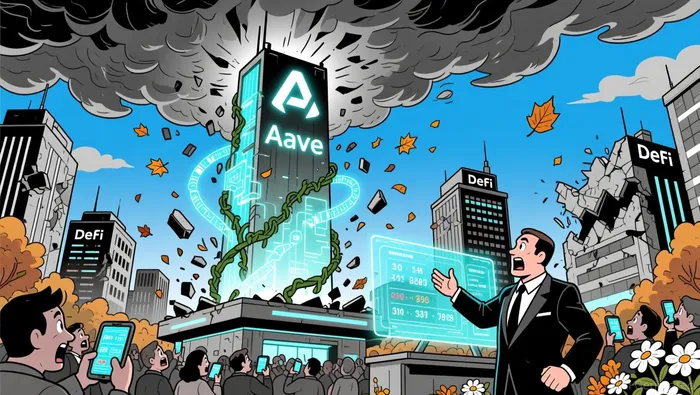
The October 2025 crash served as a stress test for Aave's infrastructure. On October 10, the protocol processed $180 million in liquidations within one hour without human intervention or bad debt, demonstrating its operational resilience. However, governance challenges persist. AaveLabs' redirection of $10 million in swap fees from the DAO treasury in December 2025 sparked debates over decentralization, with proposals to reclaim control of brand assets like aave.com. These tensions highlight the broader struggle between protocol neutrality and the practicalities of maintaining user-facing interfaces-a challenge Aave must resolve to retain institutional credibility.
Morpho: Modular Risk Mitigation and Institutional Expansion
Morpho's post-crash strategy centers on modular risk management and institutional integration. By externalizing risk assessment to third-party curators, Morpho enables isolated lending markets where each vault operates with distinct underwriting rules. This design proved critical during the xUSD/Stream Finance collapse, where Morpho's isolated-market structure contained losses to a single vault, preserving system-wide stability.
Institutional adoption has been a key driver of Morpho's growth. The Ethereum Foundation deposited 2,400 ETH and $6 million in stablecoins into Morpho's vaults, while Coinbase DeFi Lend-powered by Morpho-attracted $350 million in supply within two months. The protocol is also expanding into Asian markets with Q1 2026 JPYC stablecoin lending markets, targeting institutional capital in Japan. Morpho's partnerships with regulated banks like Société Générale and fintechs like PayPal further underscore its role in bridging traditional finance and DeFi.
Strategic Entry Points for Investors
The October 2025 crash created a unique inflection point for DeFi lending. Aave and Morpho's contrasting approaches-Aave's governance-driven protocol upgrades and Morpho's curator-led risk models-position them as complementary consolidators in a sector transitioning from speculative growth to institutional utility.
For Aave, the key entry point lies in its Aave V4 roadmap. The protocol's modular design for RWAs and institutional borrowing via custodians opens new revenue streams, while resolving governance disputes could unlock DAO-driven innovation. Investors should monitor the outcome of the brand asset proposal and the performance of Aave V4's Layer 2 deployments, which have already shown improved liquidation efficiency.
Morpho's appeal stems from its institutional traction and risk-isolation model. The protocol's expansion into JPYC markets and partnerships with PayPal and Crypto.com signal a shift toward mainstream adoption. However, investors must assess the risks of curator-driven governance, as the locus of risk has shifted from monolithic protocols to a decentralized curator layer. Morpho's ability to maintain transparency while scaling will determine its long-term viability.
Conclusion
The DeFi lending market's post-crash recovery is not a return to pre-2025 conditions but a redefinition of its role in global finance. Aave and Morpho have emerged as leaders by addressing systemic vulnerabilities-Aave through protocol resilience and governance transparency, and Morpho through modular risk frameworks and institutional integration. For investors, these protocols represent strategic entry points into a sector that is increasingly becoming the backbone of on-chain credit markets. As the industry matures, the winners will be those who adapt to institutional demands while preserving the decentralization ethos that defines DeFi.






Comentarios
Aún no hay comentarios