
DeFi Lending Infrastructure Growth: Strategic Ecosystem Partnerships Driving Yield Innovation
The DeFi lending landscape in 2025 is undergoing a transformative phase, driven by strategic ecosystem partnerships that are redefining yield generation and risk management. Despite a broader trend of yield compression across stablecoin markets-where platforms like AaveAAVE-- and SparkSPK-- report base yields as low as 3%-innovative collaborations are enabling protocols to deliver superior returns through specialized strategies, institutional-grade tools, and cross-chain integrations, as noted in a CoinDesk report. This evolution is not merely a response to market pressures but a deliberate shift toward a stratified DeFi infrastructure, where blue-chip protocols coexist with niche, strategy-driven platforms to serve diverse capital needs, according to a CoinCentral report.
Strategic Partnerships as Catalysts for Yield Innovation
One of the most significant developments in 2025 is the convergence of centralized finance (CeFi) and DeFi infrastructure, exemplified by partnerships such as Crypto.com, Morpho, and Cronos. These collaborations have introduced scalable lending solutions on the Cronos blockchain, enabling users to earn yields on wrapped BTCBTC-- and ETHETH-- while leveraging Cronos' low gas fees and high throughput, as described in a Blockchain.News report. This model reflects a broader trend of CeFi platforms acting as gateways to DeFi liquidity, with Morpho Vaults serving as the backend infrastructure for stablecoin borrowing and yield generation.
Similarly, Coinbase's integration of Bitcoin-collateralized loans via Morpho on its Base network underscores the "DeFi Mullet" thesis: user-friendly fintech interfaces paired with decentralized backends, as noted by CoinCentral. By allowing users to borrow against crypto assets without exiting the CoinbaseCOIN-- ecosystem, the platform bridges the gap between traditional finance and DeFi, expanding access to a mainstream audience while maintaining institutional-grade security, per CoinCentral.
Curation Models and Protocol Stratification
The rise of curation models has further distinguished DeFi lending in 2025. Platforms like Morpho and Euler have empowered curators-essentially DeFi asset managers-to optimize lending vaults by adjusting risk parameters, collateral types, and capital deployment strategies, as noted in the CoinDesk report. For instance, the largest USDCUSDC-- vaults on these platforms have outperformed the vaults.fyi benchmark, achieving base yields of 5-8% and total yields of 6-12% when including token rewards, according to the CoinDesk analysis. This specialization has led to a stratified ecosystem:
- Blue-chip protocols (e.g., Aave, Compound) function as stable, low-risk money market funds.
- Infrastructure optimizers (e.g., Morpho, Euler) focus on yield amplification through curation.
- Strategy providers (e.g., Gauntlet, TrueFi) offer institutional-grade solutions like AI-driven underwriting and tokenized real-world assets, as detailed in the TrueFi DAO report.
Gauntlet, for example, now manages $750 million in TVL by deploying performance-based fee structures and dynamic risk models, demonstrating the viability of curation as a revenue stream, according to CoinCentral.
Institutional Adoption and AI-Driven Efficiency
Institutional confidence in DeFi lending has surged, with protocols like Aave V4 introducing cross-chain liquidity routing and native restaking collateral to enhance capital efficiency, as reported by CoinDesk. Meanwhile, Lido Finance's stETH collateral dominates TVL across lending platforms, reflecting demand for liquid staking derivatives in yield strategies, as shown in a ProTechBro analysis.
TrueFi DAO has further bridged DeFi and traditional markets by launching tfBills (a U.S. Treasury bill token) and Polaris, a yield-bearing stablecoin designed for institutional capital flows, as described in the TrueFiTRU-- DAO report. These innovations are supported by AI-powered underwriting tools, which optimize interest rates and risk assessments in real time, reducing defaults and improving liquidity allocation, according to the ProTechBro analysis.
Conclusion: A Foundation for the Future of Finance
The strategic ecosystem partnerships driving DeFi lending in 2025 are not just incremental improvements-they represent a fundamental reimagining of financial infrastructure. By combining CeFi accessibility, DeFi efficiency, and institutional-grade tools, these collaborations are creating a resilient, multi-layered system capable of serving both retail and institutional markets. For investors, the key opportunities lie in protocols that:
- Enable cross-chain interoperability (e.g., Aave V4, Cronos).
- Leverage curation models to outperform traditional benchmarks (e.g., Morpho, Euler).
- Integrate AI and real-world assets to diversify yield sources (e.g., Gauntlet, TrueFi).
As DeFi transitions from a niche experiment to a foundational financial layer, the protocols that prioritize strategic alliances and yield innovation will likely dominate the next phase of growth. 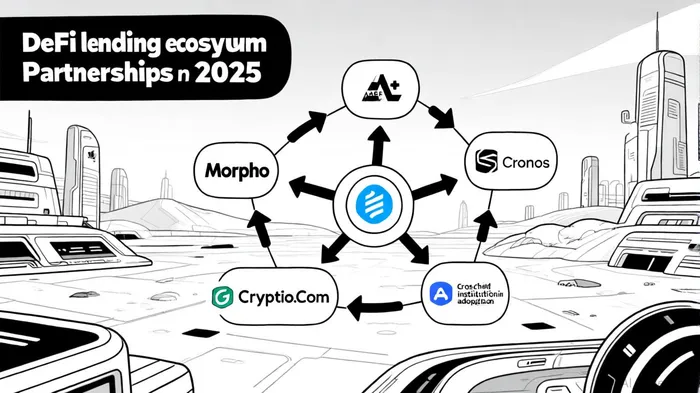





Comentarios
Aún no hay comentarios