
DeFi Exploits and Collateral Arbitrage: Capitalizing on Post-Hack Opportunities in Stablecoin Markets
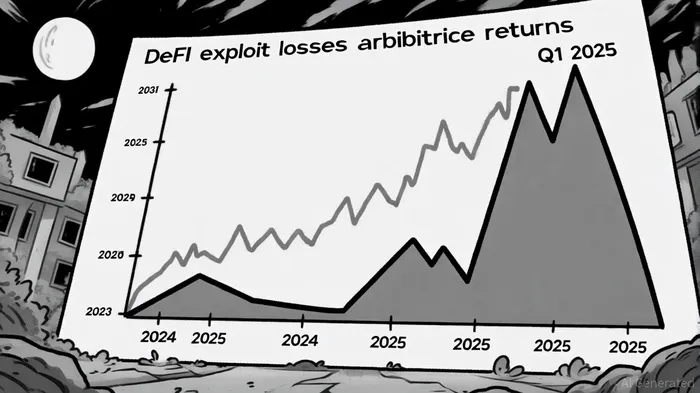
The DeFi stablecoin market in 2025 has become a battleground of innovation and vulnerability. While institutional players leverage stablecoins like USDCUSDC-- and USDTUSDT-- for high-frequency arbitrage—achieving annualized returns of 9.8% and Sharpe ratios of 2.1—the same ecosystem has seen a fivefold increase in exploits, with $2 billion lost in Q1 2025 alone [4]. Recent events, such as the September 2025 YU stablecoin exploit, underscore how post-hack volatility creates asymmetric opportunities for capital arbitrage. This article dissects the mechanics of these opportunities, the risks they entail, and strategies to navigate them profitably.
The Surge in DeFi Exploits: A New Normal
The DeFi landscape has become increasingly fragile due to cross-chain complexities and inadequate smart contract audits. In early 2025, the Bybit exploit ($1.4B loss) exposed custodial risks, while Solana's LIBRA and MELANIA exit scams ($286M and $200M) highlighted flawed token economics [4]. The YU stablecoin exploit, which caused a near-80% depeg to $0.11, exemplifies how cross-chain bridging vulnerabilities can destabilize pegs and create liquidity imbalances [2]. These incidents are not isolated but part of a systemic trend: access control flaws, oracleORCL-- manipulations, and governance gaps have become recurring attack vectors [1].
Post-Hack Arbitrage: Exploiting Peg Deviations and Liquidity Gaps
Post-exploit volatility often leads to temporary depegging, creating arbitrage windows. For instance, after the YU exploit, traders could exploit cross-venue price divergences where YU traded at discounts on DEXs versus CEXs. Similarly, stablecoins like USDC and USDT, which maintain stronger pegs due to robust reserves, become critical for hedging and capitalizing on these deviations [2].
Key strategies include:
1. Cross-Venue Spread Divergence: Traders arbitrage price gaps between CEXs and DEXs. For example, a stablecoin trading at $0.80 on a DEX versus $1.00 on a CEX allows for risk-free profit via triangular arbitrage [2].
2. Primary Market Redemption: Protocols with mint/burn mechanisms (e.g., USDC) enable arbitrageurs to redeem or mint stablecoins at par, profiting from price reversion [2].
3. Liquidity Fragmentation Routing: Advanced players use tools like Kaiko and ChainlinkLINK-- to identify the fastest execution paths, minimizing latency in volatile post-hack environments [2].
Institutional participants with verified onboarding (e.g., via compliance platforms like Elliptic) gain first-mover advantages in these strategies, as they can access primary redemption channels and bypass regulatory friction [2].
Risks and Mitigation: Navigating a Fragile Ecosystem
While post-hack arbitrage offers high returns, it is fraught with risks. The YU exploit demonstrated how shallow liquidity pools exacerbate volatility, limiting arbitrage opportunities during recovery [2]. Additionally, regulatory tailwinds—such as the U.S. Stablecoin Transparency Act and EU's MiCA—introduce compliance overhead, particularly for cross-border arbitrage [3].
To mitigate these risks, arbitrageurs employ:
- Real-Time Monitoring: AI-powered tools detect oracle deltas and liquidity shifts, enabling rapid execution [3].
- Multi-Signature Controls: Custodial solutions with multi-sig wallets reduce counterparty risks during high-volatility periods [1].
- Diversified Stablecoin Usage: Relying on over-collateralized stablecoins (e.g., DAI) rather than algorithmic ones (e.g., UST) minimizes exposure to depegging [1].
Conclusion: Balancing Opportunity and Resilience
The DeFi stablecoin market in 2025 is a double-edged sword. Exploits create short-term arbitrage windows but also expose systemic fragility. For investors, the key lies in leveraging advanced tools, regulatory clarity, and diversified strategies to capitalize on post-hack opportunities while hedging against cascading risks. As the YU exploit and others demonstrate, the future of DeFi arbitrage will belong to those who can navigate volatility with precision and foresight.






Comentarios
Aún no hay comentarios