
DeFi Data Integrity and Token Valuation Reliability: Lessons from DeFiLlama's Aster Reinstatement
The recent reinstatement of Aster's perpetual trading data by DeFiLlama has ignited a critical conversation about data integrity in decentralized finance (DeFi). This case underscores the fragility of trust in on-chain metrics and the cascading effects on token valuations. As DeFi matures, the ability to distinguish genuine market activity from synthetic noise will determine the credibility of the entire ecosystem.
The AsterASTER-- Saga: A Case Study in Data Verification Challenges
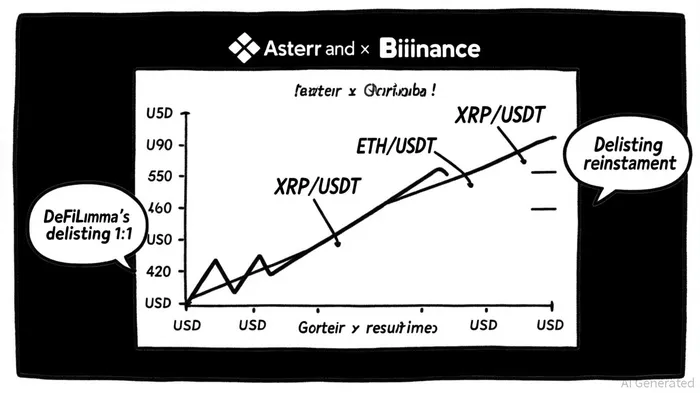
DeFiLlama's decision to delist Aster on October 6, 2025, was rooted in a glaring anomaly: Aster's perpetual futures volumes mirrored Binance's with near-perfect correlation across multiple trading pairs, including XRP/USDT and ETH/USDT, according to a Coinotag report. This pattern, described as "highly unusual for a decentralized exchange," raised red flags for wash trading-a practice where traders execute matching buy/sell orders to inflate volume metrics, as detailed in a Cointelegraph article. The platform's inability to provide granular data, such as maker/filler order details, further eroded confidence, making it impossible to verify whether trades were organic or algorithmically generated, per a CryptoBasic report.
Despite these concerns, Aster requested a reinstatement, which DeFiLlama granted in late October 2025. However, the relisting came with significant caveats: historical data was excluded, fragmenting key metrics like market share trends and cumulative revenue, according to a Cointelegraph follow-up. This created a "black box" scenario where users must interpret current volumes with caution, while longitudinal analysis remains compromised, as noted in a CoinCentral piece. The reinstatement highlights a broader tension in DeFi: the push for transparency clashes with the practical realities of verifying decentralized systems.
Data Integrity as the New Baseline for DeFi Trust
The Aster controversy is not an isolated incident. A 2025 study, "Trust as a Driver in the DeFi Market," found that up to 25% of DeFi exchanges may engage in wash trading, with metrics like TVL (Total Value Locked) and GMV (Gross Merchandise Volume) often manipulated to attract liquidity, according to a Trust study. This undermines the foundational premise of DeFi-that decentralization inherently ensures trust.
Data aggregators like DeFiLlama now play a quasi-regulatory role, acting as gatekeepers of market truth. Their decisions ripple through the ecosystem: Aster's token price dropped 10% following its delisting, illustrating how swiftly investor sentiment can shift when data credibility is questioned, as reported in a MikeRoser post. This volatility underscores a critical insight: in DeFi, token valuations are not just tied to utility or adoption but to the perceived legitimacy of the data underpinning them.
Token Valuation Reliability: Beyond TVL to Trust Metrics
Traditional valuation models for DeFi tokens often rely on TVL, revenue, and GMV. However, the Aster case reveals a flaw in these metrics: without verifiable data, they become meaningless. A 2024 study by Decentralized Finance (DeFi) Projects found that while TVL is a common benchmark, it lacks predictive power for future valuations due to its susceptibility to manipulation, as shown in a ResearchGate study. Instead, the Trust study emphasized the importance of TVL/MCAP bands-ratios that track the relationship between locked value and market cap-as a more robust indicator of investor confidence.
For instance, breakouts in TVL/MCAP bands have historically signaled price volatility, as investors react to perceived overvaluation or undervaluation, a point covered in a BitJournal guide. In Aster's case, the delisting likely triggered a band contraction, reflecting a loss of trust. Conversely, platforms with transparent, auditable data-such as those reviewed by DeFiSafety-tend to maintain stable bands, reinforcing their valuation credibility.
The Path Forward: Verification Systems and Market Resilience
DeFiLlama's reinstatement of Aster, albeit with gaps, signals a growing recognition of the need for improved verification systems. The platform is reportedly developing a new framework to validate on-chain data, which could set a precedent for industry-wide standards, according to a CryptoBreaking report. However, this also raises questions about centralization: if a single analytics firm holds the power to delist or relist projects, does that contradict DeFi's ethos?
The solution lies in decentralized verification protocols. Projects like Hyperliquid, which did not exhibit the same Binance correlation as Aster, demonstrate that transparency is achievable, as CryptoBasic reported. By incentivizing granular data sharing and third-party audits, DeFi can move toward a model where trust is algorithmically enforced rather than manually arbitrated.
Conclusion: Trust as the Ultimate Asset
The Aster sagaSAGA-- is a microcosm of DeFi's evolution. As the sector grapples with data integrity, the line between innovation and manipulation grows thinner. For investors, the lesson is clear: token valuations are only as reliable as the data that supports them. Platforms that prioritize transparency-both in their operations and in their data-will emerge as leaders, while those that rely on synthetic metrics will face the same scrutiny as Aster.
In a world where trust is the ultimate asset, DeFi's next phase will be defined by its ability to build systems that are not just decentralized, but verifiably honest.






Comentarios
Aún no hay comentarios