
DeFi Data Integrity: The Silent Crisis Undermining Trust and Capital Flows
The decentralized finance (DeFi) ecosystem, once hailed as the future of open financial systems, is facing a quiet but existential crisis: the erosion of trust due to vulnerabilities in third-party data infrastructure. As DeFi platforms increasingly rely on external data providers for price feeds, liquidity metrics, and smart contract execution, the withdrawal or manipulation of these services has triggered cascading effects on investor confidence, market capitalization, and capital flows. This analysis examines the long-term risks to DeFi protocols when third-party data integrity is compromised, drawing on recent case studies, quantitative trends, and strategic implications for investors.
The Double-Edged Sword of Third-Party Data Providers
Third-party data providers, such as ChainlinkLINK-- and OracleADA-- networks, serve as critical intermediaries in DeFi ecosystems, bridging blockchain protocols with real-world data. According to a 2025 Nature study, these providers have become "algorithmic trust anchors," enabling decentralized systems to function without centralized oversight. However, this reliance introduces new vulnerabilities. For instance, the withdrawal of a key oracle service in May 2025 led to the erroneous liquidation of $500,000 in user funds on the Avalanche-based Euler market, as documented in a Chainlink mishap report.
The TVL/MCAP bands framework, proposed by researchers in a ScienceDirect paper, highlights how investor confidence is closely tied to the perceived accuracy of data feeds. When third-party data is withdrawn or manipulated-such as in the $717,000 ZKsyncZK-- exploit in February 2025-TVL metrics become distorted, creating a feedback loop of panic withdrawals and capital flight, as detailed in a The Block analysis. This dynamic was starkly evident in Q1 2025, when DeFi TVL plummeted by 27% following the Bybit hack, which exposed weaknesses in key management and wallet controls, according to the De.Fi REKT Report.
Case Studies: When Data Fails, Protocols Collapse
The fragility of DeFi's data infrastructure is best illustrated through recent high-profile failures. In October 2020, Harvest FinanceFARM-- suffered a $24 million loss due to oracle manipulation, where attackers exploited flash loans to artificially inflate asset valuations, as documented in a SmartLiquidity case study. Similarly, Iron Finance's 2021 "death spiral" revealed the risks of partially collateralized stablecoins, as TITAN's price collapse triggered a liquidity vacuum; this is also detailed in the SmartLiquidity case study. These incidents underscore a recurring theme: when data integrity is compromised, even well-audited protocols can unravel.
A 2025 report by The Block analyzed the ZKsync exploit, where a vulnerability in the ERC-4626 standard allowed attackers to inflate the exchange rate of Mountain Protocol's wUSDM stablecoin, triggering a self-liquidation event. The incident highlighted the lack of safeguards against exchange rate manipulation in lending protocols, with experts warning that such vulnerabilities could erode investor confidence and destabilize capital flows, as noted in the same analysis.
Quantifying the Impact: TVL, Market Cap, and Investor Behavior
The financial toll of data integrity breaches is staggering. From 2020 to 2024, DeFi exploits drained $59 billion, with algorithmic stablecoin protocols accounting for 90% of losses, according to a Cryptopresales tally. In Q1 2025 alone, DeFi and CeFi exploits exceeded $2 billion, including the Bybit hack's $1.4 billion loss, according to that tally. These events have directly impacted TVL metrics: Ethereum's TVL fell to $96 billion in Q1 2025, a 25% drop from its December 2024 peak of $137 billion, as shown in Statista data.
Investor behavior has also shifted. A 2025 VoxEU column found that retail investors are more sensitive to interest rate normalization, while large investors prioritize speculative gains (a VoxEU column). However, data breaches have disrupted these patterns. For example, the TerraLUNA-- Luna collapse in 2022 caused DeFi TVL to dip below $5 billion in April 2023, only to rebound to $150 billion by September 2025, as reported in a Cryptopolitan article. This volatility reflects the fragility of trust in systems where data integrity is notNOT-- decentralized.
Strategic Implications for Investors
For investors, the lessons are clear. First, protocols that integrate decentralized oracles-such as Umbrella Network's Layer 2 solutions-are better positioned to mitigate risks, as shown by the Chainlink mishap report. Second, TVL/MCAP bands should be monitored closely, as deviations often signal underlying data integrity issues identified in the ScienceDirect paper. Third, diversification across blockchain ecosystems (e.g., EthereumETH--, ArbitrumARB--, Solana) can reduce exposure to single-point failures in data infrastructure, a point underscored by the Cryptopolitan coverage of TVL volatility.
However, the path forward is fraught with challenges. A 2025 report by the Financial Stability Board (FSB) emphasized the need for regulatory frameworks to address information asymmetry in DeFi. Until such measures are implemented, investors must prioritize protocols with robust governance, formal smart contract verification, and multi-layered oracle systems, as recommended in the SmartLiquidity case study.
Conclusion
DeFi's promise of trustless finance hinges on the integrity of its data infrastructure. Yet, as recent exploits and TVL collapses demonstrate, the withdrawal or manipulation of third-party data services can trigger systemic risks that ripple across the entire ecosystem. For investors, the key to navigating this evolving landscape lies in prioritizing protocols with decentralized data solutions, proactive governance, and transparent risk management. In a world where trust is algorithmic, the stakes have never been higher.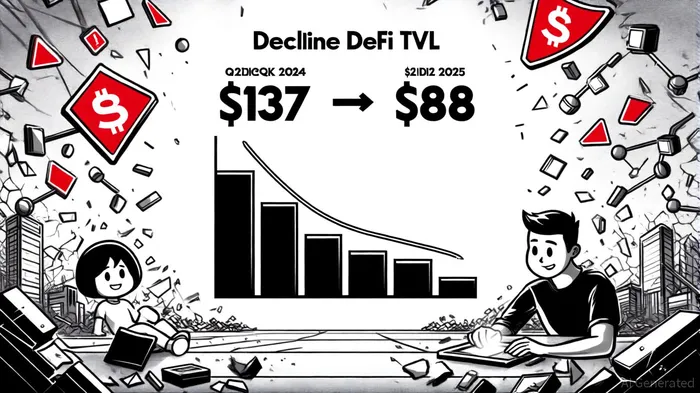





Comentarios
Aún no hay comentarios