
Defensive Income Strategies in Turbulent Times: The Case of FTHI and Macroeconomic Resilience
In an era of unpredictable macroeconomic shifts, defensive income strategies have emerged as a cornerstone for portfolio resilience. The First Trust BuyWrite Income ETF (FTHI) exemplifies this approach, blending equity exposure with options-based income generation to navigate market volatility. By analyzing FTHI's structure and performance during historical downturns-specifically the 2008 financial crisis and the 2022 market correction-investors can gain critical insights into how such strategies balance yield preservation with downside protection.
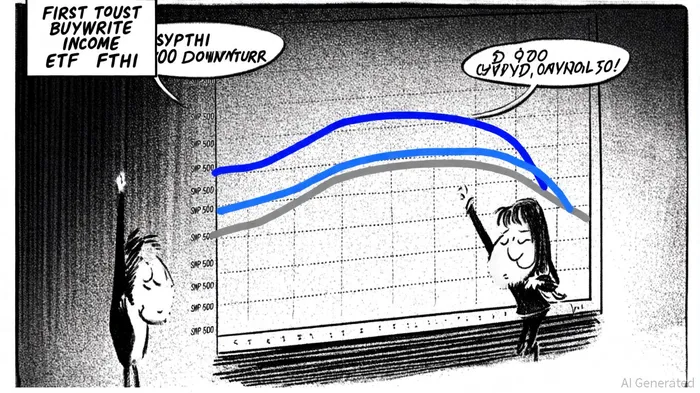
The Mechanics of FTHI: A Dual-Pronged Approach
FTHI operates through an actively managed buy-write strategy, holding a diversified portfolio of dividend-paying U.S. large-cap stocks while systematically selling out-of-the-money call options on the S&P 500 Index, according to the FTHI profile. This dual approach generates income from two sources: dividends from equity holdings and premium income from option sales. As of October 2025, FTHI's top 10 holdings, including technology giants like NVIDIANVDA-- and AppleAAPL--, account for 37.41% of its portfolio, with the sector concentrated at 32.2% in technology, per the FTHI profile. The fund's 0.76% expense ratio reflects its active management, while its 8.63% dividend yield underscores its income-focused mandate, also per the FTHI profile.
The strategy's defensive edge lies in its ability to mitigate downside risk. By selling call options, FTHI collects premiums that offset potential losses during market declines. However, this comes at the cost of capping gains during equity rallies-a trade-off that aligns with its income-generation objective, as described in the FTHI profile.
Performance During the 2008 Financial Crisis: A Test of Resilience
The 2008 financial crisis, marked by a 57% peak-to-trough decline in the S&P 500 during the 2007–2009 bear market, serves as a critical stress test for defensive strategies. While FTHI's exact total return during this period is not explicitly documented in available sources, as noted in a Money StackExchange discussion, its structural design suggests superior resilience compared to the broader market. By collecting premiums from call options, FTHI likely softened the blow of the S&P 500's collapse, offering investors a buffer against the index's 57% loss during the 2007–2009 bear market. Historical comparisons of similar buy-write strategies during the crisis indicate that such funds often underperformed in bear markets but outperformed during recoveries, as shown in ETFvest charts. This duality highlights FTHI's role as a stabilizer in volatile environments.
Navigating the 2022 Downturn: A Modern Benchmark
The 2022 market correction, driven by inflation and rising interest rates, saw the S&P 500 fall 19.4% during the 2022 stock market decline. In contrast, FTHI delivered a total return of 3.51% for the year, significantly outperforming the index, according to FinanceCharts. By generating income through option premiums, FTHI not only offset equity losses but also provided positive returns when the S&P 500 struggled, as reported by FinanceCharts. This performance aligns with its long-term average annual return of 7.50% since inception in 2014, per the FTHI profile, reinforcing its appeal for income-focused investors seeking macroeconomic resilience.
The Trade-Off: Income vs. Growth
While FTHI's defensive characteristics are compelling, its strategy inherently limits capital appreciation. During bull markets, the fund's call-writing activity caps gains, as seen in its long-term average return of 7.50% compared to the S&P 500's higher growth potential, according to the FTHI profile. Investors must weigh this trade-off against their risk tolerance and income needs. For those prioritizing consistent cash flow over aggressive growth, FTHI's structure offers a compelling solution.
Conclusion: A Strategic Tool for Uncertain Times
FTHI's performance during the 2008 and 2022 downturns validates its role as a defensive income vehicle. By combining equity exposure with options-based income, it provides a hedge against market volatility while maintaining a steady yield. However, its effectiveness is contingent on market conditions, and investors should consider it as part of a diversified portfolio. As macroeconomic uncertainties persist, strategies like FTHI's will remain vital for balancing resilience with income generation.







Comentarios
Aún no hay comentarios