
Defensive ETF Positioning in 2025: Strategic Asset Allocation for Downside Protection
In 2025, global markets have been roiled by a toxic mix of trade policy uncertainty, stubborn inflation, and geopolitical tensions. Tariff threats-most notably the Trump administration's 200% levy on European alcohol and retaliatory measures-have sent shockwaves through equity markets, while the VIX "fear index" nearly doubled in early 2025, pushing the S&P 500 down 10% from its peak [1]. Against this backdrop, defensive ETFs have emerged as critical tools for strategic asset allocation, offering downside protection without entirely sacrificing upside potential.
The Rise of Defensive Sectors: Utilities Outperform Healthcare and Consumer Staples
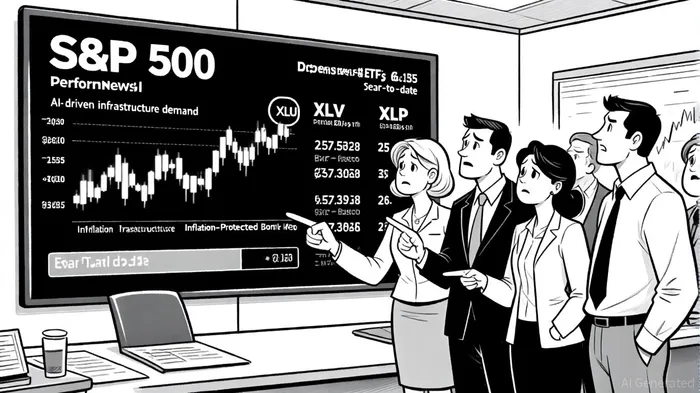
Defensive ETFs focused on utilities, healthcare, and consumer staples have shown divergent performance. The Utilities Select Sector SPDR Fund (XLU) has surged 30.76% year-to-date, driven by surging demand for infrastructure tied to AI and global electrification [5]. This outperformance contrasts sharply with the Health Care Select Sector SPDR Fund (XLV), which delivered a modest 6.77% return, and the Consumer Staples Select Sector SPDR Fund (XLP), which posted a -0.73% total return [3].
The utilities sector's strength stems from its inelastic demand and alignment with macro trends. As noted by ProsperUs, utilities are uniquely positioned to benefit from AI-driven electricity needs and supportive policy environments [5]. Meanwhile, healthcare's underperformance reflects market volatility and a lack of near-term growth catalysts, despite its inherent defensiveness [1].
Strategic Allocation: Balancing Low-Beta Equities and Inflation-Protected Bonds
To navigate this environment, investors are increasingly adopting multi-asset defensive strategies. A key framework, the "Cockroach Portfolio," allocates 60% to equities (20% each in XLV, XLUXLU--, and XLP), 20% to U.S. Treasury bonds (via GOVT), and 20% to gold (GLDM) [4]. This approach leverages low-beta equities for stability, bonds for diversification, and gold as a rare hedge against simultaneous equity-bond downturns.
Bond ETFs like the Vanguard Short-term Inflation-Protected Securities ETF (VTIP) have also gained traction, offering protection against inflation while minimizing interest-rate risk [2]. For those seeking more structured downside protection, defined-outcome ETFs-such as the Innovator Nasdaq-100 Managed Floor ETF (QFLR)-use options overlays to cap losses, though they sacrifice upside potential [5].
Downside Protection: Trade-Offs and Expert Recommendations
While defensive ETFs mitigate risk, they often come with trade-offs. For instance, 100% downside protection ETFs, which use put options to floor losses, typically cap gains at 0% to a modest range [5]. Similarly, buffer ETFs like Goldman Sachs' offerings protect against 5% to 15% declines but reset quarterly, requiring active management [4].
Experts like LPL Research advocate for a diversified approach, emphasizing short-duration TIPS, commodities, and managed futures to hedge against inflation and volatility [4]. BlackRock's 2025 Spring Investment Directions further recommend alternative assets like infrastructure and gold to reduce correlation risk [1].
Conclusion: Navigating Uncertainty with Discipline
As 2025 unfolds, the interplay of tariffs, inflation, and geopolitical risks ensures volatility will remain a constant. Defensive ETFs-particularly those targeting utilities, inflation-linked bonds, and low-volatility equities-offer a roadmap for preserving capital while maintaining exposure to growth. However, investors must weigh the trade-offs between downside protection and upside potential, tailoring allocations to their risk tolerance and time horizon. In this environment, strategic asset allocation isn't just prudent-it's essential.





Comentarios
Aún no hay comentarios