
Defensive Dividend Investing in a Low-Growth World: Essential Utilities, Verizon, and WesBanco
In an economic landscape marked by inflationary pressures, geopolitical uncertainty, and sluggish growth, income-focused investors are increasingly turning to defensive equities that offer reliable dividends and robust balance sheets. Three names-Essential Utilities (WTRG), Verizon (VZ), and WesBanco (WSBC)-stand out as compelling candidates for such portfolios. Their combination of regulated cash flows, disciplined capital structures, and consistent payout histories positions them as resilient options for investors seeking yield in volatile markets.
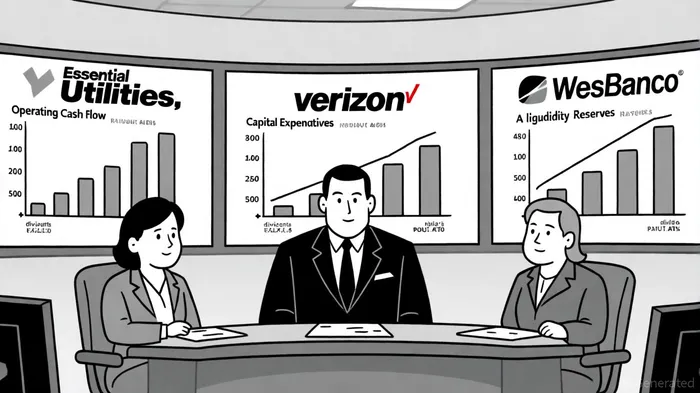
Essential Utilities: Utility Stability in a High-Debt Framework
Essential Utilities, a water and natural gas infrastructure provider, exemplifies the defensive qualities of regulated utilities. For the first half of 2025, the company reported a 34% year-over-year increase in operating cash flow to $572 million, driven by colder-than-expected winter weather and regulatory rate hikes, according to a Panabee report. However, capital expenditures (capex) surged 12% to $613 million, resulting in negative operating free cash flow of -$20 million for the period, the Panabee analysis noted.
Despite this, Essential Utilities maintains a quarterly dividend payout ratio of 86% of earnings, with a recent $0.3255 per share payout. The dividend is not currently covered by organic cash flow after capex, necessitating external financing. In H1 2025, the company raised $209 million via at-the-market equity sales and $567 million through its commercial paper program, per the Panabee analysis. While this reliance on capital markets introduces risk, Essential Utilities' $1 billion unsecured credit facility (with $420 million available) and compliance with all restrictive covenants provide a buffer. For income investors, the key takeaway is that the company's regulated cash flows and access to liquidity make its dividend sustainable, albeit with a degree of financial engineering.
Verizon: High-Capex Growth vs. Dividend Sustainability
Verizon, a telecom giant, faces the dual challenge of funding massive 5G infrastructure investments while maintaining its status as a dividend aristocrat. In Q2 2025, the company reported $16.76 billion in operating cash flow for the first half of the year, a 1.1% increase, according to a Panabee analysis. However, its 178.3% operating free cash flow payout ratio-driven by $17.5–$18.5 billion in annual capex-reveals a critical vulnerability: the dividend is not fully covered by cash flow after reinvestment.
That said, Verizon's $3.4 billion in cash and equivalents and a $12 billion undrawn credit facility offer a strong liquidity cushion. The company also raised its full-year free cash flow guidance to $19.5–$20.5 billion, reflecting confidence in its ability to balance growth and shareholder returns, according to the Verizon Q2 slides. With a 6.5% dividend yield and a 63.17% earnings-based payout ratio, Verizon's dividend appears sustainable in the near term, provided capex does not spiral further. For defensive investors, the telecom's pricing power in essential services and its ability to leverage economies of scale in 5G deployment justify its inclusion in low-growth portfolios.
WesBanco: Conservative Banking with Capital Fortification
Regional banks like WesBancoWSBC-- face unique challenges in a rising-rate environment, but the company's conservative balance sheet and disciplined capital return strategy make it a standout. In H1 2025, WesBanco reported a 40% earnings payout ratio, with $0.45 per share in dividends against $1.12 in diluted EPS, according to a WesBanco press release. This contrasts with a cash flow-based payout ratio of 88.62%, highlighting the importance of methodology in assessing sustainability.
The company's $1.5 billion in net cash (including $626 million in cash and $886 million in marketable securities) and zero parent company debt provide a formidable safety net. Additionally, WesBanco returned $57 million to shareholders via share repurchases in H1 2025, retiring 1.1 million shares. While its 4.63% dividend yield is attractive, the low Dividend Growth Potential Score (DGPS) suggests limited upside for future hikes, as noted in the Panabee analysis of Verizon's cash-flow dynamics. Nonetheless, WesBanco's conservative approach and strong liquidity make it a reliable income play in a low-growth environment.
Conclusion: Balancing Risk and Reward in Defensive Portfolios
For income-focused investors, the key to navigating a low-growth economy lies in identifying companies that combine stable cash flows, disciplined capital allocation, and financial flexibility. Essential Utilities, VerizonVZ--, and WesBanco each offer unique advantages:
- Essential Utilities leverages regulated infrastructure and access to capital markets to sustain its high-yield dividend.
- Verizon balances aggressive reinvestment in 5G with robust liquidity, ensuring its aristocrat status remains intact.
- WesBanco prioritizes capital preservation and conservative payout ratios, making it a safe harbor for bank investors.
While each company carries risks-Essential Utilities' reliance on external financing, Verizon's capex-driven payout ratio, and WesBanco's limited growth potential-their collective strengths underscore their appeal in defensive portfolios. As volatility persists, these names offer a blend of yield reliability and financial resilience that aligns with the priorities of income-focused investors.





Comentarios
Aún no hay comentarios