
Defense Technology Innovation and Energy Autonomy: Strategic Investment in U.S. Military Modernization
The U.S. military's push for energy autonomy and modernization in 2025 has catalyzed a surge in defense technology innovation, creating a fertile ground for strategic investment. As global security dynamics evolve, the Department of Defense (DoD) is prioritizing clean energy solutions, AI-driven autonomy, and advanced manufacturing to maintain battlefield dominance. This shift has positioned a new generation of defense tech companies at the forefront of national security, offering investors opportunities to align with both geopolitical imperatives and technological disruption.
Energy Autonomy: Powering the Modern Battlefield
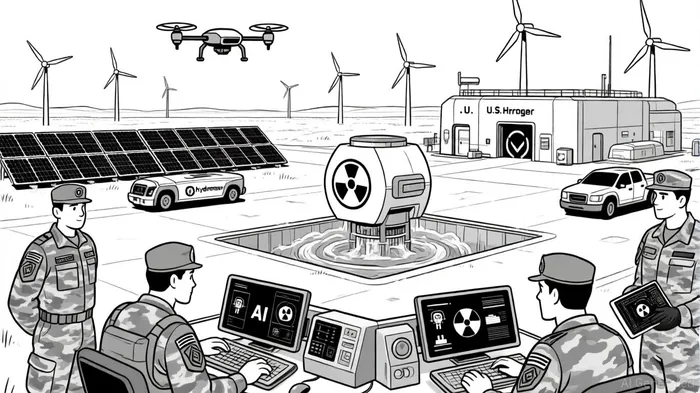
Energy resilience is no longer a secondary concern but a core component of military strategy. The DoD's recent expansion of geothermal energy initiatives, including partnerships with firms like Eavor and Fervo Energy, underscores its commitment to decentralized, grid-independent power sources [1]. For instance, Fervo Energy's Enhanced Geothermal System at Naval Air Station Fallon, Nevada, and GreenFire Energy's geothermal modeling for Marine Corps bases highlight the military's focus on utility-scale, zero-emission energy solutions [2].
Meanwhile, startups like Radiant Nuclear are revolutionizing portable power with microreactors designed for remote bases, offering a clean alternative to diesel generators [3]. These innovations align with the Army's 2025 modernization priorities, which emphasize reducing fuel logistics vulnerabilities and enhancing operational endurance [4]. Similarly, Mach Industries is advancing hydrogen-powered platforms, including unmanned aerial vehicles (UAVs) and hydrogen generation systems, to decarbonize military operations while extending mission ranges [3].
AI and Autonomous Systems: The New Frontline
Artificial intelligence (AI) and autonomy are reshaping defense capabilities, with the DoD awarding up to $200 million in contracts to firms like OpenAI, Anthropic, and Google to develop agentic AI workflows for intelligence, logistics, and combat operations [5]. Anduril Industries, a leader in AI-driven defense systems, has secured a $2.5 billion Series G funding round, propelling its valuation to $30.5 billion and enabling the development of hypersonic propulsion systems and counter-drone technologies [6].
Strategic partnerships are amplifying these efforts. Anduril's collaboration with Palantir Technologies to merge their AI platforms-Lattice and Menace with Palantir's AI Platform (AIP)-aims to streamline data readiness and secure AI deployment across the Pentagon's Replicator initiative [7]. Similarly, Shield AI is integrating its autonomous aerial systems with Palantir's Warp Speed architecture, enhancing mission planning for the Army's Tactical Intelligence Targeting Access Node (TITAN) program [8]. These alliances reflect a broader trend of software-defined defense solutions, where agility and interoperability trump traditional hardware-centric approaches.
Strategic Partnerships and Funding Momentum
The defense tech sector's rapid growth is fueled by venture capital and government contracts. In 2025, Epirus raised $250 million for its high-power microwave (HPM) weapons, while Spear AI secured funding to develop AI tools for submarine acoustic analysis [9]. Hadrian, a startup constructing robotic factories for defense manufacturing, raised $260 million to scale domestic production of critical components [9].
Traditional defense giants are also adapting. Lockheed Martin and Northrop Grumman continue to dominate missile defense and space-based systems, but they are increasingly collaborating with startups. For example, Kratos Defense partnered with Shield AI on AI-piloted planes, and Boeing is working with Shield AI on carrier-launched drones [10]. These collaborations highlight the Pentagon's push to blend legacy expertise with agile, commercial-grade technologies.
DoD Strategic Priorities: Aligning Investment with National Security
The 2025 Future Years Defense Program (FYDP) projects a $850 billion budget, with a 1.1% reduction from previous estimates but a 11% increase by 2039, driven by operation and support costs [11]. Modernization efforts are concentrated on air and missile defense, long-range precision fires, and tactical autonomy. The Army's cancellation of legacy systems like the Stryker Combat Vehicle and its pivot to the XM30 Mechanized Infantry Combat Vehicle reflect a focus on speed and adaptability [12].
Energy autonomy is implicitly embedded in these priorities. The Army's $11.8 billion air and missile defense budget includes funding for geothermal and hydrogen projects, while the DoD's geothermal initiative aims to reduce reliance on fossil fuels at 50 military installations [13]. Investors should note that companies addressing both energy resilience and AI-driven autonomy-such as NanoGraf (extreme-condition batteries) and TerraPower (nuclear energy)-are well-positioned to benefit from cross-sector demand [3].
Conclusion: A Dual-Track Investment Opportunity
The convergence of energy autonomy and AI-driven modernization presents a dual-track investment opportunity. Startups pioneering clean energy solutions and autonomous systems are not only securing government contracts but also redefining the defense industrial base. Meanwhile, traditional defense firms are leveraging partnerships to stay competitive in a rapidly evolving landscape. For investors, the key lies in identifying companies that align with the DoD's 2025 priorities-those that bridge energy resilience, AI, and operational agility-while navigating the risks of regulatory shifts and technological obsolescence.
As the Pentagon accelerates its adoption of commercial technologies, the defense sector is becoming a proving ground for innovation. The firms that thrive will be those that can scale quickly, adapt to agile procurement models, and deliver solutions that meet the dual demands of energy independence and strategic deterrence.





Comentarios
Aún no hay comentarios