
Defense Tech Convergence and 5G: Strategic Partnerships Power Next-Generation Military Communications
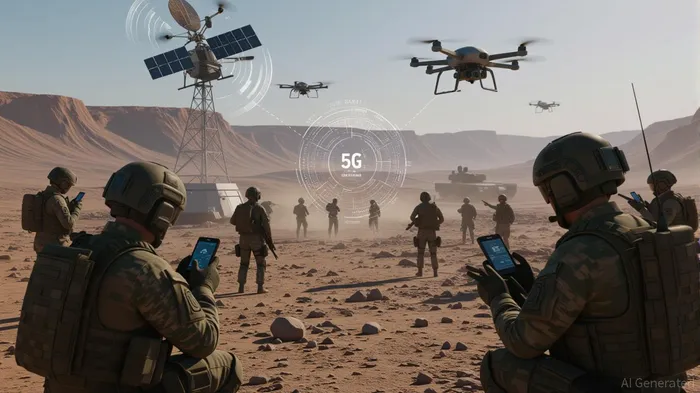
The convergence of defense technology and 5G is reshaping military communications, driven by strategic partnerships that prioritize secure, high-speed connectivity for modern warfare. As adversaries increasingly exploit digital vulnerabilities, the U.S. and its allies are accelerating investments in 5G to enable real-time intelligence sharing, autonomous systems, and resilient command-and-control networks. This shift is not merely technological but geopolitical, as nations race to dominate the next frontier of military innovation.
The Strategic Imperative of 5G in Defense
The 5G in defense market has surged from $0.36 billion in 2024 to $0.61 billion in 2025, with projections of $5.2 billion by 2029 at a compound annual growth rate (CAGR) of 70.9%[1]. This exponential growth reflects the critical role of 5G in enabling capabilities such as ultra-reliable low-latency communications (URLLC), network slicing for mission-critical applications, and integration with satellite-based non-terrestrial networks (NTN) for global coverage[4].
Lockheed Martin, a leader in this space, has developed 5G.MIL, a hybrid base station that combines commercial 5G with military-grade security. Partnering with VerizonVZ-- and NokiaMSFT--, the company has integrated advanced network management and tactical gateway capabilities, enabling seamless data transmission across air, land, and sea operations[3]. Similarly, EricssonERIC-- and QualcommQCOM-- are advancing 5G infrastructure for secure military applications, while Nokia's collaboration with KONGSBERG and blackned is streamlining deployable 5G networks for European defense forces[2].
Key Partnerships and Technical Innovations
Strategic alliances are addressing the unique demands of military communications. For instance:
- Nokia and KONGSBERG are simplifying 5G deployment for tactical systems, enhancing battlefield interoperability[1].
- IS-Wireless in Poland is building “sovereign” 5G networks free from foreign components, selected for NATO and EU innovation programs[4].
- The U.S. Air Force's Global Strike Command is procuring transportable 5G networks (T Node) to ensure connectivity for 5G-compatible devices[6].
Technologically, these partnerships focus on overcoming challenges like data interception, legacy system interoperability, and supply chain risks. Innovations include AI-powered cybersecurity perimeters, edge computing for real-time analytics, and satellite-integrated solutions to extend 5G coverage in austere environments[5]. The EU's 5G-MILNET project, for example, is developing portable, battery-powered 5G base stations with AI-driven security to outperform Wi-Fi in battlefield scenarios[1].
Funding and Geopolitical Drivers
Government investments are fueling this transformation. The U.S. has prioritized domestic 5G leadership through spectrum studies, R&D funding, and initiatives like “Rip and Replace,” which removes Chinese infrastructure from defense networks[5]. Meanwhile, tariffs and trade tensions have disrupted supply chains, forcing suppliers to re-evaluate manufacturing strategies and prioritize resilience[2].
The operational impact is profound. 5G-enabled drones, for instance, are revolutionizing intelligence, surveillance, and reconnaissance (ISR) by relaying real-time data to command centers[3]. Similarly, private 5G networks are becoming foundational for secure, mission-critical operations, with Lockheed Martin's TacSat demonstrator showcasing cross-domain satellite communications[3].
Investment Implications
For investors, the 5G defense sector offers high-growth potential but requires careful navigation of geopolitical and technical risks. Key opportunities lie in:
1. Defense contractors with 5G integration expertise (e.g., Lockheed MartinLMT--, Raytheon).
2. Telecom providers like Nokia and Ericsson, which are adapting commercial 5G for military use.
3. Specialized firms addressing niche needs, such as IS-Wireless's sovereign networks or Globalstar's satellite-enabled solutions[4].
However, challenges persist. Supply chain vulnerabilities, regulatory hurdles, and the high cost of R&D could slow adoption. Success will depend on sustained government funding and the ability of partners to balance innovation with security.
Conclusion
The fusion of 5G and defense technology is not a passing trend but a strategic necessity. As adversaries modernize their arsenals, secure, high-speed communication networks will determine battlefield outcomes—and shape the future of global power dynamics. For investors, the key is to identify firms at the intersection of cutting-edge connectivity and geopolitical demand, where strategic partnerships are turning 5G from a commercial tool into a force multiplier for national security.







Comentarios
Aún no hay comentarios