
U.S. Defense Sector Sees Surge in Opportunities Amid Trump's Ukraine Arms Deals
The U.S. defense sector is undergoing a seismic shift as President Trump's recent arms deals with Ukraine catalyze a surge in global defense spending. With geopolitical tensions intensifying and NATO allies stepping up financial commitments, defense contractors are poised to capitalize on a multi-billion-dollar boom. For investors, this represents a critical inflection point in a sector long driven by strategic volatility.
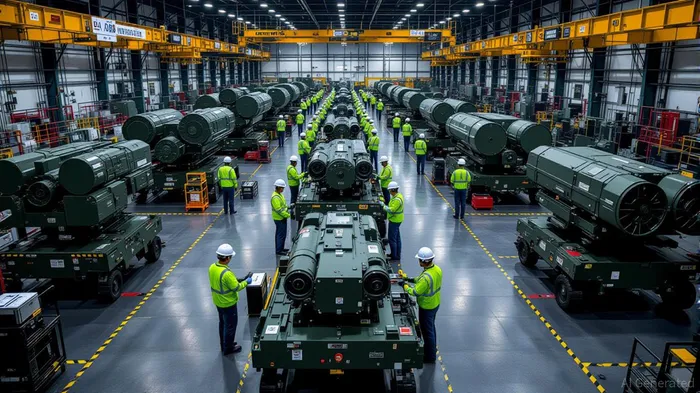
Geopolitical Catalysts and Sector-Wide Momentum
Trump's July 2025 NATO-backed deal—where European allies finance U.S.-manufactured weapons for Ukraine—has reshaped the defense landscape. By offloading financial burdens to Europe while leveraging U.S. industrial capacity, the administration has accelerated arms shipments, including 17 Patriot missile batteries, precision-guided rockets, and Javelin anti-tank systems. This shift not only stabilizes Ukraine's frontlines but also injects urgency into the production pipelines of key defense firms.
The war in Ukraine has become a proving ground for next-generation systems. Patriot batteries, for instance, have demonstrated their efficacy against Russian drones and hypersonic missiles, while Javelin systems have proven devastatingly effective in urban and open-field combat. These real-world validations are pushing allies to modernize their arsenals, creating a ripple effect of demand across the sector.
Lockheed Martin: The Hypersonic and Missile Defense Titan
Lockheed Martin (LMT) is at the forefront of this defense renaissance. As the prime contractor for the PAC-3 Missile Segment Enhancement (MSE) variant of the Patriot system, the company is ramping up production to 650 units annually by 2027—a 30% increase from 2024. The U.S. Army's decision to quadruple its PAC-3 MSE stockpile to 13,773 units by 2026 has further solidified Lockheed's role in the global missile defense ecosystem.
Beyond Patriot systems, Lockheed's Conventional Prompt Strike (CPS) hypersonic missile program is gaining traction. With adversaries like Russia and China advancing hypersonic technology, the U.S. military's push for counter-hypersonic capabilities positions LockheedLMT-- to benefit from a multi-decade growth trajectory.
Raytheon Technologies: Dominating the Patriot Pipeline
Raytheon Technologies (RTX) holds a near-monopoly on Patriot system production, a critical asset in the current climate. The company's 2025 revenue surged 17.15% year-over-year, driven by a $946 million contract to supply Romania and a $68 billion backlog for Patriot systems. Raytheon's 27.37% net profit margin underscores its profitability, while its 29.64% stock price increase since July 2025 reflects investor confidence in its strategic positioning.
The company's hypersonic initiatives, including the Hypersonic Attack Cruise Missile (HACM), further diversify its growth prospects. As NATO allies like Japan and Norway expand their missile arsenals, Raytheon's expertise in both traditional and next-gen defense systems will likely drive sustained demand.
L3Harris Technologies: The Invisible Infrastructure Player
While less visible than its peers, L3HarrisLHX-- Technologies (LHX) plays a pivotal role in supporting the Patriot ecosystem. The company's $28.4 million Commercial Broadband Satellite Program (CBSP) contract ensures seamless communication for Patriot batteries, while its production of Medium-Range Ballistic Missile (MRBM) test targets validates system performance. L3Harris' recent 8% revenue growth and $5.29 billion quarterly sales highlight its resilience in a sector increasingly driven by infrastructure and testing needs.
The firm's expansion of its Fort Wayne, Indiana facility to produce 48 defense payloads annually—including components for the Hypersonic and Boost-Tracking Space Sensor (HBTSS) program—positions it to benefit from Pentagon's $70 billion precision munition pipeline.
Investment Implications and Strategic Risks
For investors, the defense sector's current momentum is underpinned by two key trends: geopolitical-driven demand and technological modernization. The Ukraine conflict has accelerated the procurement of systems like Patriot and Javelin, while the Pentagon's focus on hypersonic defense ensures long-term growth.
However, risks remain. Congressional delays in approving large contracts, potential Russian pushback against U.S. aid, and budget constraints due to rising deficits could temper gains. Diversification through defense ETFs like the iShares U.S. Aerospace & Defense ETF (ITA) offers a safer bet for risk-averse investors.
Conclusion: A Sector Poised for Resilience
Trump's Ukraine arms deals have ignited a firestorm of activity in the U.S. defense sector. With Lockheed MartinLMT--, Raytheon, and L3Harris at the helm, the industry is well-positioned to capitalize on a confluence of geopolitical and technological forces. For investors, the message is clear: the defense sector is transitioning from a cyclical play to a structural growth engine in an era of persistent global instability.
In the end, the war in Ukraine isn't just a test of military will—it's a catalyst for a new era of defense innovation, and the companies leading this charge are set to deliver outsized returns for those who recognize the opportunity early.





Comentarios
Aún no hay comentarios