
Defense Sector Resilience and Innovation: Strategic Equity Exposure to High-Impact Technological Responders
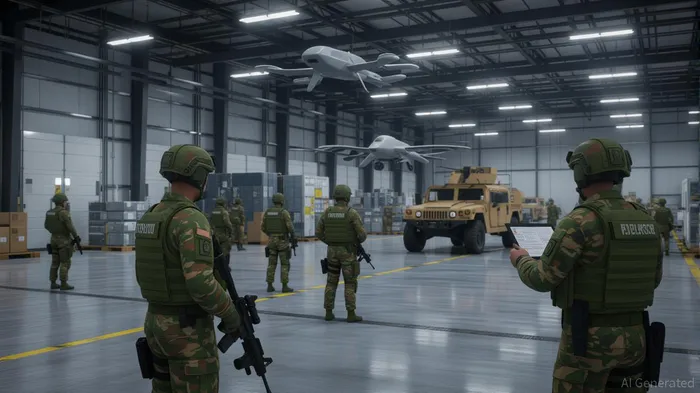
The defense sector has long been a cornerstone of economic resilience, but in 2025, it is evolving into a dynamic engine of innovation. With global tensions intensifying and U.S. defense spending projected to grow by 5.5%, companies like Austability Group are redefining how governments and allies address security challenges. For investors, this presents a unique opportunity: strategic equity exposure to high-impact, government-backed technological responders.
The Austability Model: A Case Study in Resilience
Austability Group, a privately held defense contractor, has emerged as a critical player in the U.S. and allied defense ecosystems. Its recent $273 million contract for the second Heritage-class Offshore Patrol Cutter (OPC) under the U.S. Coast Guard's $3.3 billion fleet modernization program underscores its role in infrastructure and logistics. Beyond shipbuilding, Austability's subsidiary, Austability Pty Ltd, has secured a $5 billion annual contract under the Navy's SeaPort-NxG vehicle, delivering engineering and program management services in high-stakes environments like Tinian, Niger, and Guam.
What sets Austability apart is its alignment with U.S. strategic priorities. The Department of Defense's focus on the Indo-Pacific—evidenced by $530 million allocated to OPC procurement in FY2025—has created a tailwind for companies with a regional footprint. Austability's 40+ active sites in Guam and partnerships with FluorFLR-- and Amentum in Europe and Eastern Europe position it to capitalize on this shift.
Equity Exposure: Navigating the Defense ETF Landscape
While Austability itself is not publicly traded, investors can gain exposure to its peer group through defense-focused ETFs. These vehicles aggregate exposure to companies driving innovation in aerospace, cybersecurity, and space technology—sectors where Austability's operations intersect.
- iShares U.S. Aerospace & Defense ETF (ITA)
- Key Holdings: GE AerospaceGE--, BoeingBA--, Lockheed MartinLMT--
- Why It Matters: ITA offers broad exposure to prime contractors and suppliers, including firms involved in naval and Coast Guard modernization. Its low expense ratio (0.38%) and $9.16 billion in assets make it a stable choice for long-term investors.
ARK Space Exploration & Innovation ETF (ARKX)
- Key Holdings: Rocket LabRKLB--, Kratos Defense, AeroVironmentAVAV--
- Why It Matters: ARKX targets emerging technologies like satellite communications and autonomous systems—areas where Austability's partners (e.g., Fluor) are expanding. While volatile, its 26.7% gain in 2024 highlights growth potential.
Global X Defense Tech ETF (SHLD)
- Key Holdings: PalantirPLTR-- Technologies, Leonardo, Rheinmetall
- Why It Matters: SHLD's focus on pure-play defense tech and cybersecurity aligns with Austability's mission-critical support services. Its 20.1% net asset value gain in 2025 reflects strong demand for innovation.
Strategic Considerations for Investors
- Diversification vs. Concentration: ETFs like ITA provide broad stability, while ARKX and SHLD offer concentrated exposure to high-growth niches. A balanced portfolio might allocate 60% to ITA and 40% to ARKX/SHLD.
- Geopolitical Tailwinds: The U.S. DoD's emphasis on Indo-Pacific readiness and cost-cutting measures (e.g., streamlined procurement) will likely favor companies like Austability with scalable, modular solutions.
- Risk Mitigation: Leveraged ETFs (e.g., DFEN) should be used cautiously, as their 3X daily return structure amplifies volatility.
The Road Ahead: Innovation as a Strategic Imperative
Austability's success hinges on its ability to adapt to evolving threats, from hybrid warfare to climate-driven infrastructure challenges. Its recent $14.2 billion order book and investments in hybrid electric drive systems and Arctic-capable designs position it to outpace competitors. For investors, the key is to align with ETFs that mirror this innovation-driven trajectory.
Conclusion: Building a Resilient Defense Portfolio
The defense sector's resilience in 2025 is not just about geopolitical necessity—it's about technological leapfrogging. Companies like Austability Group are at the forefront, but their private status means investors must look to ETFs for indirect exposure. By prioritizing funds that blend traditional defense primes with cutting-edge innovators, investors can hedge against macroeconomic risks while capitalizing on the sector's growth. As the U.S. and allies double down on readiness and modernization, the defense sector remains a compelling arena for strategic equity exposure.





Comentarios
Aún no hay comentarios