
U.S. Defense Sector Growth: A Long-Term Investment Play in Prime Contractors Driving Modernization
The U.S. defense sector is entering a pivotal phase of sustained growth, driven by multi-year modernization programs and strategic priorities outlined in the 2022 National Defense Strategy. With the FY2025 defense budget totaling $849.8 billion—aligned with the Fiscal Responsibility Act (FRA) of 2023—Congress and the Department of Defense (DoD) have prioritized readiness, technological innovation, and deterrence across air, sea, and cyberCYBER-- domains, as detailed in a MilitarySpot breakdown. For long-term investors, this spending spree creates a clear runway for prime defense contractors, whose portfolios are deeply intertwined with these modernization efforts.
Naval Modernization: A $48.1 Billion Opportunity
The U.S. Navy's fleet modernization is a cornerstone of the FY2025 budget, with $48.1 billion allocated for shipbuilding and sea power initiatives. General DynamicsGD-- Electric Boat (GDEB) remains the linchpin of this effort, securing a $5.1 billion contract in 2022 to advance the Columbia-class submarine program—a $100 billion, 12-boat initiative over three decades, according to Naval News. Leonardo DRSDRS--, a key subcontractor, has been awarded over $3 billion to supply propulsion systems for these submarines, while General Dynamics Mission Systems recently secured a $13.1 million contract for spare parts, according to ClearanceJobs.
Beyond submarines, the Navy is expanding its fleet of Virginia-class submarines and T-AO 205 fleet replenishment ships. HII, the sole builder of U.S. Navy aircraft carriers, has a $9.6 billion contract for amphibious ships and $913 million for Virginia-class support, as listed in ClearanceJobs' Q1 list. These programs, combined with a $6.75 billion contract for General Dynamics to build T-AO 205 ships, underscore the sector's resilience to inflationary pressures and geopolitical risks.
Airpower and Nuclear Deterrence: Lockheed MartinLMT-- and RTXRTX-- Lead the Charge
Airpower modernization received $61.2 billion in FY2025, with Lockheed Martin dominating the landscape. The company's $4.94 billion contract for precision strike missiles in Q1 2025 builds on its $3.23 billion joint air-to-surface standoff missile deal and $3.3 billion Trident II D5 missile production contract, as noted by ExecutiveBiz. Its acquisition of Terran Orbital further cements its role in space-based deterrence, a growing frontier for defense.
Raytheon Technologies (RTX) is equally pivotal, with $1.94 billion for next-generation missile interceptors and $2.1 billion for the Lower Tier Air and Missile Defense System, according to U.S. Funds. The company's $1.2 billion AMRAAM missile contract highlights its dominance in air-to-air combat systems. Meanwhile, Boeing's $6.9 billion small diameter bomb contract and $7.48 billion Joint Direct Attack Munitions deal position it as a critical player in airpower modernization, as listed in ClearanceJobs' Q1 list.
Nuclear modernization, funded at $49.2 billion, is another growth driver. Lockheed Martin's B-21 bomber program and Northrop Grumman's $2 billion Foreign Military Sales (FMS) for AARGM-ERs illustrate the sector's focus on maintaining a credible nuclear triad, according to a CBO analysis.
Cyber and Missile Defense: A $42.9 Billion Frontier
Cybersecurity and missile defense programs, collectively allocated $42.9 billion in FY2025, are reshaping the defense landscape. L3Harris Technologies, with a $587 million contract for Navy electronic warfare systems and a $281 million FMS deal with Germany, is capitalizing on this shift, according to Forecast International. Similarly, Northrop Grumman's $197.5 million bomb tactical fuse contract and Leonardo DRS's propulsion expertise highlight the sector's diversification into hybrid threats.
Long-Term Investment Thesis: Sustained Funding and Strategic Expansion
While the FY2025 budget represents a 1.7% real-term decline compared to 2024, according to MilitarySpot, the Future Years Defense Program (FYDP) projects a gradual increase to $866 billion by 2029. This trajectory, coupled with international contracts (e.g., General Electric's $5 billion F110 engine deal with Saudi Arabia), ensures long-term revenue visibility for primes. Investors should prioritize firms with diversified portfolios across naval, air, and cyber domains, as well as those with FMS capabilities to offset domestic budget volatility.
Conclusion
The U.S. defense sector's modernization push is not a short-term spike but a multi-decade transformation. Prime contractors like Lockheed Martin, General Dynamics, and RTX are not only beneficiaries of current spending but also architects of future capabilities. For investors seeking durable growth, these firms offer a compelling blend of geopolitical tailwinds, technological leadership, and fiscal discipline.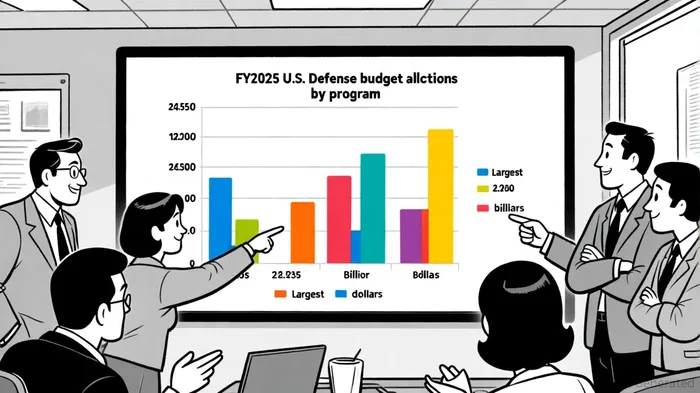







Comentarios
Aún no hay comentarios