
U.S. Defense Sector Funding Trends: Navigating Geopolitical Shifts and Technological Innovation
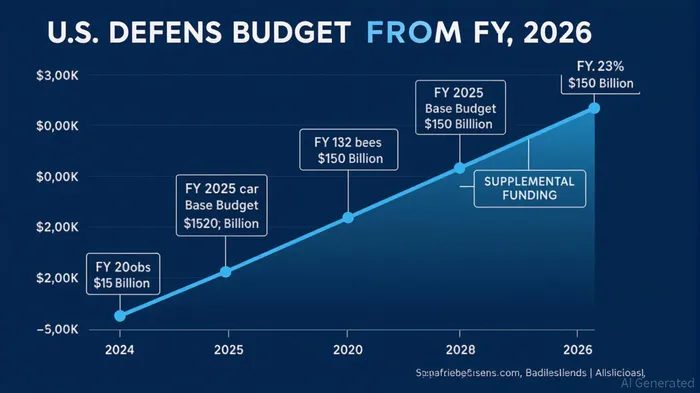
The U.S. defense sector is undergoing a transformative phase, driven by a confluence of geopolitical volatility, technological innovation, and legislative priorities. As of 2025, the Department of Defense (DoD) operates under a $852.2 billion base budget for Fiscal Year (FY) 2025, a 3.3% increase from FY 2024, with supplemental funding and long-term modernization plans pushing total expenditures toward $1,042.6 billion by FY 2026 [2]. This trajectory reflects a strategic pivot toward multi-domain deterrence, artificial intelligence (AI), and industrial base resilience, while short-term fiscal constraints and legislative delays underscore the sector's complexity.
Short-Term Spending: Legislative Uncertainty and Geopolitical Urgency
The FY 2025 defense budget remains partially funded under a continuing resolution (CR), with Congress yet to finalize full-year appropriations. This uncertainty risks a government shutdown if a resolution is not passed by March 14, 2025, or triggers sequestration if full-year funding is delayed beyond April 30 [1]. Meanwhile, the National Defense Authorization Act (NDAA) for FY 2025 authorized a $895 billion budget, aligning with the Fiscal Responsibility Act's spending caps [2]. This bipartisan agreement prioritizes nuclear modernization and AI safeguards but sidesteps contentious issues like Pentagon audits or draft registration expansion [2].
Geopolitical tensions are amplifying the urgency for rapid spending. The Russia-Ukraine war and China's military expansion in the Indo-Pacific have accelerated demand for advanced capabilities, including hypersonic systems and cyber defenses [2]. According to a report by the Center for Strategic and International Studies (CSIS), the DoD's "Replicator" initiative—a $2 billion program to deploy low-cost drone swarms—exemplifies this shift toward scalable, AI-driven combat systems [1].
Long-Term Investment Opportunities: Modernization and Industrial Resilience
While short-term fiscal constraints persist, long-term investment opportunities in the defense sector are expanding. Global defense budgets are rising at a 6.8% annual rate in Europe and 1.7% in the U.S. from 2024 to 2035, driven by the need to replace aging systems and counter hybrid threats [1]. Key areas of growth include:
- Land and Naval Modernization:
- The U.S. and European markets face a $105 billion combined opportunity to replace 155 mm artillery systems and armored vehicles [1].
Submarine and naval modernization represent a $400 billion global market through 2030, with the U.S. allocating $180 billion for next-generation undersea capabilities [1].
Air Platforms and Maintenance:
Sixth-generation fighter programs, such as the F-35 upgrade, are extending the service life of existing fleets, creating long-term revenue streams for contractors [1].
Emerging Technologies:
- AI and cyber capabilities are central to the DoD's modernization agenda. The department plans to increase IT spending from 3% to 5% of revenue to support digitization and automation [2].
- Additive manufacturing (3D printing) is gaining traction to enhance supply chain resilience, reducing lead times for critical components [2].
Strategic Implications for Investors
The defense sector's structural growth is underpinned by its role in addressing global instability. As noted by BlackRockBLK--, the U.S. defense budget, currently 3.5% of GDP, is projected to reach 5% by 2035, outpacing AI-related investments . This suggests an underappreciated alpha opportunity for investors who adopt a selective, active approach to defense equities.
However, risks remain. Legislative delays, debt ceiling negotiations, and the potential for sequestration could disrupt near-term spending. Investors must also weigh the ethical and geopolitical implications of funding programs like nuclear modernization or AI-driven autonomous systems.
Conclusion
The U.S. defense sector is at a crossroads, balancing immediate fiscal challenges with long-term strategic imperatives. Political developments—such as the NDAA's bipartisan focus on deterrence—and security threats—like China's Indo-Pacific ambitions—are reshaping spending priorities. For investors, the path forward lies in capitalizing on modernization trends, particularly in AI, cyber, and industrial base resilience, while navigating the sector's regulatory and geopolitical complexities.







Comentarios
Aún no hay comentarios