
Defense Industry Tailwinds in Europe: U.S. Contractor Exposure to Germany's F-35 Expansion
The defense industry is experiencing a seismic shift in Europe, driven by geopolitical uncertainties and a renewed emphasis on transatlantic security. At the heart of this transformation is Germany's expanding procurement of U.S.-made F-35A Lightning II fighter jets-a decision with profound implications for American defense contractors. As European nations recalibrate their military strategies, the F-35 program has emerged as a linchpin of U.S.-European collaboration, offering both strategic and financial opportunities for investors.
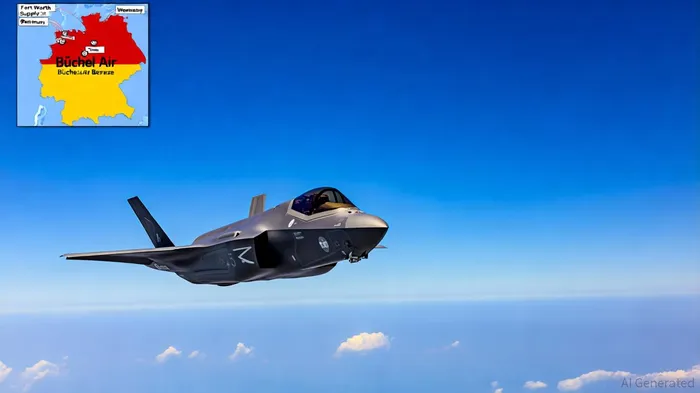
Germany's Strategic Shift and the F-35 Expansion
Germany's commitment to the F-35 program has deepened significantly in 2025. Initially, the country pledged to acquire 35 F-35A aircraft to replace its aging Panavia Tornado fleet, with deliveries slated to begin in 2026 and full operational deployment by 2027, according to Aeronews Journal. However, recent developments reveal a more ambitious plan. Germany has expanded its order to 50 F-35As, a 43% increase, to address delays in its domestic Future Combat Air System (FCAS) project and to ensure readiness for NATO's nuclear-sharing obligations, according to Army Recognition. This expansion underscores Germany's prioritization of immediate operational capabilities over long-term European defense integration, a trend likely to accelerate as regional tensions persist.
The F-35A's role in carrying U.S.-supplied B61 nuclear bombs under NATO's nuclear-sharing framework further cements its strategic value, as reported by Defence Industry. By adopting the F-35, Germany aligns its defense infrastructure with U.S. standards, ensuring interoperability and reducing reliance on non-American systems. This alignment is not merely symbolic; it translates into sustained demand for U.S. defense technology and services over the next two decades.
U.S. Defense Contractors: A Diversified Ecosystem of Exposure
While Lockheed MartinLMT--, the prime contractor for the F-35, stands to benefit directly from the expanded order, the program's global supply chain ensures broad-based exposure for other U.S. defense firms. For instance:
- Northrop Grumman contributes the center fuselage, upper wing skins, and AN/APG-81 AESA radar, critical components for the F-35's stealth and sensor capabilities, according to Simple Flying.
- BAE Systems produces 13–15% of the aircraft, including rear fuselage sections and avionics, while its new €200 million facility in Weeze, Germany, will manufacture center fuselage components for 400 aircraft over 17–20 years, as noted by The Aviationist.
- Pratt & Whitney's F135 engines power the F-35, ensuring its performance remains unmatched in contested environments, per the F-35 Partners overview.
- Raytheon and Collins Aerospace supply advanced avionics, munitions, and the Gen III helmet-mounted display system, enhancing pilot situational awareness, according to AMFG.
Notably, the Weeze facility, a joint venture between BAE Systems, Lockheed Martin, and Northrop GrummanNOC--, exemplifies the program's global integration. By localizing production in Germany, these firms not only secure long-term contracts but also mitigate supply chain risks, a critical consideration in an era of geopolitical fragmentation.
Investment Implications and Geopolitical Tailwinds
The F-35 program's expansion in Germany is emblematic of a broader trend: European nations increasingly turning to U.S. defense platforms to address urgent security needs. This shift is driven by two factors:
1. Delays in European Defense Projects: The FCAS program, a Franco-German-Spanish initiative, has faced technical and political hurdles, pushing Germany to rely on proven U.S. systems, as reported by Politico.
2. NATO's Nuclear Posture: The F-35's ability to carry B61 bombs ensures Germany's compliance with NATO's nuclear-sharing arrangements, a non-negotiable requirement for alliance cohesion, as noted by The Aviationist.
For investors, this dynamic creates a "win-win" scenario. U.S. defense contractors benefit from stable, long-term revenue streams, while European governments gain access to cutting-edge technology. The financial scale is staggering: the 50-aircraft order, combined with sustainment and training contracts, could generate over $10 billion in value for the supply chain.
Conclusion
Germany's F-35 procurement is more than a military modernization effort; it is a strategic bet on U.S. technological superiority and transatlantic solidarity. For U.S. defense contractors, this represents a golden opportunity to capitalize on Europe's defense spending surge. As the Weeze facility and other supply chain nodes come online, the financial and geopolitical dividends will extend far beyond the initial aircraft sales, embedding American firms deeply into Europe's security architecture. Investors who recognize this trend early stand to benefit from a decade-long tailwind in the defense sector.





Comentarios
Aún no hay comentarios