
Defense Industry Growth from Regional Security Demand: Capitalizing on Latin American Military Modernization
A Perfect Storm of Geopolitical and Economic Forces
The U.S. military buildup in Latin America-exemplified by the deployment of the USS Gerald R. Ford aircraft carrier in 2025-has intensified regional security dynamics. While Washington frames this as a strategy to combat illicit actors, it has also spurred Latin American nations to bolster their own capabilities. Brazil, the region's largest defense market, allocated $22.9 billion to its military in 2023, with plans to increase spending by 5.9% in 2025. This includes modernizing its air force with Saab-Embraer F-39E jets and expanding its Gripen fleet. Peru's commitment to 24 advanced fighter jets and Chile's investment in locally produced reconnaissance UAVs underscore the region's pivot toward self-reliance and technological upgrades.
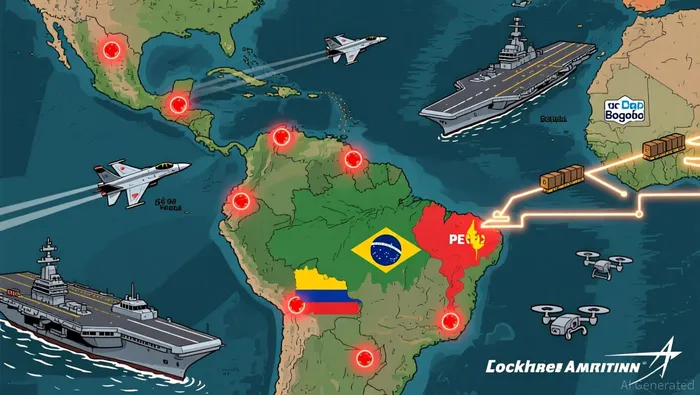
Key Players in the Latin American Defense Ecosystem
Embraer (ERJ): Brazil's aerospace giant is at the forefront of regional modernization. Its partnership with Saab to supply F-39E jets and its midlife upgrade program for the A-29 Super Tucano have positioned it as a critical player. Q3 2025 results showed strong revenue growth, with a record backlog driven by Latin American contracts. Analysts highlight Embraer's strategic alliances, such as its collaboration with Chile's ENAER, as catalysts for long-term profitability.
Lockheed Martin (LMT): The U.S. defense titan is leveraging its global missile defense expertise in Latin America. While its THAAD system is more prominent in Asia and the Middle East, Lockheed's supply chain partnerships-such as its collaboration with Italian firm Avio to produce solid rocket motors-support regional procurement needs. Q3 2025 financials revealed $18.6 billion in sales, a 9% year-over-year increase, with free cash flow of $3.3 billion enabling aggressive shareholder returns.
Saab (SAABb.ST): The Swedish defense firm's Gripen fighter jets are a cornerstone of Brazil's air force modernization. With Brazil planning to add 30 F-39E jets, Saab's regional footprint is expanding. Its partnership with EmbraerEMBJ-- not only secures contracts but also reduces reliance on foreign suppliers, a trend gaining traction in Latin America.
Financial Metrics and Market Projections
The Latin American defense market is projected to grow at a 4.8% CAGR from $61.36 billion in 2024 to $96.83 billion by 2033. Brazil alone accounts for 45% of the region's defense spending, with its 2025 budget prioritizing nuclear-powered submarines, armored vehicles, and cyber defense systems. For investors, this translates to sustained demand for companies like Embraer and Lockheed Martin, which are already securing multi-billion-dollar contracts.
However, risks persist. Economic instability in countries like Argentina and Mexico could delay procurement timelines, while geopolitical tensions-such as U.S.-Venezuela dynamics-introduce volatility. Yet, the long-term trajectory remains bullish, supported by regional cooperation initiatives like the CELAC-EU summit, which aim to counter U.S. influence through trade and security partnerships.
Conclusion: A Strategic Buy for Defense Investors
The confluence of regional security demands, U.S. military interventions, and Latin American modernization efforts creates a fertile ground for defense stocks. Embraer, Lockheed Martin, and Saab are not just beneficiaries of short-term contracts-they are integral to a structural shift in the region's defense landscape. For investors, these companies represent a blend of geopolitical tailwinds and robust financial fundamentals. As the market grows, so does the potential for outsized returns, provided one navigates the region's complexities with a long-term lens.





Comentarios
Aún no hay comentarios