
Deere's Earnings Beat vs. Ongoing Margin Pressures: Strategic Positioning in a Sector Downturn and Long-Term Resilience Amid Tariffs and Weak Farm Demand
Navigating Sector Downturns: A Mixed Bag of Strength and Weakness
Deere's revised full-year 2025 net income guidance of $4.00–$4.75 billion fell short of the $5.19 billion consensus estimate, underscoring the company's cautious stance amid a challenging macroeconomic environment. The Production & Precision Agriculture division, a core segment, faces headwinds as farmers delay large equipment purchases due to low crop prices and debt burdens. Meanwhile, the Financial Services segment demonstrated resilience, with net income rising 34% year-on-year, offering a buffer against agricultural sector volatility.
The company's struggles are emblematic of a broader industry downturn. As stated by Bloomberg, Deere's outlook highlights that the large agricultural cycle has yet to bottom, with 2026 likely marking the trough. This aligns with CEO John May's assertion that the sector must navigate "continued difficulties" in its core markets.
Strategic Initiatives: Cost Discipline and Technological Innovation
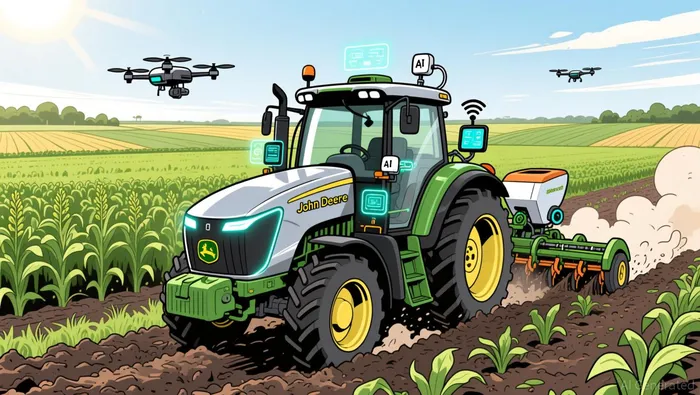
To mitigate margin pressures, Deere is doubling down on cost-cutting measures, pricing adjustments, and a diversified portfolio of used equipment. These tactics aim to offset the $1.2 billion tariff impact in 2026. However, the company's long-term resilience hinges on its ability to innovate. Deere's 2026 roadmap includes seven key innovations, such as autonomous electric tractors with AI and IoT integration, smart planters for precision seed delivery, and regenerative tillage equipment designed to enhance soil health. These advancements position Deere to lead in sustainability-driven agriculture, a sector expected to grow as climate-conscious farming practices gain traction.
The company is also diversifying beyond its core markets. While large ag remains challenging, modest growth is anticipated in smaller segments like turf and forestry. This strategic pivot reflects an acknowledgment of shifting demand patterns and a desire to reduce overreliance on cyclical agricultural markets.
Long-Term Resilience: A Question of Timing and Execution
Despite near-term headwinds, Deere's long-term prospects remain tied to its capacity to navigate the current downturn and capitalize on recovery. Management's optimism about 2026 being the "bottom of the large ag cycle" hinges on external factors such as improved crop prices and biofuels demand. If these conditions materialize, Deere's technological investments and cost discipline could drive a rebound in margins.
However, the path to recovery is not without risks. Persistent tariffs and weak farm demand could prolong the downturn, testing Deere's financial flexibility. The company's $4.75 billion net income guidance for 2025, while conservative, provides a buffer to fund innovation and weather further volatility.
Conclusion: A Balancing Act of Short-Term Pain and Long-Term Gain
Deere's Q3 earnings highlight a company navigating a complex landscape of short-term challenges and long-term opportunities. While the earnings beat demonstrates operational strength, the margin pressures and revised guidance underscore the severity of the sector downturn. By prioritizing cost management, technological innovation, and diversification, Deere is positioning itself to emerge stronger from this cycle. Investors must weigh the immediate risks against the potential rewards of a company that remains a leader in a critical industry.





Comentarios
Aún no hay comentarios