
DeepSeek V4 and the Shifting AI Valuation Landscape
The global AI landscape in 2025 is undergoing a seismic shift, driven by the emergence of cost-efficient models like DeepSeek V4. As the U.S.-China tech rivalry intensifies, DeepSeek's ability to deliver high-performance AI at a fraction of the cost of Western counterparts is reshaping both geopolitical dynamics and financial valuations. This analysis explores how DeepSeek's innovations are challenging traditional assumptions about AI development, investment flows, and the ideological underpinnings of global tech leadership.
The Technical and Cost-Efficiency Revolution
DeepSeek V4 represents a paradigm shift in AI model design. According to a report by , the model's Mixture-of-Experts (MoE) architecture activates only a subset of parameters per token, drastically reducing computational costs while maintaining performance. This efficiency is underscored by benchmark results: DeepSeek V4 achieved 87.5% correctness on the AIME 2025 math competition and a Codeforces rating of ~1930, outperforming earlier versions and rivaling GPT-4o.
Cost comparisons are even more striking. Training DeepSeek V3 required just $5.56 million, compared to an estimated $63 million for GPT-4. When deployed on AWS, DeepSeek models offer lower latency and consistent performance, making them ideal for real-time applications. These metrics position DeepSeek as a disruptive force, offering performance parity with U.S. models at 10% of the price.
Geopolitical Implications: U.S.-China Rivalry and Ideological Divides
The rise of DeepSeek is not merely a technical achievement but a geopolitical milestone. In 2025, U.S. firms secured $109.1 billion in AI funding, dwarfing China's $9.3 billion. Yet, DeepSeek's open-source strategy- releasing its R1 model under an MIT license and offering a free chatbot-has democratized access to cutting-edge AI, particularly in developing markets. This has accelerated adoption in regions like Africa and parts of Asia, where cost barriers previously limited access to advanced AI tools.
The ideological divide between U.S. and Chinese AI strategies is also sharpening. While U.S. firms emphasize proprietary, capital-intensive models, China's focus on algorithmic efficiency and open-source frameworks is redefining global perceptions of AI accessibility. This shift has prompted responses like the U.S. Stargate Project-a $500 billion AI investment initiative-aimed at countering China's growing influence.
Financial Implications: Valuation Re-Evaluation and Market Volatility
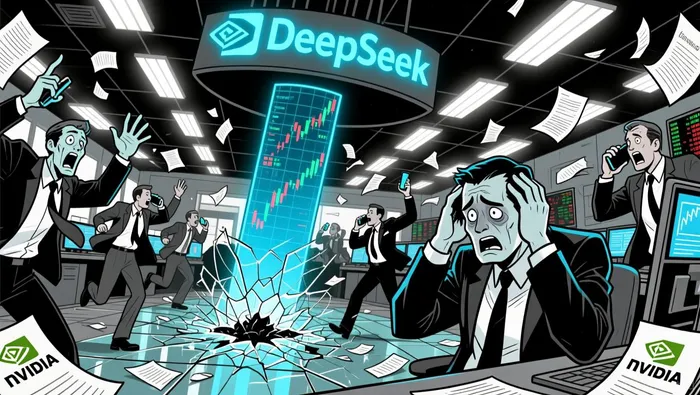
DeepSeek's cost efficiency is forcing a re-evaluation of AI valuations. Traditional models assumed that AI dominance required massive compute budgets, but DeepSeek's $5.58 million training cost for V3 versus multi-billion-dollar budgets for Western models has upended this logic. The financial impact has been immediate: NVIDIA's stock lost $593 billion in a single day following DeepSeek's 2025 release.
Investors are now recalibrating their strategies. Microsoft's integration of DeepSeek into its cloud infrastructure highlights the model's appeal for cost-sensitive applications. However, the market's initial panic has stabilized as U.S. firms like OpenAI and Google respond with competitive advancements (e.g., GPT-5 and Gemini 3) according to CNBC analysis. Analysts suggest that while DeepSeek hasn't caused a collapse in AI infrastructure spending, it has permanently altered perceptions of AI's cost structure.
Future Outlook: DeepSeek V4 and the Next Wave of AI Competition
As DeepSeek prepares to release V4, anticipated to feature a new architecture called Manifold-Constrained Hyper-Connections (mHC), the industry is bracing for further shifts in deployment and investment strategies. The model's potential to reduce compute demands even further could accelerate AI adoption in sectors like healthcare and manufacturing.
For investors, the key takeaway is clear: the AI valuation landscape is no longer dominated by sheer model size or proprietary infrastructure. Instead, algorithmic efficiency and cost structure are becoming the new benchmarks. DeepSeek's success underscores the importance of diversifying AI portfolios to include non-U.S. players and open-source alternatives.
Conclusion
DeepSeek V4 is more than a technical milestone-it is a catalyst for geopolitical and financial transformation. By challenging the U.S. tech hegemony and redefining cost efficiency, DeepSeek is reshaping global AI adoption, investment flows, and ideological narratives. For investors, the lesson is unequivocal: the future of AI will be defined not by who spends the most, but by who innovates the smartest.





Comentarios
Aún no hay comentarios