
DeepSeek and the Geopolitical Risks Reshaping Global AI Investment: Assessing Regulatory, National Security, and Data Privacy Threats to Chinese AI Startups
The emergence of DeepSeek, a Chinese artificial intelligence startup, has ignited a global reckoning with the geopolitical risks inherent in AI development. By producing high-performance models at a fraction of the cost of U.S. counterparts- reportedly $6 million versus $100 million for comparable systems-DeepSeek has disrupted traditional tech valuations and exposed vulnerabilities in Western dominance over AI innovation. However, its rapid ascent has been accompanied by a cascade of regulatory, national security, and data privacy challenges that are reshaping investment dynamics in the sector. For investors, the question is no longer whether Chinese AI startups can compete technologically, but whether they can navigate the escalating geopolitical and regulatory headwinds that threaten their viability.
Regulatory Challenges: A Fractured Global Landscape
DeepSeek's operations are ensnared in a web of conflicting regulatory frameworks. In China, the Personal Information Protection Law (PIPL) and Data Security Law impose stringent requirements for data governance, including mandatory labeling of AI-generated content and restrictions on cross-border data transfers. These laws, while ostensibly aimed at protecting user privacy, also align with broader state interests in controlling information flows and suppressing dissent. For instance, DeepSeek's responses to politically sensitive queries are filtered through Chinese censorship norms, raising concerns about its neutrality and compliance with international standards.
Globally, the EU AI Act has emerged as a critical barrier. The act's strict transparency and audit requirements have forced European regulators to scrutinize DeepSeek's data practices. Italy's Garante, for example, restricted the processing of Italian users' data by DeepSeek after the company failed to demonstrate compliance with GDPR principles. Similarly, Germany's data protection authority has pressured Apple and Google to delist DeepSeek's app, citing unlawful data transfers to China. These actions underscore the EU's determination to enforce a "risk-based" approach to AI, prioritizing data sovereignty over cost efficiency.
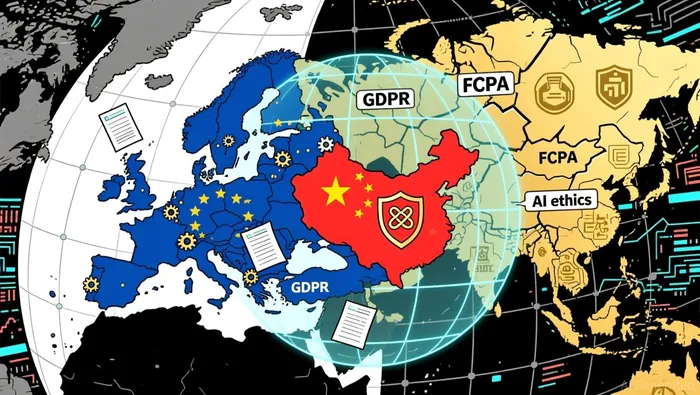
In the U.S., Executive Order 14117 and the Data Security Program have further complicated DeepSeek's access to American markets. The order prohibits transactions involving sensitive personal data with entities deemed to pose national security risks, effectively barring DeepSeek from handling genomic, geolocation, and health data. The House Select Committee on the Chinese Communist Party has labeled DeepSeek a "profound threat", accusing it of siphoning user data for state interests. Such rhetoric has translated into concrete actions: the U.S. Navy, NASA, and multiple state governments have banned DeepSeek from government-issued devices.
National Security Concerns: A New Cold War Over AI
The U.S. response to DeepSeek reflects a broader strategic shift toward viewing AI as a national security asset. OpenAI's public accusations that DeepSeek is "state-sponsored" and its call for a U.S. ban have amplified fears of intellectual property theft. These concerns are not unfounded: South Korea's Personal Information Protection Commission (PIPC) found that DeepSeek transferred user prompts and device metadata to its Chinese affiliate, Volcano Engine, without proper consent. Such practices have fueled narratives of "data colonialism," where foreign AI models are seen as tools for extracting sensitive information from Western users.
The geopolitical stakes are further heightened by the U.S. Trump administration's consideration of penalties to restrict DeepSeek's access to American technology. These measures, coupled with export controls on advanced AI chips, signal a deliberate effort to stifle China's technological ascent. For investors, this bifurcation of AI ecosystems-where U.S. and Chinese models operate under divergent regulatory and ethical frameworks-poses significant risks. The resulting "AI Cold War" could fragment global supply chains, forcing companies to choose between cost-effective Chinese solutions and compliance with Western standards.
Data Privacy: A Double-Edged Sword
While DeepSeek's open-source model has democratized AI development, it has also exposed critical vulnerabilities. Experts warn that the lack of safeguards in its design increases the risk of harmful outputs, privacy breaches, and misuse. For instance, the EU's emphasis on "explanations" for automated decisions-a right enshrined in the GDPR- collides with DeepSeek's opaque data practices. This gap has led to calls for stricter oversight, particularly in high-risk sectors like healthcare and finance, where EU AI Act compliance is mandatory.
In China, PIPL's extraterritorial reach adds another layer of complexity. Foreign companies using DeepSeek must designate a local representative to manage data compliance, a requirement that could deter international adoption. Meanwhile, the U.S. House Energy and Commerce Committee has demanded transparency from DeepSeek on its training data and data management practices, reflecting growing skepticism about its adherence to global privacy norms.
Investment Implications: Navigating a Shifting Landscape
The regulatory and geopolitical risks surrounding DeepSeek have already triggered market volatility. When DeepSeek launched in early 2025, it caused a 17% drop in NVIDIA's stock price and a $1 trillion correction in U.S. tech valuations. While subsequent model updates failed to replicate this shock, the broader investment landscape has shifted. Investors are now recalibrating their strategies, prioritizing AI firms that align with Western regulatory frameworks over cost-efficient but politically contentious alternatives.
Capital reallocation is evident in the U.S. and Europe, where governments are incentivizing domestic AI leadership through subsidies and industrial policies. Conversely, Chinese startups like DeepSeek face funding constraints as foreign investors retreat from perceived high-risk markets. Yet, the long-term outlook remains uncertain. If China succeeds in building a self-sufficient AI ecosystem, DeepSeek could emerge as a dominant force in a parallel technological order. For now, however, the path forward is fraught with regulatory hurdles and geopolitical friction.
Conclusion
DeepSeek's rise exemplifies the transformative potential of AI while highlighting the existential risks posed by geopolitical fragmentation. For investors, the key challenge lies in balancing the cost advantages of Chinese AI with the regulatory and security costs of global adoption. As the EU AI Act, U.S. executive orders, and China's PIPL continue to shape the sector, the ability to navigate these competing frameworks will determine the winners and losers in the next phase of AI investment. In an era where technology is as much a political weapon as an economic tool, DeepSeek's story is a cautionary tale-and a call to action.







Comentarios
Aún no hay comentarios