
Decred (DCR): A Strong Contender to Break the $50 Threshold in 2025-2030?
The Hybrid Consensus Model: A Governance Powerhouse
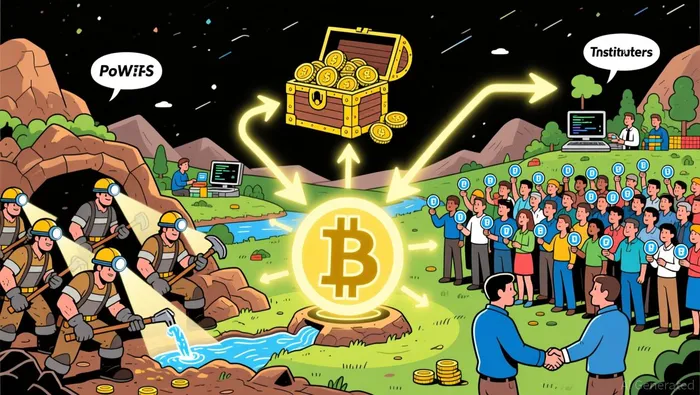
Decred's hybrid consensus mechanism is its defining feature. By allocating block rewards to PoW miners (1%), PoS voters (89%), and a community treasury (10%), the protocol ensures no single entity can dominate decision-making, according to a Weex article. This structure incentivizes token holders to stake their DCRDCR-- (currently 60% of the total supply) to vote on protocol upgrades, treasury allocations, and consensus changes, as described in a Weex article. The result is a self-sustaining ecosystem where governance is not a theoretical ideal but a daily reality.
For example, the self-funding treasury-amassing $44 million in assets by 2025-demonstrates the model's effectiveness. Unlike projects reliant on external capital, Decred's treasury funds development, marketing, and research autonomously, as noted in a Bitcoin World article. This financial independence reduces volatility and aligns long-term incentives between developers, miners, and stakeholders.
Market Dynamics: Price Predictions and Adoption Trends
The market is beginning to reflect DCR's governance strengths. Analysts project a 30% probability of DCR reaching $45–$60 by 2025, with bullish scenarios suggesting a potential $117.09 high by 2025-2030, according to a Mudrex analysis. Recent on-chain data reveals a 45% increase in active DCR addresses and $1.2 billion in transaction volume, signaling growing adoption, as reported in a Gate analysis.
Key drivers include:
1. Institutional Adoption: Partnerships like HashKey and Kraken's collaboration on tokenized assets are accelerating institutional interest in governance models like Decred's, as reported in a Finance Feeds report.
2. Regulatory Resilience: Decred's decentralized governance reduces reliance on centralized entities, a critical advantage in an era of tightening crypto regulations.
3. Yield Incentives: Stakers earn ~7% annual yields while retaining governance rights, creating a flywheel effect that boosts participation, as noted in a CoinDCX article.
Comparative Advantages: Governance vs. BitcoinBTC-- and Ethereum
Decred's governance model outperforms Bitcoin and EthereumETH-- in key areas:
- Bitcoin: Relies on miner-driven consensus, leading to slower, contentious upgrades.
- Ethereum: Post-merge, governance is centralized around a foundation and core developers, limiting community input.
- Decred: Token holders directly vote on changes, ensuring rapid, community-aligned updates.
This distinction is critical for investors. In 2025, DCR's price surged 145.92% in 24 hours amid broader market uncertainty, highlighting its appeal as a governance-optimized asset, according to a Bitcoin World article.
Strategic Investment Case
For long-term portfolios, DCR offers a unique value proposition:
- Risk Mitigation: The hybrid model balances security (PoW) with adaptability (PoS).
- Sustainability: The treasury ensures continuous development without external funding.
- Scalability: Lightning Network integration and ongoing software upgrades (e.g., DCRDEX v0.6.1) enhance utility, as described in a Mudrex analysis.
However, risks remain. A bearish market could cap DCR at $8–$12, while regulatory shifts may impact adoption. Yet, given its governance-first design and institutional tailwinds, DCR's potential to reach $50-and beyond-by 2030 is not just plausible but strategically compelling.
Conclusion
Decred's hybrid consensus, self-funding model, and active governance framework create a rare alignment of security, sustainability, and scalability. As crypto markets mature, projects like Decred-where community ownership is baked into the protocol-will likely outperform. For investors seeking exposure to governance-driven innovation, DCR represents a pivotal opportunity in 2025-2030.






Comentarios
Aún no hay comentarios