
Decoding the 'Sound of the Hammer': Structural Stress on Fiat and the Path Ahead
Jerome Powell's video statement last week was not just a political update; it was a stark signal of structural stress on the fiat system. By explicitly framing the Justice Department's grand jury subpoenas as a coercive threat to Fed independence, Powell laid bare a fundamental vulnerability. He stated the investigation was not about past testimony or a building renovation, but a direct challenge to the central bank's autonomy in setting interest rates free from political pressure. This is the core of the system's credibility.
The market's immediate reaction confirmed the gravity of the moment. Gold futures surged 2.21% to hit a new record high above $4,600 per troy ounce, a traditional safe haven rallying against perceived institutional risk. BitcoinBTC--, meanwhile, showed remarkable resilience, holding firm near $90,000 even as headlines swirled. This dual movementMOVE-- is telling: investors are fleeing the perceived fragility of state-backed money while seeking alternatives with fixed supplies and decentralized governance.
Analysts interpreted this as a definitive "sound of the hammer." Macro analyst Dario framed the moment as "the sound of the hammer hitting" and declared the fiat system "structurally compromised". His view is that markets are slowly pricing in deeper, systemic trust issues. This isn't a fleeting headline; it's a catalyst for a broader reckoning. The event crystallizes a growing concern that currency devaluation and policy capture are becoming more likely, pushing capital toward assets like gold and Bitcoin that are seen as stores of value independent of political whims. The structural stress is now in the open.
The Structural Framework: Money as Debt and the Devaluation Cycle
The political drama around the Fed is a symptom, not the root cause. The deeper vulnerability lies in the fundamental mechanics of modern money. As billionaire investor Ray Dalio has warned, the core thesis is that "money is debt". Fiat currency, he argues, is simply a promise to pay-a liability for the issuing government. When that government's debt burden becomes unsustainable, as it has in the United States with a $38 trillion national debt, the system faces a structural trap.
Governments cannot always raise taxes or cut spending enough to balance their books without triggering social upheaval. In this bind, the path of least resistance is often to devalue the currency. As Dalio stated, "If you devalue money, you devalue debt." This creates a self-reinforcing cycle: to service massive liabilities, policymakers print more money, which dilutes the value of every existing dollar. This dynamic is not unique to the U.S.; Dalio notes it is playing out in the UK and France as well, where political instability-evidenced by frequent leadership changes-reflects the pressure of economic strain.
History offers clear parallels. Dalio predicts the world is entering a period of significant currency devaluation comparable to the 1930s and 1970s. Both eras were marked by the collapse of fixed exchange rate systems and a loss of confidence in paper money, leading to sharp, often chaotic, adjustments. The current setup-a combination of massive debt, political gridlock, and central bank easing-echoes those earlier turning points.
The most potent warning signal is the market's behavior. Gold, the ultimate non-liability asset, has staged a historic rally. Last year, it delivered its best performance since 1979, with a 65% dollar-denominated return. For Dalio, this is not just a speculative move; it is a "debasement trade" in real time. The surge in gold prices reflects a growing market consensus that fiat money is losing real value. In his view, the stock market's strong dollar returns are partly an illusion, as they are measured against a depreciating currency. When measured in gold, the S&P 500's 2025 gain evaporates, turning into a decline of 28%.
This is the structural framework. The political attack on the Fed is a stress test on the system's credibility. But the underlying pressure comes from the debt mountain and the resulting devaluation cycle. Gold's rally is the market's vote of no confidence in the promise of paper money. The path ahead, Dalio suggests, is one where central banks are forced to buy gold as a hedge against the very currency they are printing.
Financial Impact and Market Metrics
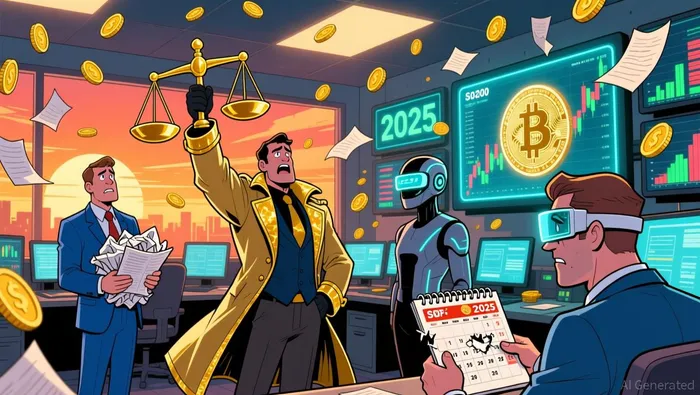
The structural debate is now being priced into concrete financial metrics. The market's immediate reaction to Powell's statement was a clear reallocation of capital. Gold futures surged 2.21% to hit a new record high above $4,600 per troy ounce, a direct hedge against perceived currency risk. Bitcoin, meanwhile, showed remarkable resilience, holding firm near $90,000. This dual movement is the financial fingerprint of a system under stress: investors are fleeing the perceived fragility of state-backed money while seeking alternatives with fixed supplies and decentralized governance. As analyst Dario framed it, the moment was a "best advertisement" for precious metals, with the fiat system now seen as "structurally compromised."
The key uncertainty driving this reallocation is the specter of "fiscal dominance." This is the scenario where political pressure forces the Federal Reserve to finance government deficits, directly undermining monetary policy credibility. As former Fed Chair Janet Yellen warned in a recent panel, fiscal dominance occurs when a government's debt burden becomes so overwhelming that monetary policy is subordinated to its financing needs. In such a world, the central bank is pressured to keep rates artificially low or to purchase large quantities of debt, not to stabilize inflation, but to ease the government's burden. The market is pricing in this risk, with gold's historic rally last year-a 65% dollar-denominated return-seen as a direct "debasement trade" against a depreciating currency.
This sets up the investor's core dilemma. The cost of hedging is the opportunity cost of holding assets like gold or Bitcoin, which do not generate income. Yet the potential cost of not hedging is a sharp devaluation event that erodes purchasing power. Ray Dalio's analysis crystallizes this tension. He argues that the stock market's strong dollar returns are partly an illusion, as they are measured against a depreciating currency. When measured in gold, the S&P 500's 2025 gain evaporates, turning into a decline of 28%. For an investor, the question is whether to accept the steady, non-income-generating drag of a gold allocation now, or to risk a catastrophic loss in real terms later if the system's credibility unravels. The market's behavior suggests many are choosing the former.
Forward-Looking Catalysts and Watchpoints
The structural thesis now requires forward-looking signals to confirm or contradict the narrative of a devaluing system. Three key watchpoints will provide the evidence needed to navigate the coming period.
First, monitoring the Federal Reserve's independence is paramount. The recent subpoenas are a clear stress test, but the real confirmation of erosion will come from policy settings. If political pressure leads to a shift in the Fed's stance-keeping rates artificially low to ease the government's debt servicing burden or accelerating asset purchases to finance deficits-it would be a definitive signal of fiscal dominance. As former Chair Janet Yellen warned, this is the scenario where monetary policy becomes the government's "financing arm." The market's reaction to Powell's statement, with Treasuries selling off and the dollar weakening, already prices in this risk. The next move will be whether the Fed's actual policy actions align with its stated independence or bend to the new political calculus.
Second, central bank gold buying and official sector demand must be tracked as a barometer of institutional confidence. When governments and central banks themselves are accumulating precious metals, it is a powerful vote of no confidence in their own currencies. The surge in gold last year, which saw a 65% dollar-denominated return, was fueled in part by this official demand. A sustained acceleration in central bank purchases would confirm that the world's financial institutions are hedging against the very devaluation cycle they are forced to manage. It would be the institutional equivalent of the market's "sell America" signal, validating the structural thesis from within the system.
Third, investors must watch for a divergence between nominal GDP growth and real interest rates. This divergence is the hallmark of a devaluation cycle. When nominal growth (the economy's size measured in current dollars) begins to consistently outpace real interest rates (the return after inflation), it signals that the currency is losing value faster than the economy is expanding in real terms. This dynamic, predicted by Ray Dalio as a path of least resistance, makes holding cash or bonds unattractive and pushes capital toward real assets and alternatives. The current setup, with massive debt and political pressure, creates the conditions for this divergence to emerge. Its onset would be the clearest signal that the cycle of printing money to devalue debt is gaining momentum.
The path ahead is defined by these catalysts. The political attack on the Fed is a symptom; the real test is whether the system's mechanics begin to unravel. By watching for a shift in Fed policy, a surge in official gold demand, and the divergence between nominal growth and real rates, investors can gauge whether the structural stress is being managed or is accelerating toward a broader reckoning.






Comentarios
Aún no hay comentarios