
Decoding the Rise of Inclusive Innovation Ecosystems in the South
The Global South is redefining the geography of innovation. Once peripheral to global tech capital flows, emerging innovation hubs in Southeast Asia, Africa, and Latin America are now central to a recalibrating investment landscape. This shift is driven by a confluence of factors: the decentralization of talent and R&D, strategic government policies, and a growing emphasis on inclusive growth. For investors, understanding the capital allocation strategies underpinning these ecosystems is critical to unlocking value while addressing systemic inequities.
The Drivers of Capital Reallocation
Globalization and remote work have eroded the traditional dominance of Silicon Valley and other Western hubs, enabling capital to flow toward regions with untapped potential. According to a World Economic Forum report, international university partnerships between the Global North and South are accelerating applied research and entrepreneurship, creating innovation ecosystems that align with local needs and global trends. Governments are also playing a pivotal role. China's Made in China 2025 policy and the EU's Digital Europe Programme are examples of how policy frameworks can catalyze domestic innovation, while sovereign wealth funds and private equity firms are increasingly targeting emerging markets, a Forbes analysis notes.
Case Studies: From Bengaluru to Nairobi
Southeast Asia's tech ecosystem exemplifies this transformation. Despite a 59% drop in total funding for startups in 2024-driven by a 77% decline in late-stage investments-the region's market valuation hit $454 billion, with Singapore securing 67% of the total capital, according to Tracxn's annual report. Fintech and enterprise applications remain dominant, but future-shaping sectors like AI infrastructure and clean energy are attracting foreign direct investment (FDI) due to their alignment with geopolitical priorities, McKinsey finds.
In Africa, capital allocation strategies are increasingly focused on long-term value creation. Kenya's Kenya Pension Fund Investment Corporation (KEPFIC), which pools local institutional capital, has become a model for aligning pension funds with private sector growth and infrastructure development, as highlighted by the LSE Business Review. Similarly, Nigeria's Lagos Innovation Hub leverages blended finance to support agritech startups addressing food security, as described in FasterCapital's case study.
Latin America's innovation districts, such as Mexico's Distrito Tec and Colombia's Ruta N, highlight the role of mission-driven capital. These hubs integrate urban regeneration with research and industry partnerships, generating jobs and sustainable growth. For instance, Distrito Tec's first phase contributed to a 12% increase in local employment and a 20% reduction in carbon emissions through smart city initiatives, according to a 2021 LSE article.
Strategic Allocation: Sectors, Partnerships, and Infrastructure
Effective capital allocation in the Global South hinges on three pillars: sector specificity, institutional collaboration, and infrastructure development. Innovation hubs thrive by focusing on sectors aligned with regional strengths. Bengaluru's dominance in SaaS and fintech, for example, is rooted in its deep talent pool and existing industry ecosystems, as noted by Forbes. Similarly, Nairobi's social-tech innovations in agriculture and logistics leverage Kenya's position as a regional trade hub.
Universities are emerging as linchpins of these ecosystems. The Global Innovation Index 2025 underscores that regions with strong academic-industry linkages-such as Boston and St. Louis-achieve higher innovation outputs. In the Global South, institutions like Tecnológico de Monterrey and the University of Nairobi are fostering applied research and entrepreneurship, attracting both domestic and international investment, a theme echoed in McKinsey's playbook.
Infrastructure development, particularly in digital and mobility sectors, is another priority. A McKinsey report notes that 75% of recent FDI has targeted future-shaping industries like semiconductor fabrication and EV manufacturing, reflecting a strategic shift toward sectors with high multiplier effects.
Challenges and the Path Forward
Despite progress, challenges persist. In Africa, underutilized local capital pools-such as pension funds-remain misaligned with development needs, necessitating structural reforms, as the LSE Business Review argues. Meanwhile, Southeast Asia's funding volatility underscores the need for diversified capital sources, including permanent capital vehicles (PCVs) that reduce exit pressures on early-stage ventures; FasterCapital's case study similarly highlights the role of patient capital.
For investors, the path forward lies in balancing financial returns with inclusive outcomes. Blended finance models, which combine public, private, and philanthropic capital, offer a framework for scaling impact. As Forrester projects, global tech spend will grow by 5.6% in 2025, with Asia Pacific leading the charge-India alone is projected to see a 9.6% increase. This growth will be most sustainable in ecosystems that prioritize equitable access to resources and opportunities.
Conclusion
The rise of inclusive innovation ecosystems in the Global South is not merely a geographic shift-it represents a reimagining of how capital can drive both economic and social progress. By aligning investment with local strengths, fostering cross-sector collaboration, and prioritizing long-term value creation, these hubs are setting a new standard for sustainable growth. For investors, the lesson is clear: the future of innovation lies in ecosystems that are as equitable as they are profitable.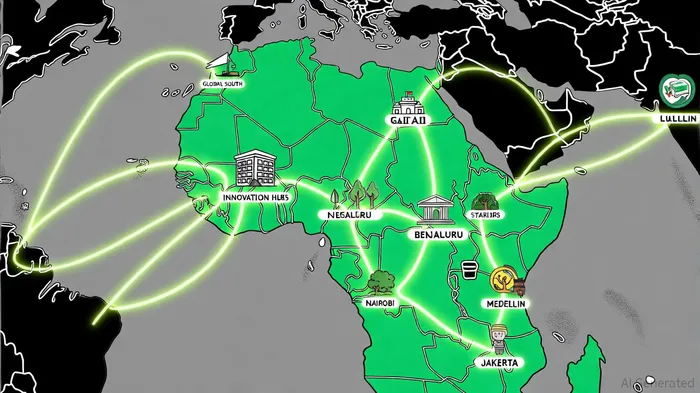







Comentarios
Aún no hay comentarios