
Decoding the McAlvany Campaign: Why 'Alien Insurance' Ads Signal a Strategic Play in Precious Metals and Macro Risk Hedges
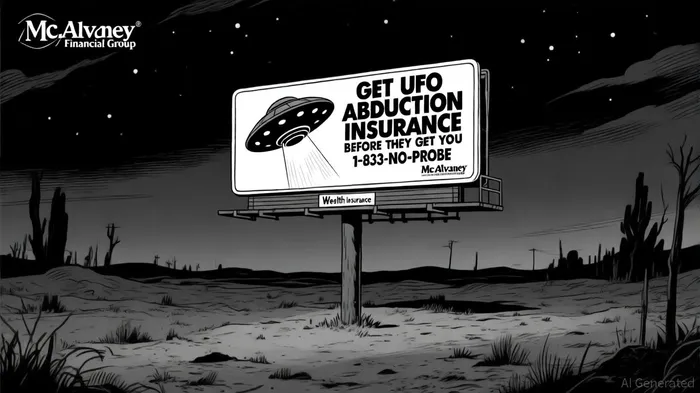
The McAlvany Financial Group's "Alien Insurance" campaign, launched in late 2025, has sparked intrigue with its absurdist humor and subversive messaging. By placing classified-style ads in The New York Times and The Wall Street Journal—featuring fictional insurance for UFO abductions and a cryptic phone number—McAlvany has cleverly redirected attention to its core offering: Gold IRAs as a form of "Wealth Insurance" for retirement savings [1]. This campaign, developed in collaboration with independent agency Fire Kite, represents more than a marketing stunt. It is a calculated strategic play rooted in behavioral finance principles and macroeconomic positioning, leveraging psychological biases and global economic trends to reframe precious metals as essential tools for hedging macro risks.
Behavioral Finance and the "Wealth Insurance" Narrative
At the heart of the campaign lies a deep understanding of behavioral finance. Traditional investment strategies often assume rational decision-making, but behavioral economics reveals that investors are frequently driven by cognitive biases such as loss aversion, herding behavior, and anchoring [2]. McAlvany's approach directly addresses these biases by reframing Gold IRAs as a form of "insurance" rather than a speculative asset. This framing taps into the human tendency to prioritize avoiding losses over pursuing gains—a principle known as loss aversion. By likening retirement savings to insuring against trivial or absurd risks (e.g., alien abductions), the campaign highlights the irony of neglecting financial security while insuring less critical assets [3].
The campaign's use of humor and absurdity also serves as a nudge to counteract herding behavior. In a market dominated by mainstream narratives—such as overreliance on equities or bonds—McAlvany's messaging encourages investors to question conventional wisdom. As behavioral finance literature notes, investors often follow the crowd, leading to suboptimal decisions during market volatility [2]. By creating a sense of urgency ("before they get you"), the campaign primes individuals to act independently, aligning with the behavioral finance concept of mental accounting, where categorizing assets into distinct "buckets" (e.g., "insured wealth") can influence decision-making [4].
Macroeconomic Positioning: Gold as a Hedge in a Volatile World
The campaign's timing aligns with a macroeconomic environment ripe for precious metals. Global inflation, while projected to decline to 5.43% in Q3 2025, remains elevated compared to historical averages [5]. Central banks, including China's and Russia's, have aggressively increased gold reserves—China alone added over 100 tonnes in recent months—as a hedge against the devaluation of fiat currencies [6]. This trend underscores gold's role as a safe-haven asset during periods of geopolitical and economic uncertainty.
The Federal Reserve's "Catch-22" dilemma—balancing inflation control with economic growth—further amplifies the appeal of Gold IRAs. With interest rates at a precarious equilibrium, investors face the risk of both market corrections and prolonged inflation. Gold, which historically retains value during currency devaluations, offers a counterbalance to these risks [7]. Additionally, the growing industrial demand for silver in renewable energy technologies (e.g., solar panels) and platinum in hydrogen fuel cells adds a new layer of strategic value to precious metals [8].
The Effectiveness of "Alien Insurance": A Behavioral and Macro Win
McAlvany's campaign succeeds by merging behavioral insights with macroeconomic realities. The absurdity of "UFO insurance" acts as a cognitive hook, overcoming the inertia of status quo bias—a well-documented barrier to portfolio diversification [2]. By directing curious readers to a phone number and a message from CEO David McAlvany, the campaign creates a low-friction pathway to engagement. This approach mirrors the foot-in-the-door technique in behavioral psychology, where an initial small commitment (e.g., calling the number) increases the likelihood of subsequent action (e.g., opening a Gold IRA) [9].
Moreover, the campaign's emphasis on "insuring wealth" resonates with the public's growing awareness of economic instability. Recent data shows a 250% rise in gold purchases in Germany and a 91% increase in China, reflecting a global shift toward tangible assets [10]. These trends validate McAlvany's thesis that investors are increasingly prioritizing risk mitigation over speculative growth, particularly in the face of geopolitical tensions and U.S. tariff policies that have eroded business and consumer sentiment [5].
Conclusion: A Blueprint for the Future of Macro Risk Hedging
The McAlvany "Alien Insurance" campaign exemplifies how behavioral finance and macroeconomic positioning can be synergistically applied to influence investor behavior. By leveraging psychological biases, reframing risk through humor, and aligning with global economic trends, McAlvany has created a compelling narrative for precious metals as a cornerstone of retirement security. As central banks continue to diversify reserves and inflationary pressures persist, the strategic value of Gold IRAs—and the innovative campaigns promoting them—will likely gain even greater traction.







Comentarios
Aún no hay comentarios