
Decoding Market Sentiment: Why Altcoins Are Still in the Crosshairs Despite BTC and ETH Optimism
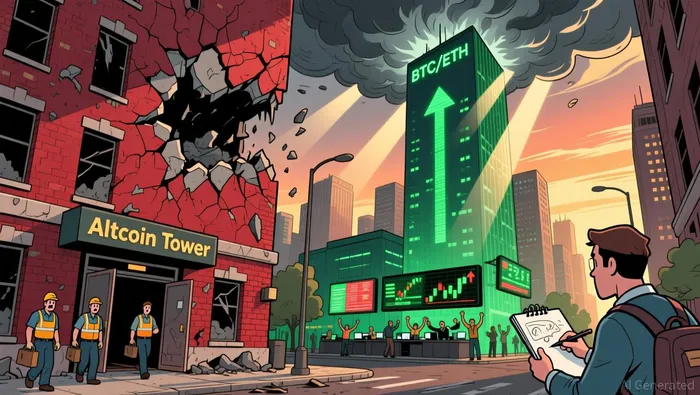
The cryptocurrency market in 2025 has entered a phase of structural bearishness, with altcoins bearing the brunt of a capital flight toward BitcoinBTC-- (BTC) and EthereumETH-- (ETH). While BTCBTC-- and ETHETH-- have maintained relative resilience-driven by institutional adoption and macroeconomic tailwinds-the broader altcoin sector has underperformed, sinking by over 40% in Q4 2025 alone. This divergence raises critical questions for investors: Why are altcoins still in the crosshairs despite optimism around BTC and ETH? And how can contrarian strategies and risk mitigation techniques navigate this bearish landscape?
Structural Bearishness: Altcoins in the Shadows
The Altcoin Season Index, a key barometer of market dynamics, has plummeted to 17/100 in 2025, signaling a weak altcoin environment and a stark shift toward larger-cap assets according to market analysis. Bitcoin's market share has surged to 59.43%, nearing its June 2025 peak of 65.12%, while the ETH/BTC ratio has climbed to 0.037%, reflecting heightened institutional preference for Ethereum-based assets. However, this growth in ETH's prominence does not offset the broader structural bearishness. Capital has been rotating from altcoins to BTC and then into stablecoins, a trend exacerbated by low liquidity.
Q4 2025 data underscores this trend: altcoins fared worse than BTC and ETH, with the broader sector collapsing by over 40% amid a market environment where traditional assets like gold and equities outperformed according to the year-end review. Privacy-focused tokens, such as ZcashZEC--, emerged as rare bright spots, but these exceptions highlight the rule of systemic underperformance according to market analysis.
Contrarian Opportunities: Undervalued Altcoins and Institutional Narratives
Despite the bearish backdrop, pockets of opportunity exist for contrarian investors. On-chain data and institutional flows reveal that large holders are moving Bitcoin out of exchanges into cold storage, reducing liquid supply and potentially supporting prices. This behavior suggests a market nearing a bottom, with capital beginning to seek value in undervalued altcoins.
Several projects with strong fundamentals and growing institutional interest stand out. ChainlinkLINK-- (LINK), a critical infrastructure provider for decentralized finance, remains approximately 70% below its 2021 high despite its role in powering oracle networks according to expert analysis. XRPXRP--, now free from the SEC lawsuit cloud, has gained traction in cross-border payments with over 350 financial institution partners according to market reports. Polygon (POL), rebranded from MATIC, has processed millions of daily transactions and hosts major DeFi platforms like UniswapUNI-- and AaveAAVE--, yet its valuation lags behind its adoption according to market analysis.
Smaller-cap altcoins like OndoONDO-- (ONDO) and JupiterJUP-- (JUP) also show promise. ONDO, a leader in tokenized Treasuries, has $690 million in assets under management and integration with BlackRock's BUIDL fund, while JUPJUP-- dominates Solana's DEX aggregator space with 21% of TVL according to market data. These projects exemplify the potential for capital rotation from BTC into altcoins, driven by utility, institutional credibility, and active development.
Risk Mitigation: Hedging in a Bear Market
Navigating a structurally bearish market requires robust risk mitigation strategies. Hedging mechanisms such as stablecoin conversions, short positions, and options provide critical tools for managing volatility. For instance, converting a portion of crypto holdings into stablecoins shields assets from price collapses while maintaining liquidity. Traders holding BTC can also short perpetual futures or buy put options to offset potential losses if prices drop.
Institutional players employ advanced techniques like delta-neutral trading, pairing long positions with short derivatives to neutralize directional risk according to market research. Multi-asset margin systems and automated strategies, including grid trading and DCA bots, further enhance resilience during market-wide sell-offs. Platforms like Binance and OKX offer dedicated Hedge Mode, enabling simultaneous long and short positions with separate margin according to platform analysis.
Dynamic rebalancing and volatility targeting are also critical. When volatility exceeds target bands, investors scale down altcoin exposure or increase stablecoin allocations according to market signals. Stress testing and Value-at-Risk (VaR) analytics help quantify potential losses, ensuring portfolios remain aligned with risk tolerance according to market research.
Conclusion: Balancing Optimism and Caution
The 2025 crypto market is a study in contrasts: BTC and ETH have solidified their dominance, while altcoins remain under pressure. Yet, this bearish environment is not a death knell for altcoins but a call for disciplined, contrarian positioning. By focusing on undervalued projects with strong fundamentals and leveraging advanced hedging strategies, investors can navigate the crosshairs of a structurally bearish market.
As 2026 approaches, the institutional era in crypto is set to accelerate, with over 100 new ETFs and $50 billion in projected inflows. For those willing to decode the market sentiment and act with precision, the path forward lies in balancing optimism for BTC and ETH with cautious, strategic exposure to altcoins.







Comentarios
Aún no hay comentarios