
Decoding Labor Risks in the Airline Sector: Air Canada's Strike and the Future of Shareholder Value
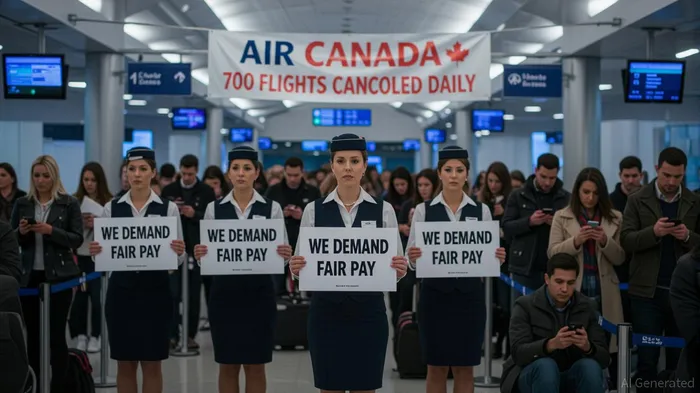
The airline sector is no stranger to turbulence, but the ongoing illegal strike at Air Canada has exposed a critical vulnerability in its operational and financial model. As of August 2025, the strike—led by 10,000 flight attendants under the Canadian Union of Public Employees (CUPE)—has entered its third day, grounding 700 flights daily and stranding 130,000 passengers. The Canada Industrial Relations Board (CIRB) has declared the strike illegal, and the federal government has invoked binding arbitration under Section 107 of the Canada Labour Code. Yet, CUPE's defiance of the return-to-work order has escalated the crisis into a high-stakes battle over labor rights, regulatory authority, and economic stability.
The Financial Fallout: A $1.4 Billion Gamble
Air Canada's Q2 2025 financials reveal a company teetering on the edge of a liquidity crisis. With a daily revenue loss of $98 million and a projected $1.4 billion in losses if the strike persists beyond two weeks, the airline has suspended its third-quarter and full-year financial guidance. Its stock price plummeted 14.25% in early August, trading at an 18% discount to U.S. peers like DeltaDAL-- and Alaska Airlines, which have resolved similar disputes through proactive labor negotiations.
The strike's impact extends beyond AirXAIR-- Canada. The broader sector is grappling with a 1.3% annual rise in non-fuel unit labor costs since 2020, driven by inflation and union demands for compensation for "ground duties" such as boarding assistance. This trend mirrors U.S. carriers like American and Alaska Airlines, which have already integrated such payments into their contracts. For investors, the lesson is clear: airlines that fail to align with evolving labor expectations risk operational paralysis and shareholder value erosion.
Sector-Wide Trends: Labor as a Strategic Asset
The Air Canada dispute is part of a larger pattern. Since 2020, North American airlinesAAL-- have faced over 20 major strikes, with labor costs rising sharply due to inflation and unionization drives. For example, Delta Air LinesDAL-- and Alaska Airlines have invested in pilot training and automation to mitigate labor shortages, while Spirit and Frontier Airlines—burdened by high debt and weak liquidity—remain vulnerable to disruptions.
The projected talent shortage of 300,000 pilots and 600,000 cabin crew by 2030 further amplifies the stakes. Airlines that prioritize workforce retention, ESG alignment, and automation—such as Delta and Alaska—have demonstrated resilience. Conversely, carriers like Air Canada, which now trades at a discount to its peers, highlight the financial risks of protracted labor conflicts.
Investment Implications: Navigating the New Normal
For long-term investors, the Air Canada strike underscores the need to evaluate airlines through a labor lens. Key metrics to monitor include:
1. Labor Cost Trends: Airlines with rising unit labor costs (e.g., Spirit, Frontier) face higher operational risks.
2. Regulatory Exposure: Governments are increasingly intervening in essential service disputes, as seen in Canada's Section 107 invocation. This could normalize regulatory overreach, eroding union bargaining power but stabilizing operations.
3. Operational Resilience: Carriers with robust liquidity, automation strategies, and proactive labor relations (e.g., Delta, Alaska) are better positioned to weather disruptions.
The broader sector's financial outlook remains mixed. While North American airlines are projected to generate $12.7 billion in 2025 profits (up from $11.5 billion in 2024), fuel volatility and labor costs remain headwinds. Investors should favor airlines with strong EBITDA margins, low debt, and proactive labor strategies. Conversely, speculative plays on carriers with weak balance sheets and unresolved labor disputes—like Air Canada—carry significant downside risk.
Conclusion: Balancing Risk and Reward
The Air Canada strike is a microcosm of the airline sector's evolving challenges. As labor costs rise and regulatory interventions become more frequent, the ability to balance worker demands with profitability will define long-term success. For investors, the path forward lies in identifying airlines that treat labor not as a cost but as a strategic asset. Those that fail to adapt—like Air Canada—risk becoming cautionary tales in an industry where operational resilience is now a prerequisite for shareholder value.





Comentarios
Aún no hay comentarios