
Decoding the Labor Market Volatility: Implications for Equity and Fixed Income Portfolios
The U.S. labor market has entered a period of heightened volatility, with recent jobless claims data sparking intense debate among economists and investors. The surge in initial claims to 236,000 for the week ending December 6, 2025-the largest increase in nearly four years-has raised alarms about early-stage economic weakness, while the Federal Reserve's cautious rate-cutting strategy and mixed labor market signals suggest a potential soft landing. This analysis dissects the conflicting narratives and evaluates their implications for equity and fixed income portfolios.
The Data: A Tale of Two Metrics
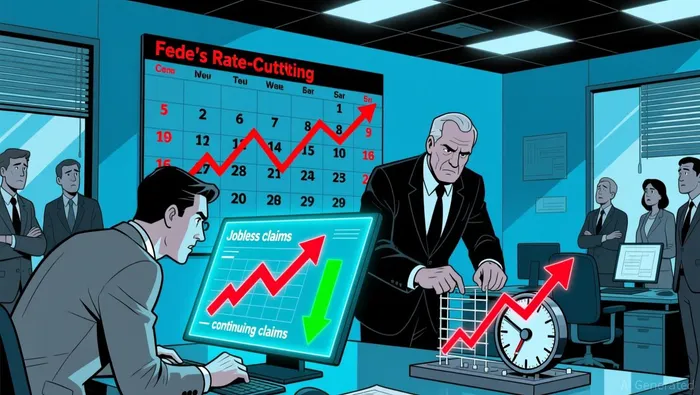
The latest jobless claims report reveals a paradox. Initial claims, a leading indicator of labor market health, spiked to a three-month high of 236,000, driven by seasonal adjustment challenges around the Thanksgiving holiday. This figure exceeded economist expectations of 220,000 and followed a downwardly revised prior week's reading of 192,000. Meanwhile, continuing claims-a measure of ongoing unemployment-fell to 1.838 million, the largest decline in four years. This duality underscores the complexity of interpreting labor market data in a post-pandemic, AI-driven economy.
The broader context is equally nuanced. The September 2025 employment report, released in late November, showed a modest 119,000 nonfarm payroll increase and a 4.4% unemployment rate. However, the U-6 underemployment rate remains elevated at 8.1%, reflecting persistent labor shortages and discouraged workers. These metrics highlight a labor market in transition: employers are adding jobs, but at a slower pace, while automation and trade policy shifts are reshaping demand for human capital.
Soft Landing or Early Weakness?
The Federal Reserve's latest projections offer a tentative roadmap. The central bank expects the unemployment rate to stabilize at 4.5% in 2025 and dip to 4.4% in 2026. This suggests confidence in a soft landing, supported by stabilizing wage growth and easing inflationary pressures. However, the Fed's 25-basis-point rate cut in December 2025-a response to sticky inflation and tariff-related disruptions-reveals lingering caution.
Key indicators point to both scenarios. On the soft-landing side:
- Wage Growth and Inflation: Stabilizing wage growth (3.1% year-over-year) and a declining core PCE inflation rate (3.4%) suggest the Fed's tightening cycle is achieving its goals.
- AI and Automation: The adoption of generative AI in sectors like healthcare and logistics is offsetting labor shortages, preserving productivity.
- Consumer Resilience: Household debt levels remain manageable, and the four-week moving average of jobless claims (216,750) has not yet breached critical thresholds for recession signals.
Conversely, early-stage weakness is signaled by:
- Labor Market Stagnation: The "no fire, no hire" dynamic-driven by automation, reduced immigration, and small business retrenchment-has led to a slowing job openings-to-unemployed ratio.
- Private-Sector Erosion: Planned job cuts in sectors like retail and manufacturing have increased by 18% year-to-date, with small businesses disproportionately affected.
- Geopolitical Risks: Ongoing tariff wars and potential geopolitical shocks could exacerbate inflation and disrupt supply chains.
Implications for Portfolios
The dual narratives of resilience and fragility demand a nuanced approach to asset allocation.
Equities: A soft landing would likely support equities, particularly in sectors benefiting from AI-driven productivity gains (e.g., tech, healthcare). However, early-stage weakness could pressure cyclical sectors like industrials and consumer discretionary, which are sensitive to labor market deterioration. Investors should prioritize companies with strong balance sheets and pricing power to weather volatility.
Fixed Income: The Fed's dovish pivot and inflation concerns suggest a flattening yield curve, with long-term Treasury yields potentially rising if recession fears intensify. High-quality corporate bonds may outperform, while municipal bonds could benefit from state-level fiscal stimulus aimed at mitigating labor shortages.
Alternatives: Gold and commodities may act as hedges against inflation and geopolitical risks, while real estate investment trusts (REITs) could benefit from a stable labor market and urban migration trends.
Conclusion: Navigating the Uncertainty
The labor market's volatility reflects a broader economic tug-of-war between structural transformation and cyclical fragility. While the Fed's rate cuts and AI-driven productivity gains support a soft landing, the "no fire, no hire" dynamic and rising job cuts signal early-stage weakness. Investors must remain agile, balancing exposure to growth-oriented equities with defensive fixed income and alternative assets. As the December 2025 data underscores, the path forward will depend on the Fed's ability to navigate inflation while preserving labor market stability-a delicate balancing act that will define 2026's investment landscape.







Comentarios
Aún no hay comentarios