
Decoding the US Import Slowdown: A Structural Shift or a Policy Distortion?
The headline numbers tell a clear story of exhaustion. U.S. container imports fell 5.9% in December, capping a year where total volumes ended 0.4% below 2024. This modest annual decline masks a dramatic swing. Early in 2025, imports surged as buyers stockpiled goods to avoid potential tariffs, particularly from China. That front-loading has now fully unwound, leaving the trade flow at a lower baseline.
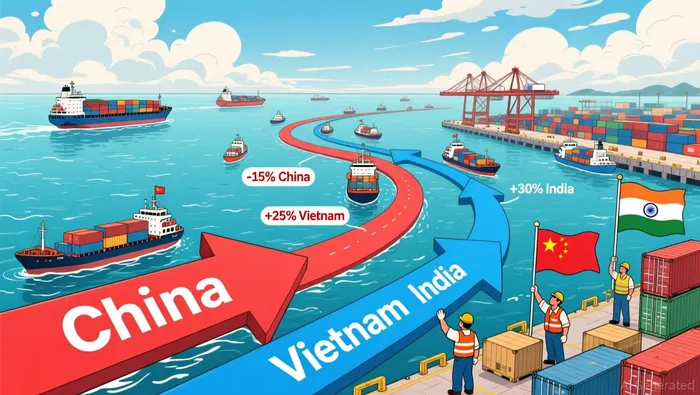
At the heart of this deceleration is a fundamental shift in sourcing. China's dominance has visibly receded. In December, shipments from the Middle Kingdom fell 21.8% year over year, a steep drop that drove a broader contraction. More telling is the market share metric: China's share of total U.S. container imports fell to a six-year low of 31.7% last month. This is not just a temporary dip; it is the visible outcome of policy-driven realignment.
The trend is not isolated to China. The top 10 countries of origin saw a combined 8.4% year-over-year decline in December, with China's collapse accounting for more than the total net drop. India and Taiwan also posted significant contractions. This broad-based weakness, while China-led, signals that the initial wave of tariff-induced inventory hoarding has given way to a more structural recalibration of global supply chains. The front-loading is over, and the new normal appears to be one of lower volumes and a more diversified, yet still pressured, import base.
The Engine: Policy Distortion vs. Structural Diversification
The slowdown is a dual force, driven by both a temporary policy distortion and a persistent structural shift. The immediate trigger is clear: the front-loading of 2025 imports to beat the threat of Trump's IEEPA tariffs. Those tariffs were paused for months, then reinstated in August, creating a classic "buy now, pay later" dynamic. The result was a massive surge in the first quarter, followed by a sharp unwinding as inventories were drawn down. This is a policy-induced distortion, and its exhaustion is now visible in the data. As one economist noted, the goods deficit has been shrinking month-over-month since the tariffs took effect, but the sheer volume imported earlier means the deficit for the full year will still exceed a trillion dollars.
Yet beneath this cyclical dip lies a longer-term trend that is reshaping the global supply chain. The diversification away from China, Hong Kong, and Korea has been a steady process for over a decade. According to Wells Fargo data, the share of supplier volume from that region has fallen from 90% to 50%. This is not a reaction to a single tariff threat but a strategic, multi-year realignment that began during the first Trump administration and has intensified since. The migration is now a 50/50 split between northern and southern Asia-Pacific, with midsize suppliers moving into countries like Vietnam, Indonesia, Thailand, and India.
This structural shift is most vividly illustrated by the emergence of Southeast Asia as a new manufacturing hub. The region is not just a backup plan; it is a growing center of gravity. In 2023, Vietnam alone received $16 billion in greenfield manufacturing FDI, a tangible vote of confidence from global investors. This investment is translating into trade flows, with container volumes to the U.S. from Vietnam up 23% year-over-year. The policy distortion of 2025 may have paused the import stream, but it did not reverse the underlying migration of production. The slowdown is therefore a combination of inventory correction and a permanent recalibration of sourcing. The new normal is lower volumes, but also a more diversified and resilient base.
Financial Impact and Forward Scenarios
The slowdown is now hitting corporate balance sheets directly. As the front-loaded inventories from early 2025 deplete, importers face a dual squeeze. First, they must replenish stock without the earlier tariff-induced buffer. Second, the effective tariff rate on goods has risen to double digits, directly increasing the cost of each purchase. This combination is straining working capital, forcing companies to seek more trade financing to preserve cash. For sectors with thin margins, like retail and pharmaceuticals, the pressure is acute, leading to renegotiations of payment terms and a greater reliance on financial arrangements to manage the cash crunch.
This sets the stage for competing scenarios in 2026, hinging on a pending Supreme Court decision. A ruling against the tariffs would be a major policy reversal, likely providing a near-term boost to import volumes and easing the financial strain on balance sheets. Yet even in that scenario, the structural diversification trend is likely to persist. The long-term migration of production to Southeast Asia and India is a multi-year investment story, not a temporary reaction to a single tariff threat. The court's decision may reverse the policy distortion, but it cannot instantly rewind the recalibrated supply chain.
If the tariffs remain intact, a new baseline for the trade deficit is emerging. The data suggests the monthly goods deficit would settle in an average range of $50 billion to $70 billion. This would represent a significant reduction from the $1.26 trillion projected for 2025, but still a massive outflow. The forward outlook is thus defined by a tension: the potential for a policy-driven rebound versus the permanence of a more diversified sourcing model. The Supreme Court's ruling will determine the near-term trajectory, but the structural shift away from China is already embedded in the trade flows. The new normal is lower, more complex, and more resilient.
Catalysts and Risks: What to Watch in 2026
The structural shift away from China is now the baseline. The real test for 2026 is whether this diversification is permanent or merely a pause in a volatile cycle. The path forward hinges on a few key catalysts and risks that will provide clarity.
First, watch for the resolution of pending policy distortions. The ongoing uncertainty from pending Liberation Day tariff rulings and persistent Red Sea security risks continues to cloud trade flows. A clear ruling on the tariffs would remove a major overhang, while a resolution to the Red Sea disruptions would ease a critical shipping chokepoint. Their outcomes will determine if the current cautious environment is a policy-induced pause or a reflection of deeper, lasting recalibration.
Second, monitor the progress of bilateral trade talks, which could set a template for the broader ASEAN migration. The recent agreement between the U.S. and Vietnam, which imposes a 20% tariff on domestic exports while removing tariffs on U.S. imports, is a critical litmus test. This deal offers much-needed clarity for investors and sets a potential benchmark for negotiations with other ASEAN nations. Success here would validate the friendshoring trend; a breakdown would signal that geopolitical friction is overwhelming economic logic.
Finally, track the sustainability of Southeast Asian manufacturing growth. The region's emergence as a new hub is not automatic. The key indicators are tangible: greenfield manufacturing FDI and export volumes. Vietnam's receipt of $16 billion in FDI in 2023 and its 21.5% year-over-year growth in container volumes are strong early signs. Indonesia, with its $33 billion in FDI, is following a similar path. The sustainability of this growth depends on whether these nations can maintain the structural reforms and infrastructure investment needed to support it. If their manufacturing base continues to expand, the shift is permanent. If growth stalls, it may simply be a temporary flight from China's higher costs and risks.
The bottom line is that the structural shift thesis will be confirmed by policy clarity, successful trade deals, and sustained industrial expansion in the South. Any failure on these fronts would suggest the current slowdown is more than just a recalibration-it is a sign of a trade system under strain.







Comentarios
Aún no hay comentarios