
Decoding Ethereum Whale Activity: Strategic Implications for 2026 Investors
Ethereum's 2025 market dynamics have been shaped by a confluence of on-chain behavioral shifts and institutional capital flows, creating a complex landscape for 2026 investors. Whale activity, institutional positioning, and leveraged derivatives exposure all point to a market at a critical inflection point. By dissecting these signals, investors can better navigate the risks and opportunities ahead.
Whale Accumulation and Market Sentiment
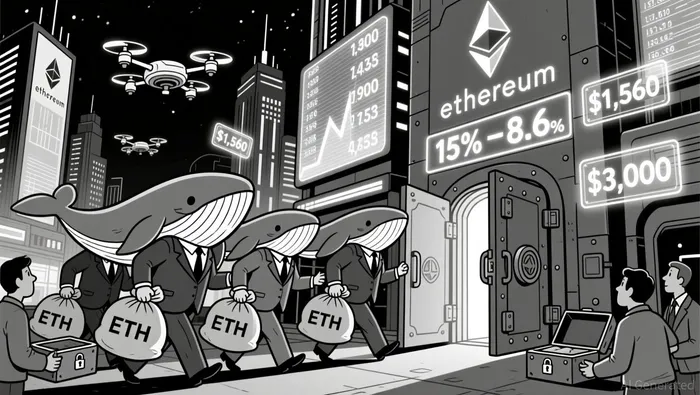
Q3 2025 on-chain data reveals a striking trend: EthereumETH-- whales have accumulated over 800,000 ETH between mid-October and early December, with large holders continuously raising their cost basis from $1,560 in June to near $3,000 by year-end according to data. This accumulation occurred as ETH traded between $2,800 and $4,200, suggesting strategic positioning by sophisticated investors ahead of potential volatility. Such behavior often signals a strengthening market structure, as whales act as a stabilizing force during price corrections.
Exchange reserves have also fallen to 8.6% of the total supply-the lowest since Ethereum's public trading began in 2015-indicating a shift toward self-custody and reduced liquidity on exchanges according to analysis. This dynamic amplifies price reactions during high-demand periods, as fewer tokens are available for immediate trading. For 2026 investors, this means whale-driven accumulation could act as a structural floor, particularly if institutional demand continues to outpace retail outflows.
Institutional Positioning and Regulatory Tailwinds
Institutional adoption of Ethereum has accelerated in 2025, driven by its role as a programmable infrastructure layer and a hedge against fiat currency risks. Major players like Trend Research have expanded their holdings to 580,000 ETH, while corporate treasuries collectively hold over 10 million ETH, valued at $46.22 billion according to market data. This shift reflects Ethereum's transition from speculative exposure to a core asset in institutional portfolios, bolstered by regulatory clarity such as the U.S. crypto market structure legislation according to research.
Spot Ethereum ETFs have further cemented this trend, with U.S.-listed ETPs attracting $5.4 billion in net inflows by July 2025. These products now hold nearly 6 million ETH, or 5% of the circulating supply, signaling growing institutional confidence. Additionally, Ethereum's dominance in stablecoin ecosystems-processing 50% of stablecoin balances and 45% of transaction values-positions it as a critical infrastructure asset for tokenized finance according to analysis.
Leveraged Positions and Liquidation Risks
Despite bullish fundamentals, Ethereum's derivatives market remains a double-edged sword. Leveraged long positions have exposed whales to significant losses, exemplified by the "BitcoinOG" whale, whose $700 million ETH long position incurred $54 million in unrealized losses as prices fell below $3,000 according to market reports. On December 15 alone, over $196 million in Ethereum liquidations occurred, with leverage ratios peaking near 0.58-a historically high level that increases the risk of cascading sell-offs according to analysis.
The 50% drop in stablecoin inflows into exchanges since mid-2025 exacerbates this risk, reducing the buy-side depth needed to absorb sell pressure according to market data. For 2026 investors, this highlights the importance of hedging against volatility. Strategies such as short-dated options or diversified exposure to Ethereum's underlying infrastructure (e.g., staking yields, Layer 2 solutions) could mitigate downside risks while capitalizing on long-term growth.
Strategic Implications for 2026 Investors
The interplay of whale accumulation, institutional inflows, and leveraged positions creates a nuanced outlook for 2026. Ethereum is projected to trade sideways between $3,000–$3,200 into early 2026, with a breakout above $3,200 requiring sustained volume and institutional follow-through according to market analysis. Call interest clusters around $3,000–$3,300, while the put-to-call ratio (~0.63) suggests a mild bullish bias according to analysis.
Position timing should prioritize dips, as institutional and whale activity indicates a $2,500 price floor supported by ETF inflows and staking participation according to market data. However, investors must remain cautious of liquidation risks, particularly in thin liquidity environments. A balanced approach-combining long-term ETH exposure with short-term hedging via options or stablecoin pairs-could optimize returns while managing volatility.
Conclusion
Ethereum's 2026 trajectory hinges on its ability to navigate leveraged derivatives risks while capitalizing on institutional adoption and whale-driven accumulation. The convergence of on-chain strength, regulatory tailwinds, and infrastructure utility positions ETH as a strategic asset for investors seeking exposure to the next phase of digital finance. By decoding whale behavior and institutional positioning, investors can align their strategies with the evolving dynamics of a maturing market.







Comentarios
Aún no hay comentarios