
Decoding the Dollar's Range-Bound Dilemma: What Key U.S. Economic Data Mean for Traders in 2026
The U.S. dollar's behavior in 2026 has become a puzzle for traders, caught between the gravitational pull of Fed policy uncertainty and shifting global capital flows. After a sharp decline in 2025, the greenback remains in a range-bound pattern, reflecting a delicate balance between structural pressures-such as rising U.S. debt-and the Federal Reserve's cautious approach to rate adjustments. For investors, understanding this dynamic requires a close read of recent economic data and a strategic recalibration of currency positioning.
Fed Policy and Economic Data: A Delicate Balance
The December 2025 Federal Open Market Committee (FOMC) meeting underscored the Fed's evolving stance. While the U.S. economy expanded at a 1.7% annualized rate in Q4 2025, outperforming earlier forecasts, the labor market showed signs of cooling, with the unemployment rate rising to 4.5% and job gains slowing. These trends, coupled with persistent inflation-core PCE inflation remained at 3.0% in Q4 2025, driven by cost-push shocks from tariffs- led the Fed to cut the federal funds rate by 25 basis points. The central bank emphasized a data-dependent approach, signaling that further easing would hinge on inflation moderation and labor market softening.
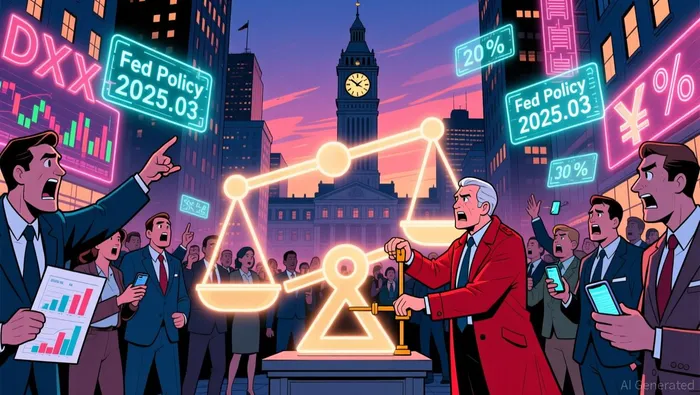 Crucially, the Fed's projections suggest that inflationary pressures from tariffs will peak in early 2026 but remain modest, with core PCE inflation expected to fall to 2.5% by year-end. This trajectory creates a policy conundrum: while the Fed aims to normalize rates, the risk of premature easing could reignite inflationary expectations, complicating the dollar's path.
Currency Positioning Strategies in a Dovish Environment
The dollar's range-bound behavior has prompted traders to adopt nuanced positioning strategies. Despite its decline, the U.S. currency remains overvalued relative to most global peers, with only nine of 34 major currencies more overvalued than the greenback. This paradox has driven U.S.-based investors to seek non-U.S. assets, particularly in emerging markets (EM), where improved credit fundamentals and fiscal flexibility are attracting capital.
For non-U.S. investors, hedging strategies have become a focal point. In high-rate environments like South Africa, hedging U.S. dollar exposure can generate positive returns, while in low-rate regions such as Japan or the euro area, hedging costs often outweigh benefits. This divergence has led to a fragmented approach, with investors tailoring strategies to local inflation and interest rate dynamics.
Emerging markets hard currency debt (EMD HC) has also emerged as a key diversifier. As the dollar weakens, EMD HC offers a combination of yield and currency appreciation potential, particularly in economies with stable fiscal policies. This trend reflects a broader shift in global capital flows, where EM assets are increasingly seen as less correlated with U.S. policy risks.
Regional Tactics and Asset Allocation Shifts
Looking ahead, the Fed's policy trajectory will remain a critical driver of currency positioning. A dovish shift-such as premature rate cuts-could paradoxically push long-term Treasury yields higher as traders anticipate inflationary risks, creating a "bear steepening" of the yield curve. For USD/JPY, this scenario could reinforce a bearish bias if the Bank of Japan raises rates in response to domestic inflation and wage growth, narrowing the yield differential with the U.S.
Asset allocation strategies are also evolving. A weaker dollar is expected to bolster commodities and EM assets, while non-U.S. equities-particularly in Europe and China-are favored over U.S. stocks. Fixed-income investors are eyeing government bonds, which are projected to rally in early 2026 as central banks pivot from inflation control to normalization. Meanwhile, securitized and high-yield credit, along with EM debt, are highlighted as income-generating alternatives in a low-yield world.
Navigating the Uncertain Path Ahead
For traders, the key to navigating 2026 lies in diversification and agility. A multi-asset approach-combining non-U.S. equities, selectively hedged dollar exposure, and EM debt-offers a buffer against Fed policy uncertainty. The dollar's projected 5% decline on a DXY basis, with EUR/USD potentially reaching 1.2400 and USD/JPY hitting 146.00, underscores the need for proactive positioning.
Yet, the Fed's data-dependent stance means surprises are inevitable. Traders must remain attuned to evolving economic signals, from labor market trends to inflation persistence, while balancing short-term volatility with long-term structural shifts. In this environment, patience and adaptability will be as valuable as technical analysis.







Comentarios
Aún no hay comentarios