
Decoding the December Fed Rate Cut: Santa Claus Rally or Volatility Trigger?
The Federal Reserve's December 2025 meeting has become a focal point for investors weighing the potential for a seasonal Santa Claus rally against the risks of prolonged economic uncertainty. With a 25-basis-point rate cut expected to bring the federal funds rate to 3.5%-3.75%, markets are grappling with conflicting signals: optimism over monetary easing versus concerns about inflationary headwinds and AI-driven volatility. This analysis explores how investors can position for both scenarios while deciphering the Fed's nuanced messaging.
Fed Signals and Market Expectations
The Federal Open Market Committee (FOMC) faces a critical juncture. While weak labor market data-including high layoff announcements and slowing hiring-has pushed the Fed toward a third consecutive rate cut in 2025, internal divisions persist. Several officials have raised alarms about inflation, particularly tariff-driven pressures, which complicate efforts to return to the 2% target. This duality is reflected in the market: CMECME-- FedWatch futures show an 88% probability of a December cut, yet S&P 500 futures fell 0.64% pre-market on December 1, signaling caution.
Fed Chair Jerome Powell's post-meeting press conference will be pivotal. Historically, his dovish remarks have spurred short-term rallies, but 2025's environment is uniquely fragile. A report by Bloomberg notes, Powell's recent emphasis on "data-dependent" policy has left investors wary of overreacting to a single rate cut. 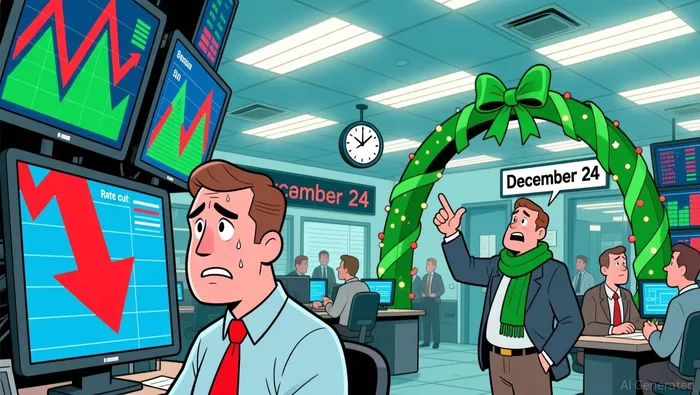 . The September Summary of Economic Projections, which anticipated one 2026 cut after three in 2025, further underscores the Fed's cautious stance.
Historical Context and the Santa Rally's Erosion
The Santa Claus rally, historically averaging 1.3% for the S&P 500, has shown signs of erosion in recent years. In 2024, the index fell 2.4% in December despite a 23.3% annual gain, a trend attributed to hawkish Fed signals and inflationary pressures. For 2025, the 80% probability of a December cut suggests favorable conditions for a rally, yet market dynamics have shifted.
A key factor is the AI-driven volatility in tech stocks. As stated by Reuters, concerns over overvaluation and debt-driven growth have led to profit-taking, destabilizing traditional seasonal patterns. Additionally, global market declines in Asia and Europe have dampened risk appetite, with defensive sectors gaining traction. These shifts highlight the fragility of the Santa rally in an era of macroeconomic uncertainty.
Positioning for Volatility: Strategic Considerations
Investors must balance the potential for a short-term rally with the risks of a prolonged correction. Three strategies emerge from the data:
Sector Rotation: A rotation away from megacap tech stocks toward defensive sectors (e.g., utilities, consumer staples) has gained momentum. This trend reflects a broader hedging strategy against potential AI-driven corrections.
Options Hedging: With volatility indices (VIX) hovering near multi-year highs, investors are increasingly using put options to protect against downside risks. A report by James Investment notes, this approach has become standard for portfolios exposed to rate-sensitive assets.
Monitoring Macro Data: The delayed release of November jobs and inflation data due to the government shutdown adds uncertainty. Investors should prioritize real-time indicators like consumer confidence and manufacturing activity, which have shown mixed signals.
The Fed's Role in Shaping Outcomes
The Fed's December decision will likely set the tone for year-end markets, but its influence extends beyond the immediate rate cut. Powell's messaging on inflation and 2026 policy expectations will shape investor sentiment. For instance, a January 2026 cut probability of just 21% suggests the Fed is unlikely to adopt a dovish bias for long, tempering rally expectations.
Moreover, the Fed's struggle to balance growth and inflation-exemplified by tariff-driven price pressures-means volatility is likely to persist. As stated by the Wall Street Journal, the central bank's credibility hinges on its ability to navigate this tightrope without triggering a market selloff.
Conclusion
The December 2025 Fed rate cut presents a dual-edged scenario: a potential Santa Claus rally fueled by monetary easing, but also heightened risks from inflationary pressures and AI-driven volatility. Investors must adopt a nuanced approach, leveraging defensive positioning and hedging strategies while closely monitoring Fed signals. While historical patterns suggest optimism, the evolving macroeconomic landscape demands caution. The coming weeks will test whether the Fed can engineer a soft landing-or if markets will face a harsher reality.







Comentarios
Aún no hay comentarios