
Decoding Crypto Volatility: How Liquidation Data Powers Contrarian Investing
In the high-stakes arena of cryptocurrency markets, volatility is both a curse and a catalyst. For contrarian investors, however, the chaos of liquidation events—where leveraged positions are forcibly closed—offers a unique lens to gauge market sentiment and identify asymmetric opportunities. Recent data and academic insights reveal that liquidation patterns act as a barometer for fear and euphoria, making them a strategic tool for navigating crypto's unpredictable tides.
The Liquidation Paradox: Fear as a Frenzy Indicator
When markets plunge, liquidations surge. But these events aren't just signs of panic—they're contrarian signals. A 2025 study introduced the Cryptocurrency Fear Sentiment Index (CFSI), which correlates Google Trends data with volatility spikes in BitcoinBTC-- and Ethereum[5]. During periods of extreme fear, such as the Russia-Ukraine war or global pandemic, the CFSI spiked, directly preceding sharp price rebounds. This aligns with behavioral finance theories like the adaptive market hypothesis, which posits that investor sentiment, not just fundamentals, drives short-term price action[3].
For example, in Q2 2025, Ethereum's liquidation volumes outpaced Bitcoin's by 37%, driven by its role in leveraged DeFi protocols and perpetual futures[3]. This suggests Ethereum's ecosystem is more susceptible to margin calls during downturns, creating short-term oversold conditions. Contrarian investors who recognized this imbalance could have positioned for a rebound as liquidation-driven selling exhausted itself.
Market Cap Shifts and the Bitcoin Dominance Play
The 2024 Q3 report from CoinGecko underscores a critical trend: Bitcoin's market dominance rose to 53.6%, while altcoins collectively lost ground[1]. This shift wasn't just a function of price—it reflected a flight to safety amid uncertainty. When Bitcoin's dominance surges, it often signals a market reset, with altcoins becoming undervalued relative to BTCBTC--.
Liquidation data amplifies this insight. In Q2 2025, total crypto market cap hit $3.5 trillion, but spot trading volumes on centralized exchanges fell 27.7% quarter-on-quarter[1]. Meanwhile, decentralized exchanges (DEXs) saw a 25.3% volume increase, indicating a structural shift toward on-chain liquidity. For contrarians, this duality—centralized liquidations vs. decentralized resilience—highlights where capital is fleeing and where it might return.
Risk Management: Turning Liquidation Data into Action
Leveraging liquidation data requires a disciplined approach. Here's how to apply it:
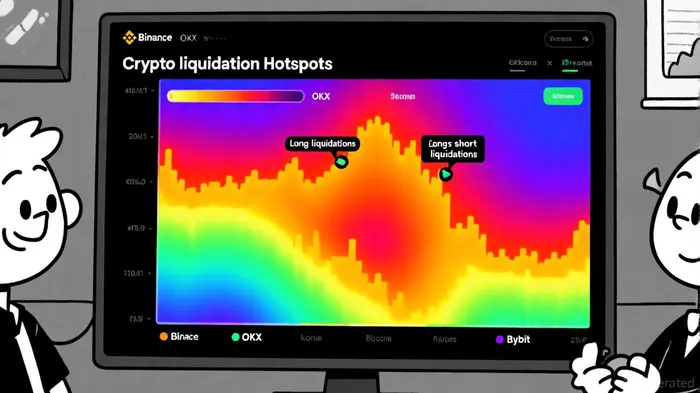
Identify Key Reversal Levels: Liquidation heatmaps from platforms like Gate.ioIO-- or CoinPerps reveal price zones where large positions are concentrated[2]. A surge in long liquidations near a critical support level often precedes a short squeeze, while short liquidations at resistance suggest a bullish reversal.
Monitor Exchange-Specific Dynamics: Binance, OKX, and Bybit account for 70% of liquidation volumes[4]. During Q2 2025, Bybit's liquidation activity spiked during the U.S. debt ceiling crisis, amplifying Bitcoin's 10% single-day drop. Traders who recognized this pattern could have hedged or shorted selectively.
Diversify Across BTC and Altcoins: Bitcoin's dominance often peaks during bear markets, creating buying opportunities for undervalued altcoins like SolanaSOL-- or Cardano[3]. Liquidation data helps time these entries—when altcoin liquidations plateau, it signals capitulation.
The Contrarian Edge in a Leverage-Driven World
Crypto's leverage culture turns liquidation data into a double-edged sword. While it magnifies downside risks, it also creates predictable inflection points. For instance, Ethereum's Q3 2024 liquidation volumes hit $194 million, driven by leveraged staking and perpetual futures[3]. This volatility isn't random—it's a function of algorithmic trading and margin calls, which academic research increasingly models as behavioral feedback loops[1].
Contrarian investors who master this framework can outperform in volatile markets. By treating liquidation data as a sentiment gauge rather than a panic trigger, they position themselves to buy the dip—or short the euphoria—before the crowd.






Comentarios
Aún no hay comentarios