
Decoding Crypto Institutionalization: XRP ETFs, SHIB Accumulation, and Vitalik's Stablecoin Blueprint
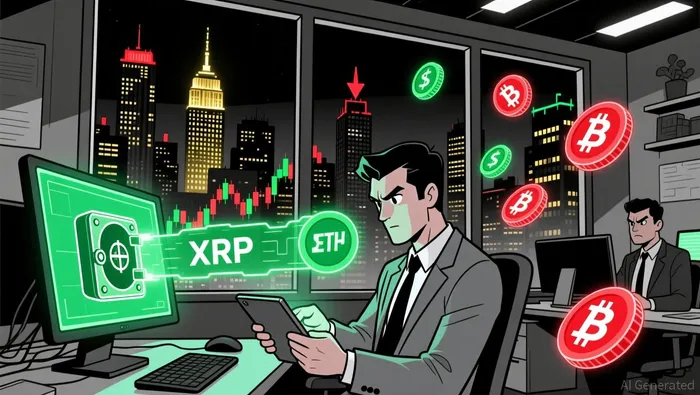
The crypto market in 2025 is witnessing a seismic shift as institutional capital reshapes traditional paradigms of asset allocation, regulatory engagement, and technological innovation. From XRPXRP-- ETFs absorbing record inflows to Vitalik Buterin's reimagining of Ethereum's infrastructure, the interplay of token parking, whale behavior, and protocol-level upgrades is unlocking new frontiers for investors. This analysis dissects these dynamics, offering a roadmap for navigating the evolving institutionalization of crypto.
XRP ETFs: A New Paradigm for Institutional Token Parking
Institutional adoption of XRP has surged in 2025, driven by regulatory clarity and strategic utility narratives. XRP ETFs absorbed $483 million in December 2025 alone, outpacing BitcoinBTC-- and EthereumETH-- ETFs despite a 15% drop in XRP's spot price to $1.77. This inflow persisted for 30 consecutive trading days, signaling a decoupling of short-term price volatility from long-term institutional conviction.
The SEC's decision to drop its appeal against Ripple in 2025, coupled with the appointment of crypto-friendly regulator Paul Atkins as chairman, created a critical inflection point. Ripple CEO Brad Garlinghouse has since emphasized expanding XRP's utility and RLUSD in 2026, building on 2025's institutional traction. Analysts argue that XRP ETFs, now holding over $1.3 billion in assets, are acting as a "token parking" mechanism-allowing institutions to hedge against regulatory uncertainty while capitalizing on XRP's cross-border payment use cases.
This trend underscores a broader shift: institutions are prioritizing assets with clear regulatory pathways and real-world applications over speculative narratives. For investors, XRP's supply tightening and sustained ETF inflows suggest a potential price re-rating in 2026.
SHIB Accumulation: Institutional Whales and the 2026 Rumble
While SHIB's institutional adoption remains less visible than XRP's, subtle signals hint at a brewing "2026 Rumble." Data from crypto analytics platforms reveals a 111% surge in SHIB whale transactions in late 2025, as institutions quietly reload for potential market moves. Though no direct evidence of SHIBSHIB-- ETFs or stablecoin integrations exists, the accumulation patterns mirror those seen in Bitcoin and Ethereum during pre-ETF approval phases.
SHIB's unique position as a memeMEME-- token with growing DeFi and NFT integrations could make it an attractive target for institutional diversification strategies. However, its lack of regulatory clarity and utility-driven narratives currently limits mainstream adoption. For forward-looking investors, SHIB's whale activity-coupled with its low price-presents a speculative opportunity, albeit with higher volatility risk compared to XRP or Ethereum.
Vitalik's Stablecoin Blueprint: Scaling Ethereum's Institutional Appeal
Ethereum's institutionalization in 2025 is being propelled by Vitalik Buterin's ambitious design proposals. At the core of his vision is a gas futures market, which allows users to lock in transaction costs in advance, reducing fee volatility and enabling businesses to plan more effectively. This innovation, building on EIP-1559's base fee mechanism, transforms gas from a reactive cost to a predictable resource.
Buterin's five core ideas for Ethereum's future-scaling to 10x transactions per second, integrating zero-knowledge proofs for privacy, simplifying the protocol, enhancing real-world utility (e.g., DAOs, prediction markets), and strengthening decentralization- position Ethereum as a robust infrastructure for institutional-grade applications. Notably, his warnings about the unresolved challenges of decentralized stablecoins highlight a critical gap: while Ethereum's base layer is maturing, stablecoin innovation remains a frontier for institutional experimentation.
For investors, Ethereum's design upgrades-particularly its focus on scalability and privacy-signal a platform primed for enterprise adoption. Buterin's emphasis on "walk-away" and "insider attack" tests further reinforces Ethereum's resilience, a key concern for institutional custodians.
Structural Opportunities for Forward-Looking Investors
The convergence of XRP ETF inflows, SHIB whale accumulation, and Ethereum's protocol upgrades is creating a multi-layered investment landscape:
1. Token Parking and Regulatory Arbitrage: XRP ETFs demonstrate how institutions are leveraging regulatory clarity to park capital in assets with utility-driven narratives. Investors should monitor SEC actions and ETF inflow trends for early signals of institutional interest.
2. Whale Behavior as a Leading Indicator: SHIB's whale activity, while speculative, mirrors pre-ETF patterns seen in Bitcoin and Ethereum. Investors with risk tolerance for volatility may consider SHIB as a speculative play ahead of potential 2026 adoption waves.
3. Ethereum's Infrastructure Play: Vitalik's proposals position Ethereum as a foundational layer for institutional-grade applications. Investors should focus on projects building on Ethereum's scalability and privacy upgrades, particularly in DeFi and cross-chain solutions.
Conclusion
Institutional capital is no longer a peripheral force in crypto-it is the engine driving market structure. XRP ETFs, SHIB accumulation, and Ethereum's design innovations collectively signal a shift toward assets with regulatory clarity, utility, and scalability. For investors, the key lies in identifying where institutional capital is parking, accumulating, and innovating. As 2026 approaches, the winners will be those who decode these signals early.






Comentarios
Aún no hay comentarios