
Decoding the Contrarian Moves of Crypto Whales: Longs, Shorts, and the Trump-China Narrative
The cryptocurrency market in late 2025 has become a battleground for macroeconomic and geopolitical forces, with U.S.-China trade dynamics and central bank policies shaping investor sentiment and whale positioning. In this high-leverage, high-volatility environment, understanding the contrarian strategies of crypto whales-large holders who move markets-requires dissecting their responses to shifting narratives, particularly the Trump-China trade narrative.
The Trump-China Trade Narrative: A Double-Edged Sword
The October 2025 U.S.-China trade agreement, which suspended tariffs and rare earth export controls, initially triggered a modest crypto rally. BitcoinBTC-- and EthereumETH-- saw short-term gains, but the broader market remained cautious. The Crypto Fear & Greed Index lingered in the "fear" range at 37 as of November 3, 2025, reflecting skepticism about the deal's durability and unresolved enforcement challenges. This duality-temporary relief versus long-term uncertainty-has created a fragmented landscape where whales are hedging, accumulating, and liquidating assets based on divergent macroeconomic expectations.
For instance, spot Bitcoin ETFs like BlackRock's IBIT and Fidelity's offerings recorded significant outflows post-deal, signaling institutional caution. Meanwhile, retail and smaller institutional players began to test the waters, betting on a potential stabilization of geopolitical risks. This divergence highlights the market's sensitivity to the temporary nature of the agreement and the broader uncertainty surrounding Federal Reserve policy.
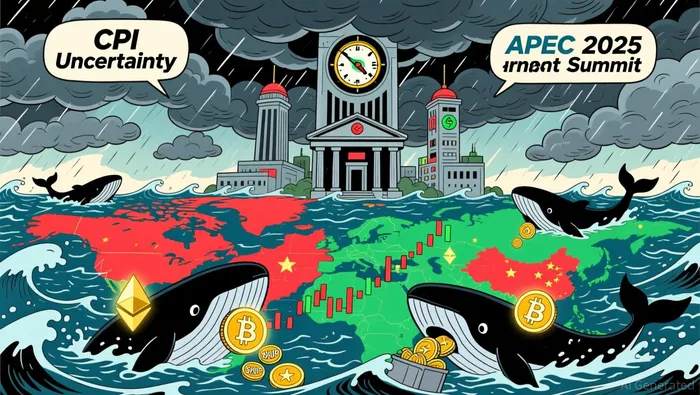
Whale Positioning: Accumulation, Hedging, and Contrarian Bets
Crypto whales have adopted varied strategies in response to the Trump-China narrative. On one hand, they are accumulating tokens perceived as resilient to macroeconomic shocks. For example, Pippin (PIPPIN) saw a 12.34% increase in whale holdings, with prices consolidating in a bullish flag pattern. This suggests positioning for a potential upside if the U.S. CPI print comes in neutral or softer, a scenario that could reinforce risk-on sentiment.
Conversely, Maple Finance (SYRUP) witnessed a 5.5 million token sell-off by whales, indicating hedging against a "hot" CPI print or renewed trade tensions. The token's liquidity profile and exposure to interest rate-sensitive sectors likely made it a target for risk-off strategies.
The most intriguing case is Fartcoin (FARTCOIN), where standard whales sold while mega whales increased holdings. This conflicting behavior underscores the market's anticipation of volatility during macro-driven events. Mega whales, often with deeper liquidity access, may be positioning for sharp price swings, while smaller whales are retreating.
APEC 2025: A Pivotal Summit for Market Sentiment
The APEC 2025 summit in Gyeongju, South Korea, further amplified the Trump-China narrative. The in-person meeting between President Trump and President Xi Jinping, the first since the 2024 U.S. election, triggered a short-term crypto rebound. Bitcoin surged 2–3% to $110,459 as investors priced in the possibility of trade de-escalation. However, the market's response was fragile: a re-escalation of tensions could trigger renewed sell-offs, given crypto's leverage to broader risk appetite.
South Korea's role as host nation added another layer of complexity. With over a quarter of its adult population owning cryptocurrencies, the country's economic diplomacy and regulatory stance are increasingly influential. APEC's focus on "connectivity, innovation, and prosperity" also highlighted the region's growing role in shaping global digital asset frameworks.
Central Bank Signals and the Path Forward
While geopolitical narratives dominate headlines, central bank policies remain a critical undercurrent. The Federal Reserve's signals of potential rate cuts in December 2025, alongside dovish stances from the ECB and BoE, have created a mixed environment. Whales are navigating this ambiguity by balancing exposure to rate-sensitive assets (e.g., Ethereum) with more defensive plays (e.g., Bitcoin as a store of value).
However, the broader market context remains challenging. Despite a positive performance in traditional asset classes, Bitcoin and Ethereum fell by -16.1% and -21.3%, respectively, in November 2025. This divergence underscores crypto's unique sensitivity to macroeconomic and geopolitical risks, particularly in a high-leverage environment.
Conclusion: Navigating Contrarian Moves in a Volatile Landscape
The Trump-China narrative and APEC 2025 have exposed the crypto market's fragility and its reliance on geopolitical stability. Whales are adopting contrarian strategies-accumulating in some tokens while hedging in others-to navigate this uncertainty. For investors, the key takeaway is to monitor both geopolitical developments (e.g., trade negotiations, APEC outcomes) and macroeconomic indicators (e.g., CPI, central bank policy) for signals of positioning shifts.
In a market where sentiment can swing from fear to greed in hours, understanding whale behavior provides a critical edge. As the Fed and global policymakers continue to recalibrate, the crypto market's next move may hinge on whether the Trump-China narrative evolves into a durable détente-or a new flashpoint.





Comentarios
Aún no hay comentarios